Showing posts with label ADH. Show all posts

Wednesday, March 18, 2015

Santa Cruz Barillas: Natural resource defenders Saúl Méndez and Rogelio Velásquez sentenced to 33 years in prison

Posted on March 2, 2015 by ACOGUATE
Translation by NISGUA

Detained and awaiting trial since August 27, 2013, natural resource defenders Saúl Méndez and Antonio Rogelio Velásquez of Santa Cruz Barillas were recently sentenced to 33 years and four months in prison. They were found guilty of being accomplices in the August 2010 assassinations of one man and one woman, acts in which both leaders deny participating. Now, their lawyers have presented Special Appeals against the sentence, contending that there are flaws in the grounds of the sentence and the trial proceedings. These appeals will be heard in a public hearing on April 29, 2015 in Huehuetenango. 

The two accused maintain that they are victims of the political persecution of the hydroelectric company Hidro Santa Cruz S.A., subsidiary of the Spanish Hidralia Energía S.A., for their commitment to the defense of territory and their roles in the Civil Society of Barillas. They were first incarcerated along with seven other people from May 2012 to January 2013 in the context of the social conflict generated by the hydroelectric projects Cambalam I y Cambalam II of Hidro Santa Cruz S.A. On this first occasion, they were accused of having participated in the disturbances associated with the assassination of community member Andrés Francisco Miguel, on May 1st of that year. Andrés was reportedly shot by the company’s security personal. (1) The UN Working Group on Arbitrary Detention determined in its Opinion 46/2012 (2) that these arrests were arbitrary, and for lack of proof, all nine people were finally released.


ACOGUATE has accompanied the Civil Society of Barillas since January 2013 and has observed the hearings in the case against Saúl Méndez and Rogelio Velásquez, while also accompanying Carlos Bezares of the Center for Legal Defense, the lawyer coordinating the defense of the accused in collaboration with Association CEIBA.


The accused report pressures


In his final statement in the November 14th hearing, Saúl Méndez declared: “The company Hidro Santa Cruz is what has been behind all of this.” Similarly, Rogelio Velásquez said that he is a prisoner “for defending natural resources.” Saúl Méndez also referred to one plaintiff witness, Wagner Roberto Mérida Reyes, as someone “who came to accuse us in 2012.” The aforementioned UN Opinion revealed that on May 2, 2012 Saúl Méndez and Rogelio Velásquez, along with a third person, were detained by unidentified members of the Reyes family, who drove them to the military base.  The wives of both prisoners claim that during the 2012 imprisonment of their husbands, people involved with the company threatened them saying that both leaders would be accused of the crimes for which they were recently convicted if they didn’t end their opposition to Hidro Santa Cruz, S.A. (3)

Special Appeal by the defense identifies flaws 


In the beginning of December 2014, the defense lawyers filed a Special Appeal against the condemnatory sentence, identifying ten procedural errors (defective proceedings during the trial) and five foundational errors (incongruent legal foundation), which in their opinion were committed throughout the process. (4)

The defense points to several procedural errors: “The accused submitted evidence after the investigation deadline. The Court also accepted testimonies as coherent, when in fact they were contradictory and not aligned with the description of the events as outlined in the factual report presented by the Public Prosecutor.” Among the foundational errors, the lawyers indicate that the Court confirmed the Public Prosecutor’s investigation to be insufficient. When indicating that the men collaborated in the crime, the Court did not establish a clear and precise means in which this collaboration occurred that would indicate complicity in a crime.

The Regional Tribunal of the Court of Appeals of the Department of Huehuetenango formally admitted the Special Appeal on December 18, 2014, and as such, the sentence will be reviewed. The Seventh Appeals Court of Huehuetenango will hold a public hearing on the Special Appeal  on April 29, 2015. The acceptance of the appeal for procedural errors would either lead to a repetition of the trial from the beginning or a new tribunal would be assigned to consider the new actions [Special Appeal], while using the same evidence, witnesses and expert testimonies. The acceptance of the procedural complaint would mean that the Court would dictate a new sentence, complete with new legal grounds for the decision (without repeating the previous phases).

Support for the two sides


During some trial hearings, a group of about 20 women gathered at the court house wearing t-shirts with the message: “Justice for Guadalupe,” in reference to Guadalupe Francisco Felipe, one of the two people killed during the events being tried in the case. Throughout trial proceedings, members of the Departmental Assembly of Huehuetenango (ADH), members of the Civil Society of Barillas, and others of their own accord, affirmed the innocence of Saúl Méndez y Rogelio Velásquez and demanded their liberty, rejecting what they considered to be “criminalization for defending natural resources.”

As we wait for the Special Appeal process to be reviewed, the prisoners and their families continue to receive an outpouring of solidarity. Among these demonstrations was a Solidarity Festival for the Political Prisoners held on December 6 in the central park of Huehuetenango in support of the imprisoned leaders and their loved ones. The event included music and other artistic expressions that reflected solidarity. Those gathered included people defending natural resources through other struggles like community members from San José del Golfo and San Pedro Ayampuc, organized in the La Puya encampment against the imposition of the mining project El Tambor. They joined in the calls to demand the release of the two men from Barillas. (5) The event concluded with a visit to Saúl Méndez y Rogelio Velásquez in prison, bringing them candles and music as an act of solidarity. (6)

Together, since their second detention, Saúl Méndez and Rogelio Velásquez have spent one year and seven months in prison, while their wives and children – five in the case of Saúl and six in the case of Rogelio - have had to get by without the resources they provided as farmers. Rogelio Velásquez and his wife, Carmelia Sosa Mérida, also care for two of Carmelia’s brothers who were orphaned at a young age. Their economic situation will become even more difficult if the reparations payment approved on November 19, 2014, of 15,000 quetzales from each of the accused for the daughter of the victim, is upheld. This reparation is not applicable until the sentence is confirmed, that is to say, until the defense exhausts all of the available resources.

United Nations and the OMCT hear the case


The UN Special Rapporteur on the situation of human rights defenders, Michel Forst (France), carried out an unofficial visit to Guatemala at the end of January 2015. On January 27, he met with dozens of human rights defenders who gave testimony on the human rights violations taking place in Guatemala. Among the participants were Carmelia Sosa Mérida, the wife of Rogelio Velásquez, and Rubén Herrera, defender of natural resources and member of the ADH who told the Special Rapporteur about the case of Saúl Méndez and Rogelio Velásquez.

On February 26, 2015 the report, "Smaller than David: the struggle of human rights defenders [Más pequeños que David: la lucha de los defensores y defensoras de derechos humanos],” was presented in Huehuetenango. The report was written by the Observatory for the Protection of Human Rights Defenders (OBS) in collaboration with the Human Rights Defenders Unit of Guatemala (UDEFEGUA) during their international investigation mission in Guatemala in November 2013. The OBS is part of the World Organization against Torture (OMCT) and the International Federation for Human Rights (FIDH). Santa Cruz Barillas is one of the cases they are investigating in the report, paying special attention to the judicial process against Saúl Méndez y Rogelio Velásquez.
During the presentation of the report, Miguel Martín (OMCT) made reference to the pre-trial imprisonment of the other three leaders from the Barillas Civil Society, which had occurred on the same day.


Since 2013, Hidro Santa Cruz S.A. employees have accused Francisco Juan Pedro, Adalberto Villatoro and Arturo Pablo of threats, instigating crime, illicit association, abduction, and kidnapping. Miguel Martín mentioned that these imprisonments are very serious and expressed his solidarity with the detained. He stated that being a human rights defender is “a risky activity in Guatemala” and demonstrated his concern for the “lack of guarantees to access to due process in the [Guatemalan] justice system.”

Representatives of the OBS, UDEFEGUA, ADH and individuals visited Saúl Méndez and Rogelio Velásquez and well as Francisco Juan Pedro, Adalberto Villatoro and Arturo Pablo, on February 27 in the Preventative Center for Men in Huehuetenango.

_______

(1) Emisoras Unidas, 26 de diciembre de 2013, Capturan a dos hombres por el asesinato de campesino en Santa Cruz Barillas,  noticias.emisorasunidas.com/noticias/nacionales/capturan-dos-hombres-sindicados-asesinato-campesino-santa-cruz-barillas. Comunicado del Ministerio Público, 1 de junio de 2012, Prueba balística confirma el arma utilizada en el asesinato de campesino en Santa Cruz Barillas, www.mp.gob.gt/2012/06/prueba-balistica-confirma-el-arma-utilizada-en-el-asesinato-de-campesino-en-santa-cruz-barillas/

(2) Opinión 46/2012 del Grupo de Trabajo sobre la Detención Arbitraria de la ONU, 15 de enero de 2013, acoguate.files.wordpress.com/2013/03/gtda-opinion-no-46-2012-guatemala.pdf

(3) Centro de Medios Independientes, 14 de octubre de 2014, Mujeres valientes: las esposas de los presos políticos, cmiguate.org/mujeres-valientes-las-esposas-de-los-presos-politicos/

(4) Centro de Medios Independientes, 24 de diciembre de 2014, Apelación Especial a favor de los presos políticos de Barillas señala Vicios de la Sentencia, cmiguate.org/apelacion-especial-a-favor-de-los-presos-politicos-de-barillas-senala-vicios-de-la-sentencia/

(5) Telesur, 11 de diciembre de 2014,  Ciudadanos de Guatemala se solidarizan con líderes comunitarios presos, www.youtube.com/watch?v=krDIJWVw27s&list=UUbHFKMtqLYkIBRiPHJwxu_w#t=16

(6) Telesur, 8 de diciembre de 2014, Piden con música la liberación de dos presos políticos en Guatemala,  www.youtube.com/watch?v=jrfptIYDN_I

Thursday, November 20, 2014

Human rights defenders from Barillas convicted despite irregularities in proceedings

An excerpt from a press release issued by the Guatemalan Unit for the 
Protection of Human Rights Defenders (UDEFEGUA):

"On Thursday, November 13, the trial court judge in Villa Nueva sent Oscar Morales, a leader in the resistance movement in San Rafael las Flores, to trial for allegedly threatening the manager of the mining company, Minera San Rafael, S.A., subsidiary of Canadian company Tahoe Resources. During the evidentiary hearing, the judge revealed his partiality when he indicted the human rights defender without a proper investigation. The judge is now sending the case to trial without a clear investigation and despite the fact that the Public Prosecutor's office has stated that they do not have enough evidence to accuse the defendant. In sending the case to trial, it has become clear that the judge is prioritizing private interests that are represented by lawyers of the third-party plaintiff. The trial against Oscar Morales opens on December 29.

On November 14, Saúl Aurelio Méndez and Rogelio Velásquez, water rights defenders from Barillas, Huehuetenango, were convicted by a Sentencing Tribunal in Huehuetenango for conspiracy to commit murder. The two human rights defenders were illegally detained on May 2, 2012 during a state of siege imposed by the government of Guatemala. After a lengthy process, they were released and declared innocent. However, while en-route with their lawyer for the final hearing on this case, they were arrested by the police outside the Guatemala City court house for the murder and femicide of two people who were lynched in Barillas in 2010.

Both the legal process itself and the verdict against the human rights defenders were plagued with irregularities. The verdict was reached without proving the individual responsibility of the accused, violating one of the core guarantees of the judicial system that states that individuals cannot be brought to trial for the actions of others. Both cases demonstrate how private interests trump justice, leading to the political persecution of social leaders and human rights defenders."

Link to original press release in Spanish can be found here.


Other statements from Guatemala:

"They accuse me of something I did not commit. My intention has always been to defend the rights of nature." (Saúl Aurelio Méndez Muñoz)

"I am someone of few material resources. I have fought for the rights of Mother Nature and for defending natural resources, I am now in prison." (Antonio Rogelio Velásquez)

"Together with their communities, [Saúl and Rogelio] expressed their opposition to the construction of the hydroelectric Hidro Santa Cruz. This struggle has meant repression and criminalization for them, their families and their communities by the Guatemalan state who, far from working for the wellbeing of the citizens of the country, protect the interests of transnational companies such as Ecoener Hidralia and its extractive projects in northern Huehuetenango. All of this threatens the lives of communities and the natural resources of the Guatemalan people." (Statement from the Departmental Assembly of Huehuetenango)

"It is clear that the case of Rogelio and Saúl corresponds to a strategy of terror that seeks to weaken community resistance and paralyze social movements in defense of territory. This [goal] wasn't achieved because those of us who defend life and territory remain united.” (Statement from the Departmental Assembly of Huehuetenango)

Link to original statements in Spanish can be found here.

Wednesday, March 5, 2014

ADH expresses solidarity with Santa Cruz Barillas political prisoners

We demand liberty for our leaders; they have not committed crimes
Photo: ADH

Departmental Assembly of Huehuetenango Communiqué in Solidarity with the Civil Society Movement of Santa Cruz Barillas

Today, March 4, 2014, we attended two hearings in which the cases would be presented of six leaders from Santa Cruz Barillas who are persecuted by Guatemalan injustice and Hidro Santa Cruz. We accompany the men and women who have dedicated themselves to their cause, our cause. The hearings were suspended, but that doesn’t mean that our presence or our voice is not useful. Saúl Méndez, Rogelio Velásquez, Adalberto “Don Tello” Villatoro, Francisco “Chico Palas” Juan, Arturo Pablo and Diego Marcos are each accused of different crimes by the Spanish company Hidro Cruz. The orchestrated “legal” cases form part of a strategy of criminalization in order to undermine the defense of territory.

The persecution, criminalization and repression carried out by Otto Pérez Molina’s military government and the Guatemalan state aim to minimize or put an end to the opposition to the implementation of mining exploitation projects, like in the cases of the resistances at San José del Golfo, San Rafael las Flores or in other cases of natural resources like water in hydroelectric projects like Cambalan I and Cambalan II in Santa Cruz Barillas.

We, as indigenous peoples, have never understood the Guatemala justice system because it is blind, mute and deaf when it deals with defending our rights. The historic aggression that is once again emphasized by the Guatemalan state against the Chuj, Q’anjob’al, Akateko and Mestizo people in northern Huehuetenango is no more than the continued utilization of all the institutional resources that political actors have at their reach to continue with the pillaging and plundering of our territories. Our history, our territory and our lives are in danger and that is why we respond pacifically at the outrageous concept that to national and foreign companies we are objects.

We, the people, have not called the companies to our territories, nor have we needed the state, because it has always abandoned us, what we want is to live in peace and continue constructing our own path toward the good life (el buen vivir).

This government, like others, will not stop us; the struggle of Barrillas and its leaders is everyone’s struggle. No to criminalization; yes to the liberation of our political prisoners.

Departmental Assembly of Huehuetenango

March 4, 2014

La ADH expresa su solidaridad con presos políticos de Santa Cruz Barillas


Foto: ADH

Comunicado Asamblea de Pueblos de Huehuetenango, ADH, en Solidaridad con el Movimiento fe la Sociedad Civil de Santa Cruz Barillas

El día de hoy, 4 de marzo de 2014, acudimos a dos audiencias en las que se ventilan los casos de seis líderes de Santa Cruz Barillas, que son perseguidos por la injusticia guatemalteca e hidro santa cruz. Los acompañamos mujeres y hombres que hacemos de su causa, nuestra causa. Las audiencias fueron suspendidas, pero no por ello deja de tener sentido nuestra presencia y palabra. Saúl Méndez, Rogelio Velásquez, Adalberto “Don Tello” Villatoro, Francisco “Chico Palas” Juan, Arturo Pablo y Diego Marcos, son acusados de diferentes delitos por la empresa española hidro cruz. Son casos “legales” orquestados que forman parte de una estrategia de criminalización para debilitar la defensa del territorio. 

La persecución, criminalización y represión por parte del gobierno militar de Otto Pérez Molina y del Estado guatemalteco, tiene como objetivo minimizar y o acabar con la oposición a la implantación de proyectos de explotación minera, como los casos de resistencia en San José del Golfo y San Rafael Las Flores o el de otros bienes naturales como el agua en el caso de proyectos hidroeléctricos como Cambalan I y Cambalan II en Santa Cruz Barillas. 

Nosotros, como Pueblos nunca hemos entendido a la justicia guatemalteca porque es ciega, muda y sorda cuando de defender nuestros derechos se trata. La agresión histórica y que hoy nuevamente se acentúa en contra de los Pueblos Chuj, Q´anjob´al, Akateko y Mestizo del Norte de Huehuetenango por parte del Estado guatemalteco, no es más que la continuidad de la utilización de todos los recursos institucionales que sus operadores políticos tienen a su alcance para continuar con el saqueo y despojo de nuestros territorios. Nuestra historia, nuestra tierra y nuestra Vida están en peligro y por ello es que respondemos pacíficamente al atropello de que somos objeto por parte de empresarios nacionales y extranjeros. 

Nosotros los Pueblos no hemos llamado a las empresas a nuestros territorios, ni nunca hemos necesitado al Estado, porque éste siempre nos abandonó, lo que queremos es vivir en paz y seguir construyendo nuestro propio camino hacia el buen vivir. 

Este gobierno como otros no nos detendrá, la lucha del pueblo de Barillas y sus líderes es de todos. No a la criminalización y sí a la liberación de nuestros presos políticos. 

Asamblea de Pueblos de Huehuetenango, ADH. 

4 de marzo de 2014 

Friday, February 7, 2014

ADH denounces World Bank and Inter-American Development Bank

The Departmental Assembly of Huehuetenango in Defense of Territory and for the Autonomy and Free Determination of the People – ADH – informs the national and international community:


During 1981, 1982, 1983, the Guatemalan Army massacred the Achí communities that lived on the banks of the Chixoy River; 444 people, including youth, children, men and women were executed. The justification of the massacre was the existence of an internal armed conflict, but in reality, they carried out this strategy in order to clean the zone and implant the construction of the Chixoy hydro-electric project. The National Electrification Institute – INDE – was responsible for the execution of this project, having received a loan from the World Bank and the Inter-American Development Bank for almost 1 billion dollars. In 2012, the Inter-American Court on Human Rights condemned the State of Guatemala for the massacres of Rio Negro and called for fulfillment of the reparations to the victims' family members for the damages caused, including the expropriation of land, crops, animals, identity and culture.

On January 17, 2014, after a 32-year community struggle, the Congress and President of the United States made a declaration demanding that the State of Guatemala and Otto Pérez Molina should pay the $154,000,000 in damages to the victims. The response of “ Mr. President “ was immediate: “To give these communities $154,000,000, is like saying that we are going to privilege these communities and leave others out.”  “Mr. President” this is a historic debt owed by the Guatemalan State to the victims of the massacres and the civilized world. The communities of Río Negro continue living in extreme poverty and in inhumane conditions. Your response, “Mr. President”, is irresponsible and aberrant.

Today, February 7, 2014, the Departmental Assembly of Huehuetenango – ADH – and the people of Santa Cruz Barillas, demand that the military government of Otto Pérez Molina respond responsibly and quickly to resolve once and for all the conflict in Barillas. 31 years later, the same methods are being repeated by Hidralia-Hidro Santa Cruz. It is time to end the conflict created by the Spanish company in its attempt to implant two hydro-electric projects in the Q’am’balam River. The conflict has gone on for five years and has resulted in the persecution, intimidation, and co-opting of community leaders. There have been assassinations, imprisonment; there is fear and terror. “Mr. President,” it is necessary to stop these companies.

The sad and terrifying story of Chixoy is related to the current persecution in Barillas through international financial institutions. The World Bank and the Inter- American Development Bank are financing Hidro Santa Cruz through the Inter-American Corporation for Infrastructure Financing (CIFI), which in 2010 provided financing for the Canbalam hydroelectric dam. In 2008, CIFI received an $80,000,000 loan from the International Financial Corporation of the World Bank Group.  In 2001, CIFI received $10,000,000 from the Inter-American Investment Corporation of the Inter-American Development Bank. We believe that these investments are responsible for the human rights violations and the damages suffered by the communities of Barillas.

Mr. Otto Pérez Molina, do you want to continue protecting companies that act illegally? What do you and your government stand to gain? Will you continue to repress the Q’anjob’al and Mestizo communities of Santa Cruz Barillas? Or what are your plans for this region that has been abandoned by the state of Guatemala?

For all of the previous reasons, as the ADH we demand:

A: The end to persecution, repression and criminalization of community leaders.
B: That the Spanish company Hidralia-Hidro Santa Cruz be expelled from the country given the harm it has caused to the communities of Barillas.
C: That Hidralia-Hidro Santa Cruz pay material, physical, physiological and cultural damages to the victims.

We call on:
  • International organizations and the Inter American Commission on Human Rights – IACDH to visit in order to investigate the damages caused by Hidralia-Hidro Santa Cruz and that they issue a public statement.
  • The governments of Europe, Canada and Latin America to investigate and make a public statement against the improper use given to funds provided by the World Bank and Inter-American Development Bank. 
  • International solidarity organizations to denounce these acts and remain vigilant to the evolution of Otto Pérez Molina’s military government so that he upholds his responsibilities and that the persecution, repression and criminalization ends. 
  • National organization to close our ranks in solidarity and unity of the People.

We demand liberty for our political prisoners.

The people of Barillas are not responsible for the violence; they are the object of a dark plan of repression and criminalization.

We are all Barillas
Life and Territory have no owner

Departmental Assembly of Huehuetenango – ADH – February 7, 2014

ADH denuncia al Banco Mundial y el Banco Interamericano de Desarrollo


La Asamblea de los Pueblos de Huehuetenango en Defensa del Territorio y por la Autonomía y La Libre Determinación de los Pueblos – ADH- a la comunidad nacional e internacional INFORMAMOS:


Que en los años 1981, 1982, 1983, las comunidades del pueblo Achi que vivían en las orillas del Rio Chixoy fueron masacradas y 444 personas entre adultos, jóvenes y niños, mujeres y hombres fueron ejecutados por el ejercito de Guatemala. Con la justificación de la existencia de un conflicto armado interno, llevaron a cabo la estrategia de limpiar la zona para implantar la construcción del proyecto hidroeléctrico Chixoy. El Instituto Nacional de Electrificación-INDE- es el responsable de la ejecución de este proyecto habiendo recibido créditos del Banco Mundial y del Banco Interamericano del Desarrollo por un monto de casi un mil millón de dólares. En el año 2012 la Corte Interamericana de Derechos Humanos condenó al Estado de Guatemala por las masacres de Rio Negro y exigían el resarcimiento a los familiares de las victimas por los daños ocasionados en expropiación de tierras, cultivos, animales, identidad y cultura.

Después de 32 años de lucha de las comunidades, el Congreso y el Presidente de los Estados Unidos, el 17 de enero del 2014, se pronunció y exigió al Estado Guatemalteco y a Otto Pérez Molina que debe de pagar 1,200 millones de quetzales en daños a las victimas. La respuesta del “Señor Presidente” no se hizo esperar: “Darles a estas comunidades 1.2 millardos, es como decir que vamos a privilegiar a estas comunidades y las otras se van a quedar por un lado.” “Señor Presidente”, esta es una deuda histórica del Estado Guatemalteco a las victimas de las masacres y al mundo civilizado. Las comunidades del Río Negro continúan viviendo en extrema pobreza en condiciones infrahumanas. Su respuesta, “Señor Presidente”, es irresponsable y aberrante.

Hoy, 7 de febrero de 2014, como Asamblea de Pueblos de Huehuetenango – ADH – y como pueblo de Santa Cruz Barillas, exigimos al gobierno militar de Otto Pérez Molina una respuesta responsable y a tiempo para resolver de una vez por todas el conflicto Barillense. Se están repitiendo los mismos métodos después de 31 años y ya es tiempo de terminar el conflicto generado por la empresa Española, Hidralia-Hidro Santa Cruz que en su intención de implantar dos proyectos hidroeléctricas en el Rio Q’am’balam, lleva cinco años de estar persiguiendo, intimidando, cooptando a lideres y lideresas comunitarias. Ya hay asesinados, encarcelados, hay miedo y terror. “Señor Presidente” es necesario parar a estas empresas.

La triste y aterradora historia de Chixoy se vincula a la actual persecución en Barillas a través de las instituciones financieras internacionales. El Banco Mundial y el Banco Interamericano de Desarrollo son las financistas de Hidro Santa Cruz a través de la Corporación Interamericana para el Financiamiento de Infraestructura (CIFI) quien en el año 2010, financió la represa Canbalam. La CIFI recibió una inversión de US$80 millones en 2008, por parte de la Corporación Financiera Internacional (CFI) del Grupo del Banco Mundial, y otra inversión de US$10 millones en 2001 por parte de la Corporación Interamericana de Inversión del Banco Interamericano de Desarrollo. Consideramos que estas inversiones también son responsable de violaciones de derechos fundamentales y los daños provocados a las comunidades Barillenses.

Señor Otto Pérez Molina, quiere seguir protegiendo a las empresas con conductas delincuenciales? Que gana usted y su gobierno? Seguirá reprimiendo a las comunidades Q’anjob’ales y Mestizas de Santa Cruz Barillas, o cuales son los planes para esta región tan abandonada por el Estado Guatemalteco?

Por todo la anterior, como ADH exigimos:

A: Que cese la persecución, la represión y la criminalización contra lideres y lideresas comunitarias.
B: Que se expulse del país a la empresa Española Hidralia-Hidro Santa Cruz por todo lo que ha hecho y actuado en contra de las comunidades en Barillas.
C: Que se paguen todos los daños a las victimas: materiales, físicos, psicológicas, identitarias y culturales por parte de Hidralia-Hidro Santa Cruz.

Hacemos un llamado a:

  • Organismos internacionales y a la Comisión Interamericana de Derechos Humanos – CIDH, para que visiten e investiguen los daños ocasionados por la empresa Hidralia-Hidro Santa Cruz y que se pronuncie.
  • Los gobiernos de Europa, EEUU, Canadá y América Latina para que investiguen y se pronuncian en contra del mal uso que le dan a los fondos del Banco Mundial y Banco Interamericano de Desarrollo.
  • Las organizaciones solidarias internacionales para que denuncien estos hechos y que estén vigilantes, para ver como evoluciona este gobierno militar de Otto Pérez Molina y para que cumpla con su deber y que cese con la persecución, represión, y criminalización.
  • Las organizaciones nacionales hermanas y cercanas para que cerremos filas en la solidaridad y unidad de los Pueblos.

Exigimos la libertad de nuestros presos políticos.

Los Barillenses no son responsables de la violencia, son objeto de un plan tenebroso de represión y criminalización.

Todos y Todas Somos Barillas
La Vida y el Territorio no Tienen Dueño

Asamblea de los Pueblos de Huehuetenango -ADH- 7 de febrero de 2014

Thursday, January 23, 2014

ADH statement in solidarity with Barillas political prisoners and the people of Sipakapa

On January 14, the people of Sipakapa joined together to take action in denouncing the granting of the Los Chocoyos mining exploration license to Goldcorp Inc. Earlier this month, the Sipakapa Maya Council, together with the Western People's Council (CPO), filed a legal complaint against the Ministry of Energy and Mines for authorizing the license to the Canadian company. In the following statement, the Departmental Assembly of Huehuetenango (ADH) express their solidarity with the people of Sipakapa, as well as Saúl Méndez and Rogelio Velásquez, political prisoners and members of the resistance to the Cambalam hydro-electric project.

The people of Sipakapa protest Los Chocoyos mining project on January 14. Photo: CPO


The Departmental Assembly of Huehuetenango, ADH
Public Statement

The people's struggle in defense of territory, before the transnational attack and extractive model, reflect the aggressions and pillage that help to further the neoliberal model in the height of the 21st century.

In 2005, the community consultation in Sipakapa taught us a nonviolent form to defend our territory and life. The people of Sipakapa protested and demanded respect for their community decision. Today, once again, the people have organized and peacefully demanded respect for their consultation, expressing their dissatisfaction of the new invasion of their territory, as a result of the extended mining exploitation at the Marlin mine.

Neither the companies nor the current government understand that our territories are not for sale and they will be defended in different forms in the past, present and always, as the people of Sipakapa demonstrate.

Today, we also denounce the continued persecution and criminalization of our leaders carried out by transnational companies with the support of Otto Pérez Molina's government. The case of Saúl Méndez and Rogelio Velásquez, members of the ADH and leaders of the resistance to the Spanish hydro-electric project Hidro Santa Cruz in Santa Cruz Barillas, is a clear example of such criminalization. Méndez and Velásquez are being persecuted through the Guatemalan legal system, such that the meaning of justice is corrupted. We, along with their families, affirm that this is a political persecution.

As the Departmental Assembly of Huehuetenango, we denounce nationally and internationally the open and obscene invasion of our territories by foreign companies, with the approval of the current government, as is demonstrated once again with the case of Sipakapa. We express our solidarity with the struggle and demands by the people of Sipakapa.

We express our solidarity with Rogelio Velásquez and Saúl Méndez, along with their families and communities, and we demand their freedom. We express our solidarity with the communities and organizations that defend their rights, life and Mother Earth.

We demand respect from Otto Pérez Molina's government toward the community consultations, our community's decisions, autonomy and self-determination.

We demand freedom for our political prisoners
For the autonomy and self-determination of our communities
The Departmental Assembly of Huehuetenango (ADH), member of the Western People's Council (CPO)

Huehuetenango, January 17, 2014

Comunicado de la ADH en solidaridad con presos políticos de Barillas y el pueblo de Sipakapa

El 14 de enero, el pueblo de Sipakapa se manifestó en contra de la licencia minera, Los Chocoyos, autorizado a Goldcorp Inc. Al principio del mes, el Consejo Maya Sipakapense y el Consejo de los Pueblos del Occidente (CPO), denunciaron al Ministerio de Energía y Minas por autorizar la licencia de exploración minera a la empresa canadiense. 

En el siguiente comunicado, la Asamblea de Pueblos de Huehuetenango se solidariza con el pueblo de Sipakapa. La ADH también apoya a Saúl Méndez y Rogelio Velásquez, presos políticos y miembros de la resistencia al proyecto hidroeléctrico Cambalam en Santa Cruz Barillas.
Comunidades de Sipakapa se manifiestan en contra de Los Chocoyos, el 14 de enero. Foto: CPO

 Asamblea de pueblos de Huehuetenango, ADH
Pronunciamiento Público

La lucha de los pueblos en defensa de su territorio, ante la ofensiva transnacional y el modelo extractivista, son reflejo de las agresiones y el saqueo que en pleno siglo XXI da continuad al modelo neoliberal. En el Año 2005, aprendimos de la Consulta Comunitaria de Sipakapa una forma no violenta de defender nuestra tierra y nuestra vida. El pueblo sipakapense se manifestó y exigió respeto a la decisión comunitaria, hoy nuevamente se ha organizado y en forma pacífica exige el respeto a su consulta, así también manifiesta su descontento ante la nueva invasión a su territorio por la extensión de la explotación minera de la mina Marlín.

Las empresas no entienden y tampoco los gobiernos de turno que nuestras tierras no están en venta y que serán defendidas de diferentes maneras en el ayer, hoy y siempre; como lo está demostrando el pueblo de Sipakapa.

También, el día de hoy denunciamos la continuidad de la persecución y criminalización que las empresas transnacionales llevan a cabo con el respaldo del gobierno de Otto Pérez Molina en contra de nuestros líderes y lideresas. El caso de los compañeros Saúl Méndez y Rogelio Velásquez, líderes de la resistencia de Santa Cruz Barillas ante la imposición del proyecto hidroeléctrico español Hidro Santa Cruz, es un claro ejemplo de ello. Están siendo perseguidos usando las leyes guatemaltecas, con lo cual se pervierte el sentido de la justicia. Nosotros y sus familias afirmamos que es una persecución política.

Como Asamblea de Pueblos de Huehuetenango, denunciamos nacional e internacionalmente la invasión abierta y vulgar a nuestros territorios por empresas extranjeras al amparo de los gobiernos de turno, como lo demuestra nuevamente el caso de Sipakapa. Nos solidarizamos con las luchas y las reivindicaciones del pueblo sipakapense.

Nos solidarizamos con Rogelio Velásquez y Saúl Méndez, así como con sus familias y comunidades y exigimos su libertad. Nos solidarizamos con las comunidades y las organizaciones que defienden sus derechos, su vida y la Madre Tierra.

Al gobierno de Otto Pérez Molina, le exigimos el respeto a nuestras Consultas Comunitarias, a nuestras decisiones y a la Autonomía y libre determinación de los Pueblos.


Exigimos la libertad de nuestros presos políticos
Por la autonomía y libre determinación de los pueblos
La Asamblea de Pueblos de Huehuetenango, ADH, miembro del CPO

Huehuetenango, 17 de enero de 2014

Tuesday, October 1, 2013

Communiqué denouncing recent repression in Northern Huehuetenango

On September 28, conflict erupted again in Northern Huehuetenango in response to the imposition of Spanish-owned Cambalam hydro-electric project in Santa Cruz Barillas. Despite ongoing criminalization and repression, community members continue to demand respect for the 2007 community consultation rejecting large-scale development projects in their territory.


During his September 3 visit to Barillas, President Otto Pérez Molina hailed hydro-electric projects as the future of development in the region and announced the establishment of a dialogue round table, supposedly to address ongoing community opposition to the projects. In the end, the promise of dialogue remained unfulfilled; the conversation did not take place, as the president failed to attend the meeting scheduled for September 19. While the public discourse has advocated for negotiation with communities, in practice, the government has consistently responded to popular opposition with militarization, repression and criminalization.

In the communique below, the Western Peoples' Council and the Departmental Assembly of Huehuetenango denounce this new wave of violence and militarization and call for international solidarity, the cancellation of licenses for controversial mega-projects and respect for community right to consultation.

We denounce before the international and national community:
The current aggression against the Q'anjob'al, Akateko, Chuj and mestizo peoples in Northern Huehuetenango by the President and Commander of Chief of the national army, General Otto Fernando Pérez Molina, who in a recent press conference highlighted the importance of water, mineral, oil and forest resources.

These aggressions are part of a new process of transnational invasion, protected by the government in power, who take turns implementing projects of plunder in the name of false development. These actions are framed within a strategy of counterinsurgency and make us remember and relive the internal armed conflict of the 1980s during which the army orchestrated plans of aggression and violated civil society's fundamental human rights.

On September 28-30 of this year, the government used low flying helicopters, armored vehicles, army troops and National Civil Police (PNC) special forces units to terrorize the population. This strategy of invasion, which disproportionately uses police and military forces characteristic of a state of war, resulted in one civilian death and many injured.  This result is the unforgivable responsibility of the government.

This repressive and terrorist behavior attempts to paralyze communities' pacific and legitimate struggle in defense of territory. The licenses [for mega-projects] have been granted to companies in territories where we exist and live, and that we have been caring for during thousands of years. We will not allow our territories to be destroyed.

THEREFORE: We call on the international and national community to speak out and show solidarity with the people of Guatemala. We will remain vigilant and in permanent observation of the human and collective rights of the people, as attacks against the civilian population of Barillas continue.

WE DEMAND:
1. The government and its ministries respect the human and collective rights of the people, and that they stop lying to and confusing the national and international community.
2. The withdrawal of all army and PNC special forces troops in Northern Huehuetenango in order to guarantee the protection of human rights and not to serve transnational companies.
3. The cancellation of mining, hydroelectric, oil and other mega-project licenses that have been granted in Huehuetenango and which are responsible for undermining peace and liberty.
4. Respect for community consultations carried out   from 2006 to the present.

The Q'anjob'al, Chuj, Akateko and mestizo people have historically cared for territory for the benefit of everyone, including future generations. We only want to be treated as people and to be allowed to live freely in peace and harmony with Mother Nature.

Departmental Assembly of Huehuetenango (ADH)
Members of the Western Peoples' Council (CPO)

Huehuetenango, September 30, 2013

Comunicado denunciando agresiones en el Norte de Huehuetenango

A LA COMUNIDAD NACIONAL E INTERNACIONAL EXPRESAMOS:

La agresión actual a los pueblos Q’anjob’al, Akateko, Chuj y mestizo de la Región Norte del departamento de Huehuetenango, de parte del Presidente y comandante en Jefe del Ejército Nacional, General Otto Fernando Pérez Molina, quien en conferencia de prensa resaltó la importancia rica de los recursos hídricos, minerales, petrolero y forestales. Estas agresiones, son parte del nuevo proceso de invasión transnacional tutelado por los gobiernos que se turnan en el poder e implantan proyectos de saqueo en nombre de un Falso Desarrollo. Estas acciones, se enmarcan dentro de una estrategia de carácter contrainsurgente que hacen recordar y revivir el conflicto armado interno de los años ochenta, donde los militares orquestaban planes de agresión y violentaban derechos humanos fundamentales de la sociedad civil; los días 28, 29 y 30 de septiembre del presente año, han usado helicópteros a vuelo rasante, vehículos artillados, tropas del ejército y elementos de fuerzas especiales de la Policía Nacional Civil, para aterrorizar a la población. Toda la estrategia de invasión ha utilizado desproporcionadamente a los elementos policiales y militares con características de estado de Guerra, en la cual se ha ocasionado la muerte de ciudadanos y varios heridos; ésta, es una responsabilidad imperdonable del Estado. Estas conductas represivas y terroristas, pretenden paralizar las luchas pacíficas y legítimas en defensa del territorio de los pueblos. Las licencias han sido otorgadas a las empresas en territorios donde existimos, vivimos y que hemos cuidado por miles de años.y no permitiremos que nos destruyan.

POR LO TANTO: Hacemos un llamado a la comunidad nacional e internacional para que se pronuncie y se solidarice con los pueblos que conviven en Guatemala. Mantendremos una vigilancia y observancia permanente de los derechos humanos y derechos colectivos de los pueblos, porque los ataques continúan en contra de la población civil de Barillas.

EXIGIMOS:
1. Al Gobierno y sus Ministros que respeten los derechos humanos y colectivos de los pueblos así como dejar de mentir y confundir a la comunidad nacional e internacional.
2. El retiro de todas las tropas del ejército y fuerzas especiales de la PNC del Norte de Huehuetenango, garantizando la protección de los derechos humanos y no al servicio de las empresas transnacionales.
3. La cancelación de las licencias mineras, hidroeléctricas, petroleras y otros mega-proyectos otorgados en el departamento, que son las causas del socavamiento de la paz y la libertad de los pueblos.
4. El respeto a las consultas comunitarias expresadas desde el año 2,006 hasta la fecha.

LOS PUEBLOS Q'ANJOB'AL, CHUJ, AKATEKO Y MESTIZO HAN CUIDADO HISTORICAMENTE EL TERRITORIO PARA QUE TODOS Y LAS FUTURAS GENERACIONES. LOS PUEBLOS SOLO QUEREMOS QUE NOS TRATEN COMO PERSONAS Y QUE NOS DEJEN VIVIR EN PAZ Y EN ARMONÍA CON LA MADRE NATURALEZA.

ASAMBLEA DEPARTAMENTAL DE LOS PUEBLOS DE HUEHUETENANGO ADH. MIEMBROS DEL CONSEJO DE LOS PUEBLOS DE OCCIDENTE, CPO.

Huehuetenango, 30 de Septiembre del año 2,013.

Wednesday, August 28, 2013

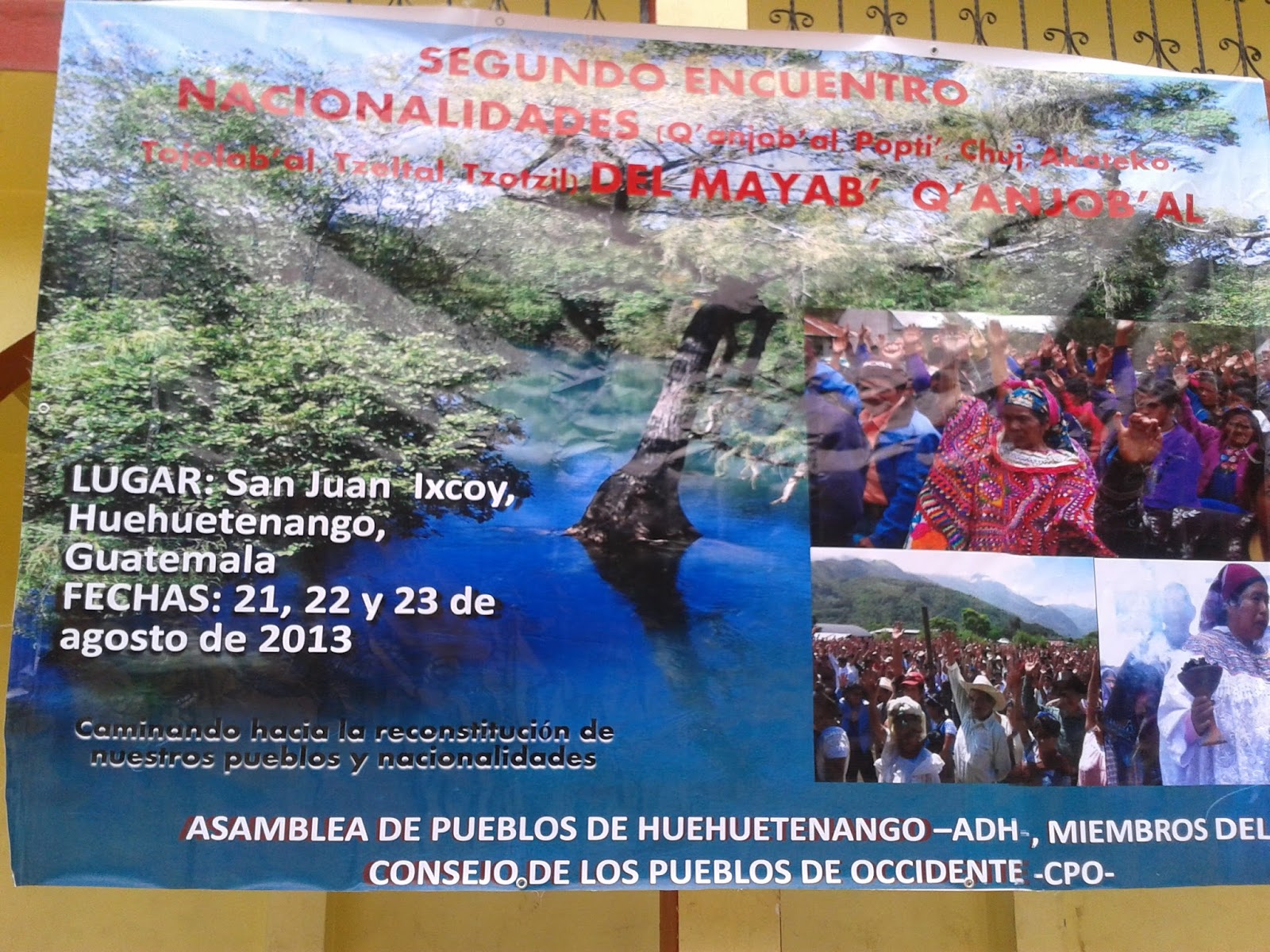
Declaration of the Second Gathering of the Q'anjob'al Nationalities


On August 21 – 23, leaders and representatives of twenty Maya Q'anjob'al communities in northern Huehuetenango and Chiapas, Mexico, gathered in San Juan Ixcoy, Huehuetenango to discuss the ongoing imposition of large-scale development projects on their territory and to continue generating strategies for unified resistance moving forward. The three day, cross-border event focused on the reconstitution and autonomy of the Q'anjob'al peoples through the strengthening of the cultural, social, economic and political ties that have historically linked indigenous communities in the border zone between Guatemala and Mexico.

In welcoming the community representatives Francisco Mateo Morales of the Departmental Assembly of Huehuetenango (ADH) explained the essence of the cross-border gathering: “Before we were divided and dispersed in towns, municipalities and countries, we were one, united people. Now our border communities are threatened by the same mega-projects – a new invasion armed with the discourse of false development. We are gathered here to continue the dialogue in order to construct new initiatives, new paths and alternatives for development.”

The gathering reiterated the legitimacy of the community consultation as an expression of cultural and political identity, and as an important tool by which indigenous peoples exercise their nationally and intentionally recognized right to free, prior and informed consent. In 2006 the Huehuetenango communities of Concepción Huista and Santa Eulalia were the first to carry out community consultations. In 2009, eight municipalities located in northern Huehuetenango, together with the Departmental Assembly of Huehuetenango and the Western Peoples' Council (CPO), were the first to declare their territory “free of mining and mega-projects”.


DECLARATION OF THE SECOND GATHERING OF THE Q'ANJOB'AL NATIONALITIES

We are decedents of the Maya Civilization, gathered together at the start of the New Era Jun Tun, Jun Katún, Jun B’aktunes, on the days Oxlajon Watan, Jun K'ana' y Kab' Ab'ak, in the place known as Oyeb’ Tx’o’ Konob’, at the foot of the Sacred Place Kab'tz’in, in Q'anjob'al territory, known today as the Municipality of San Juan Ixcoy. The leaders of Yalimox, Jolom konob', Oyeb Tx’o’ Konob’, Tz'unun Ha', Wajxaklajunh, Yaxb'atz', Hakatan, Tajlaq, Xajlaj, Concepción Huista, San Atonio Huista, Santa Ana Huista, Tila, San Juan Cancuc, Ixtapa Nibak, Las Margaritas, La Trinitaria, Ch'enalvo, San Cristóbal Jovel, Chanja' nationalities of the Q'anjob'al, Chuj, Akateka, Popti', Chol, Tojolab'al, Tzeltal y Tzotzil nation, come together at the Second Gathering of the Mayab' Q'anjob'al Nationalities to share our smiles, happiness and congratulations, and to unite our thoughts, ideas and words with strength and cosmic energy.

Despite the force with which the new invasion attempts to once again plunder our territory, our peoples have jointly worked to strengthen our political, social, economic, cultural and environmental struggles in order to continue our path toward the reconstitution of our nationality according to our cosmovision inherited from our ancestors.

Conscious of the role we play today before our families, our communities, our peoples, and the world, in this Second Encounter of the Mayab' Q'anjob'al Nationalities:

WE DECLARE:

Since the date of the First Gathering until today, the Nation States have increased the handing over of the natural resources of our territories to transnational companies and corporations. At the same time, the States have increased their servility in favor of the above-mentioned companies and corporations by militarizing communities. The justice system functions in support of mega-projects and the the States' public policies work in collaboration with business interests, resulting in the flagrant violation of our nationally and internationally recognized individual and collective rights.

The elements, natural resources and assets that exist in our territories are our treasure, our wealth and our invaluable ancestral inheritance, and it is up to us to administer these resources according to our cosmovision. Decisions regarding the administration of these resources belong to the original peoples, and not the government nor the companies. The governments and the companies only provoke conflict, pain, fear, anguish, persecution, imprisonment, abduction, torture and assassinations in our territories.

We reiterate our commitment to continue defending our mother earth, the sacred corn, the water, the forests, the mountains, our families, our communities and our people, making use of our own values, principles and ancestral practices with the firm conviction to maintain governability, strengthen democracy and to continue strengthening the unity of the Q'anjob'al nationalities. We will also base this effort on national and international legislation.

The Patq'um, the Q'umlb'ail, the Lajti', among others, are our peoples' social political systems based on our own consmovision through which we continue to practice the construction of consensus, agreements and actions in order to strengthen the Q'anjob'al nationalities.

We resume and strengthen political, economic, social and cultural exchange between our peoples, overcoming the obstacles of the administrative and political limits imposed by the States. We commit to continue working to re-establish the ancestral autonomy of our Q'anjob'al nationalities and not allow our small differences to convert into obstacles, but rather to recognize our diversity as our cultural wealth.

The Nationalities of the Q'anjob'al People are not represented by the Guatemalan or Mexican states; that is to say, we are a Nation without a State. Therefore, we will tirelessly fight with other nationalities of Maya descent for the construction of Plurinational States in order to no longer be a Q'anjob'al Nation without a State.

Oyeb Tx’o’ Konob’, Kab’ Ab’ak.
San Juan Ixcoy, August 23, 2013

Declaración del segundo encuentro de las nacionalidades Q'anjob'al

Durante el 21 - 23 de agosto, representantes de 20 comunidades Maya Q'anjob'al del norte de Huehuetenango y Chiapas, México se reunieron en San Juan Ixcoy, Huehuetenango para el Segundo Encuentro de las Nacionalidades Q'anjob'al. Los participantes discutieron la imposición de proyectos de desarrollo en sus territorios y estrategias para seguir adelante con una resistencia unida. El encuentro resaltó las consultas comunitarias como una expresión legitima de su identidad cultural y política.


En 2006, las comunidades de Concepción Huista y Santa Eulalia en el departamento de Huehuetenango se realizaron unos de los primeras consultas comunitarios. En 2009, 8 municipios en el norte de Huehuetenango, junto con la Asamblea de Pueblos de Huehuetenango por la Defensa del Territorio y el Consejo de Pueblos de Occidente, se declararon "libres de minería y de megaproyectos".


DECLARACIÓN DEL SEGUNDO ENCUENTRO DE LAS NACIONALIDADES Q'ANJOB'AL

Nosotras y nosotros descendientes de la Civilización Maya, en el inicio de la Nueva Era Jun Tun, Jun Katún, Jun B’aktunes, reunidos los días Oxlajon Watan, Jun K'ana' y Kab' Ab'ak, en el lugar denominado Oyeb’ Tx’o’ Konob’, al pie del Lugar Sagrado Kab'tz’in, del territorio Q'anjob'al, conocido hoy como Municipio de San Juan Ixcoy, lideresas y líderes de Yalimox, Jolom konob', Oyeb Tx’o’ Konob’, Tz'unun Ha', Wajxaklajunh, Yaxb'atz', Hakatan, Tajlaq, Xajlaj, Concepción Huista, San Atonio Huista, Santa Ana Huista, Tila, San Juan Cancuc, Ixtapa Nibak, Las Margaritas, La Trinitaria, Ch'enalvo, San Cristóbal Jovel, Chanja'; de las nacionalidades Q'anjob'al, Chuj, Akateka, Popti', Chol, Tojolab'al, Tzeltal y Tzotzil, de la Nación Q'anjob'al, venimos a compartir, nuestras sonrisas, alegrías y felicidades; a unir nuestros pensamientos ideas y palabras, con la fuerza y energía cósmica en el Segundo Encuentro de las Nacionalidades del Mayab’ Q'anjob'al.

A pesar de la fuerza con que la nueva invasión pretende saquear otra vez nuestro territorio, nuestros pueblos, de manera conjunta hemos fortalecido nuestras luchas en lo político, social, económico, cultural y ambiental, para seguir caminando hacia la reconstitución de nuestra nacionalidad conforme a nuestra Cosmovisión, heredada de nuestros ancestros.

Conscientes del rol que hoy jugamos ante nuestras familias, nuestras comunidades, nuestros pueblos, y ante el mundo, en este Segundo Encuentro de las Nacionalidades del Mayab’ Q'anjob'al:

DECLARAMOS:
Que del Primer Encuentro a la fecha, los Estados Nacionales han incrementado la entrega de los bienes de nuestro territorio a las empresas y corporaciones transnacionales. A su vez, los Estados han incrementado el servilismo a favor de las mencionadas empresas y corporaciones, militarizando las comunidades; el sistema de justicia actúa en apoya a los megaproyectos, las políticas públicas de los Estados se elaboran en congruencia con los intereses empresariales, violando de esta manera flagrantemente nuestros derechos individuales y colectivos, reconocidos por las legislaciones nacionales e internacionales.

Los elementos, recursos y bienes naturales existentes en nuestros territorios, son nuestro tesoro, nuestra riqueza y herencia ancestral invaluable y nos corresponde administrarlos de acuerdo a nuestra cosmovisión. Las decisiones para su administración corresponden a los pueblos originarios y no de los gobiernos ni las empresas. Los gobiernos y las empresas solamente han provocado conflictividades, dolor, miedo, angustia, persecución, encarcelamiento, secuestro, tortura y asesinato en nuestros territorios.

Reiteramos nuestro compromiso en seguir defendiendo nuestra madre tierra, el sagrado maíz, el agua, los bosques, las montañas, nuestras familias, nuestras comunidades, nuestros pueblos, haciendo uso de nuestros propios valores, principios y prácticas ancestrales, con la firme convicción de mantener la gobernabilidad, fortalecimiento de la democracia y seguir fortaleciendo la unidad de las nacionalidades Q'anjob'al, basándonos también en las legislaciones nacionales e internacionales.

El Patq'um, el Q'umlb'ail, el Lajti', entre otros, son sistemas sociopolíticos propios de nuestros pueblos desde nuestra propia cosmovisión, los que seguiremos practicando, construyendo consensos, acuerdos y acciones en el fortalecimiento de las nacionalidades Q'anjob'al.

Retomar y fortalecer el intercambio político, económico, social y cultural entre nuestros pueblos, sin que sean un obstáculo los límites administrativos y políticos impuestos por los Estados. Por lo que nos comprometemos a seguir trabajando para restablecer la autonomía ancestral de nuestras nacionalidades Q'anjob'al, sin que se constituyan como obstáculo nuestras pequeñas diferencias, por el contrario, nuestra diversidad es nuestra riqueza cultural.

Las Nacionalidades del Pueblo Q’anjob’al no están representadas ni en el Estado guatemalteco ni en el Estado mexicano, es decir, somos una Nación sin Estado, por lo tanto, lucharemos incansablemente con las otras nacionalidades de ascendencia Maya para la construcción de Estados Plurinacionales para dejar de ser Nación Q’anjob’al sin Estado.

Oyeb Tx’o’ Konob’, Kab’ Ab’ak
San Juan Ixcoy, 23 de agosto de 2013

Friday, July 12, 2013

Organizaciones Indigenas denuncian propuesta de moratoria minera

LOS PUEBLOS ORIGINARIOS NUNCA HAN PEDIDO MORATORIAS; UN PRESIDENTE DEMOCRÁTICO DEBE SER CONGRUENTE CON LOS RESULTADOS DE LAS CONSULTAS COMUNITARIAS DE BUENA FE

El anunció del Presidente de la República de Guatemala de presentar una iniciativa de ley en el Congreso de la República para decretar “una moratoria por dos años para no dar más licencias para la minería metálica” en el país, mientras comienza el debate por una nueva Ley de Minería, en el Legislativo, no es novedosa ni trascendente para los Pueblos Originarios de Guatemala; su antecesor, el Señor Alvaro Colom Caballeros ya lo había ensayado. Retraer la moratoria para el otorgamiento de licencias mineras, es otra evidencia de lo precipitado e improvisa actitud del actual gobernante con la que se levanto la moratoria predecesora.

Aún, cuando los Pueblos originarios habían presentado una acción de inconstitucionalidad en contra de la actual Ley de Minería, el Ejecutivo realizó dos acciones desesperadas: a) la suspensión de la moratoria dejada por su predecesor y, b) la presentación de una iniciativa de reforma de la Ley de referencia.

Con la suspensión de la primera moratoria, masivamente se otorgaron inconsultamente licencias de actividad minera en territorios indígenas y, con la iniciativa de reforma de la ley, se evidencia la falta de patriotismo el resguardo de la soberanía nacional. Esta iniciativa maquiavélica detalla que, en caso de que se apruebe una reforma al Decreto 48-97, Ley de Minería, o se cree una nueva Ley, el recién entregado proyecto quedaría derogado. 

La iniciativa de ley de Moratoria -“suspensión de la emisión de licencias”- no tendrá vigencia de forma inmediata, ya que esta tiene que ser leída en el Pleno, enviarse a la Comisión de Energía y Minas para buscar su dictamen y luego retornar el proyecto para iniciar su discusión.

Esta iniciativa es una “cortina de humo y un perfecto show” que buscar apaciguar la resistencia comunitaria, los conflictos originados por la imposición del modelo minero en el país.  Esta propuesta es contradictoria, cuando en año y medio el Ejecutivo ha entregado alrededor de cien licencias de minería metálica. 

Los pueblos no han pedido moratorias en las consultas comunitarias; los pueblos han exigido al Gobierno respeto a las decisiones emitidas desde las consultas comunitarias de buena fe, en las cuales, se han rechazado rotundamente el modelo de muerte encubierto en la actividad minera.

Guatemala, no necesita saquear al país para generar su propio desarrollo, la actividad minera no es la alternativa única ni prioritaria para un modelo de desarrollo integral.  

Huehuetenango, julio de 2013

ASAMBLEA DE PUEBLOS DE HUEHUETENANGO –ADH-; 
MIEMBROS DEL CONSEJO DE PUEBLOS DE OCCIDENTE –CPO-

Thursday, July 11, 2013

Indigenous organizations denounce proposed mining moratorium

In a televised program broadcast from outside Tahoe Resources’ conflictive Escobal mine project, President Otto Pérez Molina announced a proposed two-year moratorium on the granting of new mineral mining licenses. A similar moratorium put in place under the Colom presidency was lifted under the Molina administration, allowing for the issuance of roughly 100 exploration and exploitation licenses during the last year and a half. The President and Minister of Energy and Mines, Erick Archila, took care in assuring the public and Tahoe executives in particular, that the decision would not impact the Escobal project, approved for mineral exploitation in April of 2013.

He also explained that the purpose of the moratorium is to allow the government to pass reforms to the 1997 Mining Law. In a groundbreaking legal action filed in July 2012, this same law was denounced by the Western Peoples Council (CPO) as unconstitutional, as it fails to fulfill national and international mandates that require the State to consult with indigenous people regarding policies that will significantly impact their territories. In March, 2013, more than eight months after the action was filed, Guatemala's highest court upheld the Mining Law, rejecting the CPO appeal.

Indigenous and campesino organizations denounced the latest moratorium as a political show intended to calm widespread resistance to harmful mining projects, while pushing through reforms that do nothing to address the real issues including the lack of respect for communities' right to consultation on projects that impact their lives, livelihoods and territories.

Read NISGUA's translation of the declaration from the Western Peoples' Council and the Departmental Assembly of Huehuetenango below. See the original Spanish version here

THE ORIGINAL PEOPLES HAVE NEVER ASKED FOR A MORATORIUM; A DEMOCRATIC PRESIDENT SHOULD BE CONSISTENT WITH THE RESULTS OF THE GOOD FAITH COMMUNITY CONSULTATIONS

The announcement of the President of the Republic of Guatemala to present a law initiative to the Congress of the Republic to decree “a two year moratorium on the granting of additional licenses for mineral mining” in the country, while starting the debate for a new Mining Law in the legislative branch, is neither novel nor substantive for the Original Peoples of Guatemala. The current president’s predecessor, Mr. Alvaro Colom Caballeros, had already put this into practice.

To bring back a moratorium on the granting of mining licenses is more evidence of the hasty and improvised attitude of the current government in lifting the moratorium previously in place.

Furthermore, after the Original Peoples presented a legal action of unconstitutionality against the current Mining Law, the Executive Branch carried out two desperate actions: a) the suspension of the moratorium put in place by the previous president, and b) the presentation of a new initiative to reform the Mining Law.

The suspension of the first moratorium brought the massive granting of un-consulted licenses for mining in indigenous territories, while the Mining Law reform initiative demonstrates the lack of patriotic interest in protecting national sovereignty. This Machiavellian initiative makes clear that the  recently announced proposed moratorium would be repealed in the case of reforms to Mining Law Decree 48-97, or if a new law is created.

The moratorium law initiative - “suspension of the granting of licenses” - will not immediately go into effect as it must be read in the plenary, sent to the Commission of Energy and Mines for analysis and then sent back to Congress for discussion.

This initiative is a “smoke screen and a total show” that seeks to placate community resistance and conflicts as a result of the imposition of the mining model in the country. This proposal is contradictory because during the last year and a half the Executive has granted roughly 100 mineral mining licenses.

The people have not asked for a moratorium on community consultations; the people have demanded that the government respect the decisions of the good-faith community consultations that have overwhelmingly rejected this model of death disguised as mining activity.

Guatemala does not need to plunder the country in order to generate its own development. Mining activity is not the only alternative nor is it a priority for an integral development model.

Huehuetenango, July 2013

DEPARTMENTAL ASSEMBLY OF HUEHUETENANGO  -ADH-
MEMBERS OF THE WESTERN PEOPLES' COUNCIL  -CPO- 


Friday, May 31, 2013

Rubén Herrera Released from Prison!


Rubén Herrera and Cecilia Mérida moments after Rubén was liberated.
Yesterday, Rubén Herrera, unjustly imprisoned since March 15 for his resistance to the Cambalam hydro-electric project, was released from custody and cleared of all charges in one of two legal processes against him. The second process (176-2011) dating back to 2009, was provisionally closed at the request of the Public Prosecutor's office. Judge Miguel Gálvez of Guatemala City's High Risk Court “B” agreed with the prosecutor's assessment that the evidence against Herrera was imprecise and contradictory, and granted the prosecution a six month time frame to build a better case or present closing arguments. 

Beginning with Herrera's first hearing in Santa Eulalia, Huehuetenango, the Public Prosecutor's office has maintained that the case lacks evidence linking Herrera to the crimes. Despite these arguments the presiding judge in Santa Eulalia, at the request of co-plaintiffs Ecoener Hidralia Energía/Hidro Santa Cruz S.A, ordered the case forward. 

At the beginning of trial proceedings on Thursday, the Public Prosecutor reiterated its request to provisionally close both cases against Rubén Herrera citing a lack of evidence linking him to the accusations. What followed was an unusual scene, during which the lawyers at the prosecution table argued against each other. Lawyers for co-plaintiff Hidro Santa Cruz denounced the Public Prosecutor's “surprising” request and “passive attitude”, and requested that Judge Gálvez proceed to trial. Joining the Hidro Santa Cruz's legal team was a familiar face from the genocide trial, César Calderón, defense attorney for former director of military intelligence José Mauricio Rodríguez Sánchez. 

During the three hours that followed, the defense team representing Herrera argued the two separate cases, demonstrating both the political nature of the charges, the questionable behavior of representatives of the judicial system in Santa Eulalia, and the lack of concrete evidence against Herrera. 

In the 2012 case (65-2012), Judge Gálvez dismissed the charges outright. The case was permanently closed citing the fact that none of the testimonies provided by witnesses and victims in the case file even mention Rubén Herrera. In the 2009 case, Gálvez upheld the request from the Public Prosecutor to provisionally close the case stating that the accusations and arrest warrant were based on “two or three flimsy declarations”. Throughout the hearing, Judge Gálvez referenced his belief that social conflict in Barillas is the result of a lack of respect for international law protecting communities' right to consultation. 

In response to the provisional closure of the 2009 case, Cecilia Mérida, Rubén's life partner, stated that it will allow them more time to continue to disprove the allegations against Rubén; and more time to prove that he has been falsely accused by the company in order to undermine popular resistance to the hydro-electric project. Throughout the duration of his imprisonment, Herrera, Mérida and the Departmental Assembly of Huehuetenango (ADH) have continued their struggle in defense of territory in the face of rising repression and criminalization. Rubén declared soon after his release: "In prison I learned that it doesn't matter where you are, you can continue to fight.”

While the 2012 case against Rubén is closed, three of the 11 men unjustly imprisoned for eight months for their peaceful resistance to the Cambalam project continue to be linked to the same the May 1, 2012 incident and continue to await the permanent closure of their case. Likewise, 20 additional individuals still have arrest warrants pending against them related to the same event. 

Dozens of supporters packed the courtroom yesterday in support of Rubén and the struggle for communities' right to self determination. More than 2,800 people from the international community demonstrated their solidarity by signing the petition demanding Rubén's release and the end to persecution of community leaders, which was delivered to Guatemalan authorities last week

Supporters filled the seats and lined the aisles in support of Rubén.
The role of international solidarity continues to be important for the individuals, communities and organizations defending the right to consultation, particularly as criminalization of peaceful protest continues to intensify in Guatemala. In the words of the ADH: “In a very special way, we want to thank the show of solidarity with our cause. We are confident that this solidarity encourages and strengthens us to continue fighting.”


 NISGUA works closely with the Departmental Assembly of Huehuetenango (ADH) in their efforts to promote self-determination and alternative visions of development in the highland department of Huehuetenango. The ADH receives international human rights accompaniment from NISGUA through the ACOGUATE project and participated in NISGUA's 2010 tour.