Showing posts with label Huehuetenango. Show all posts

Thursday, July 9, 2015

NISGUA's 2015 summer of grassroots organizing kicks off in Los Angeles

Last month, Los Angeles communities kicked off our summer of grassroots organizing and celebration with the first “house party” of the season hosted by the inspiring collective and cultural space, Eastside Cáfe in El Sereno. Local organizers came together with LA cultural performers and families to celebrate the 10-year anniversary of the community consultation movement in Guatemala to defend land and life against resource extraction. Together with music, dance, poetry and ritual, we celebrated the ancestral decision-making practices that have been honored and held at the center of the movements for self-determination across Guatemala.

Lead organizer, Natasha Kerr, expressed her involvement with June’s event: 

“Volunteering with NISGUA allows me to reconnect with my Guatemalan roots. I feel energized to build community and defend our Mother Earth along with our brothers and sisters in Guatemala. I feel part of a movement that transcends borders and is creating a new path for future generations.”

Women from Grupo Folklorico Mi Bella Guatemala perform a
ceremonial dance at the event in Los Angeles.
Photo credit: Claudia Hernandez

Between performances, NISGUA was honored to teleconference with community leader and former political prisoner, Rubén Herrera, who helped to organize the community consultation in Barillas, Huehuetenango. Rubén Herrera spoke about the current situation of criminalization and detention of leaders in the region and called for international solidarity with their struggle. The LA community responded with messages of encouragement to the eight political prisoners from Huehuetenango who have been unjustly imprisoned because of their leadership in defending their land, culture, and communities. 

One supporter writes, “We are at an event in Los Angeles, California, educating our North American community about your struggle and commitment. Together, we call for your freedom and for justice in Guatemala.” 

Special thanks to Grupo Folklorico Mi Bella Guatemala, Trés Generaciones, Fidél Sanchez, and Jóvenes en Resistencia for your beautiful contributions to the event. For some photos please visit our FB album here.

Just two days after the kick-off to our summer of house parties, one of our participants on the 2015 Rivers For Life delegation also held an intimate gathering of family and friends for a report back just outside of LA. Accompanied by beautiful photos and an engaging conversation on how the history of imperialism and U.S. policy continues to shape the current realities for Guatemala, the event answered calls by our partners at ACODET that delegates return to their homes and communities to share their experiences visiting and learning with the communities in resistance to the Xalalá Dam.

The next community event is planned for tomorrow, Friday July 11, 4:30pm-7:30pm, at Sun Rise Restaurant in San Francisco, CA. Please see the event page on FB for more details or email megan@nisgua.org. We are still hoping more U.S. cities will participate in this season of grassroots community building. For support in planning your event, please email megan[AT]nisgua.org, and we will provide you with all the tools you may need for a successful and meaningful house party this summer!

Tuesday, June 23, 2015

Second solidarity festival for political prisoners in Huehuetenango

"This is all of our struggle. Who doesn't breathe this air? Who doesn't drink this water? Who doesn't feel the rays of the shining sun on their face? Standing up for life - this is my husband's crime. How many of our brothers and sisters have given their lives for life? For more than 500 years, people have tried to instill fear into us. We need to join together in this struggle....it's all of our struggle." - Juana Mendez, wife of political prisoner Rigoberto Juarez.

Photo credit: NISGUA
Saturday, people gathered in Huehuetenango for the second Solidarity Festival with political prisoners. Since the first festival last December, six more land defenders from Huehuetenango have been arrested on trumped-up charges, as part of a state and corporate strategy to silence opposition to resource extraction projects in Guatemala. This brings the total to eight.

Those in attendance sign letters of support to those imprisoned.
Photo credit: NISGUA
For more information on community consultations in Guatemala and the pattern of criminalizing leaders, read NISGUA's latest report: Commemorating 10 years of community consultations in defense of life. The report is also available in Spanish.

Musician Tito Medina performed in the square, and then went
to the prison to sing to several of the political prisoners.
Photo credit: NISGUA
The messages of the day were simple: Stop criminalizing legitimate struggles for the defense of land and freedom for political prisoners. Musicians came to show their support and unite struggles, including from La Puya who know first hand what it is like to have their movements criminalized by the heavy hand of an unjust legal system manipulated by corporate power.

Rubén Herrera, who has spent the last several years either in jail or battling arrest warrants was present. "I know what it's like to be in prison," he said. "These courts won't give us justice. These arrests are supported by the companies, but I'm here to tell you what those who are in prison would tell you if they could be here. We won't accept this - not yesterday, not today, not tomorrow. The struggle we're in is to change our country. That's why we're here."

Rubén Herrera, together with his partner Cecilia Mérida.
Photo credit: NISGUA
Over the next few months, we invite you to participate in NISGUA's summer of base-building and host a house party. Those gathered will be invited to send a letter of encouragement to the political prisoners and one to the U.S. Embassy, expressing concern for the growing manipulation and corruption of the Guatemalan justice system in order to persecute human rights defenders. Gather together to celebrate, find inspiration, and draw connections from community-based movements for self-determination occurring throughout Guatemala, and strengthen our home network for justice and social change.

House parties are already being organized in San Francisco, Madison, Portland, Los Angeles, Austin, Seattle, and Toronto, Canada. Don't see your city on the list? Write to megan[at]nisgua.org to host an event or find other ways to get connected. Stay tuned for an online version of our action to support political prisoners in Huehuetenango.

Friday, June 19, 2015

Commemorating 10 years of community consultations in defense of land and life

For generations, indigenous communities in Guatemala have held consultations to make decisions on issues affecting their people and their lands. While the signing of the Peace Accords in 1996 facilitated the adoption of national laws and international agreements that recognized the particular rights of indigenous peoples, the post-conflict neoliberal economic model prioritized resource extraction — a practice fundamentally at odds with upholding these rights. Specifically, the 1997 Mining Law weakened oversight and lowered royalty rates for mining companies, and the 2005 Central American Free Trade Agreement further established foreign direct investment as a pillar of the Guatemalan economy.

Transnational mining and hydroelectric companies were given free rein to begin operations without the consent of impacted communities, and they quickly gained access to huge swaths of land in order to carry out resource exploration and exploitation activities. In a land mass comparable to Tennessee, over 360 mining licenses have been issued and more than 600 are pending.

This month, NISGUA releases a report documenting the referenda movement in Guatemala as a community strategy to defend land against mining and other mega-development projects. We invite you to read the full report, "Commemorating 10 years of community consultations in defense of land and life" in English here. The report is also available in Spanish.

Communities in Santa Cruz del Quiché unanimously vote
against resource extraction. Photo credit: James Rodríguez, mimundo.org
Over the past ten years, more than a million people have voted in community referenda to ban mining activities on their lands. This ancestral decision-making practice is an act of resistance and expression of people power that has been a source of inspiration for movements for self-determination throughout the country and the world. 

But together with the force of the Guatemalan government, resource extractions are fighting back and actively seeking the detention of those who oppose their projects. In the past few years, dozens of people opposed to mining projects have been arrested on trumped-up charges and have spent months - and even years - in prison awaiting a trial. Today, eight community leaders from Huehuetenango who played key roles in the organization of consultations in their territory are in prison. These husbands, fathers, brothers and sons stood up to demand respect for the results of the consultation even as state violence and repression mobilized to impose the projects against communities’ will.

We invite you to read the full version of the report and take action to support the political prisoners from Huehuetenango who continue to stand up for land and life.

Monday, June 15, 2015

Accompanier Perspectives: Huehuetenango

Dear Family and Friends,

Thanks to those of you who’ve responded to my recent call for action in solidarity with political prisoners in Huehuetenango and for financial support in NISGUA’s successful May Match campaign! Those of you who’ve signed in support of the release of Saúl Méndez and Rogelio Velasquez will have your voices heard in the coming weeks as NISGUA’s partners in Madrid coordinate the presentation of the petition to Guatemalan embassies in North American and Europe.

It has been a while since I’ve reached out to you all with more substantive updates and reflections on my work as a human rights accompanier in Guatemala, but I’ve been thinking of you. Firstly, with the (bittersweet) excitement of knowing that I’ll be seeing many of you soon as I conclude my six-month contract this week and start to make my way back north. And secondly, with curiosity and hope in the histories converging in the current moment in both the U.S. and Guatemala that have provoked diverse forms of protest and commentary in response to the specific violences of institutionalized racism and corruption. 

Throughout the unfolding of what many are calling a “black spring” in the United States, I have been doing my best to stay well-informed and vocal from afar, but have learned that while social media helps me keep my anger current, it also affirms distance and lends itself to feelings of powerlessness. For this reason, I am especially looking forward to opportunities for shared, in-real-life reflection (and action) with those of you who’ve been directly engaging (as listeners, as actors) in the #BlackLivesMatter movement. Even from where I stand in Guatemala, it is clear that the questions we need to ask ourselves are difficult, the answers complex, and the stakes as high as they have always been.

Right now in Guatemala, the same is true. This spring, in the largest wave of popular protests since the signing of the Peace Accords in 1996, the population has demanded the resignation of public figures (including the president) believed to be linked to the crime syndicate “La Linea,” which compromised customs revenue by waiving import tariffs in exchange for bribes. The protests (connected by their shared usage of #RenunciaYa or #StepDownAlready) have led to the resignation of the vice-president last month (which analysts have also linked to the influence of the U.S. embassy and American economic interests) and have energized similar investigations aimed at undermining impunity. In a country where an indigenous majority experiences some of the deepest poverty in the region and where the current regime frequently cites a deficit for the deplorable conditions of its education and health systems, it is not surprising that the abuse of public funds has been met with unrest. 

#BlackLivesMatter and #RenunicaYa have emerged from distinct contexts and reflect varied objectives, but they have something important in common: a dawning recognition that the creation of a just present requires deep and critical engagement with the past. Beyond expressing just rage in response to specific instances of extreme police violence, #BlackLivesMatter protests address the pervasive reality of institutionalized anti-black racism as a direct legacy of African slavery in North America. Similarly, the diverse perspectives represented in #RenunciaYa question the meaning of democracy and peace since the signing of the Peace Accords and reflect a shared acknowledgement that today, as they have long been, terror and impunity are the rule in Guatemala, while justice is the illusive exception. 

So, what does all of this have to do with human rights accompaniment? 

While the theft of public funds by La Linea may seem petty in comparison to the genocidal violence exercised by the state against poor and indigenous Guatemalans for decades (and centuries), the scandal is emblematic of the institutional precarity that permits human rights abuses to thrive in Guatemala. Weak courts, racist police, and highly corruptible public officials are easily utilized by transnational companies to repress movements that challenge their extractive, exploitative logic. In the midst of #RenunciaYa’s unfolding, three more leaders of the resistance to hydroelectric development in Huehuetenango have been incarcerated, and over a dozen more have had warrants issued for their arrest. The most recent arrests bring the total number of political prisoners in the north of Huehuetenango to 9, with every organization that I’ve accompanied experiencing the threat of the incarceration of its leaders. 

While criminalization has intensified in my time as an accompanier (six new prisoners in six months), it is not a new phenomenon in Huehuetenango. In May 2012, five years after the people of Santa Cruz Barillas had unanimously refused the presence of extractive mega-projects in their territory in a consulta comunitaria, an activist who had vocally opposed the installation of two hydroelectric dams on the Cambalam River was murdered by the company’s private security. In the days following his murder, anticipating impunity, the people of Barillas rose up to demand justice for his death. The state responded with a state of siege, militarizing the city and its outlying villages, suspending civil liberties, and making massive arrests alleging destruction of company property and threats to its employees. For survivors of the internal armed conflict, the presence of the military was traumatizing; many took refuge in the forest, convinced that the war had started again, and some still suffer effects of post-traumatic stress. 

While military intervention in Barillas sought to terrorize a public in unrest, the justice system has sent clear messages about its take on the value of rural Guatemalan life and transnational private property. The employees of Hidro Santa Cruz who murdered Andrés Francisco Miguel have yet to be successfully sentenced three years after his death, while community leaders have spent months and years in pretrial detention accusations based on their leadership, and not in their proved participation in criminal activity. Often, it has taken years to close their cases even after they have been released for lack of proof or faulty investigations. 

In my last update, I introduced criminalization as a strategy for repressing and neutralizing social movements. In simple terms, criminalization literally makes activist leadership a crime. In the cases I’ve witnessed in my time as an accompanier, leaders have been charged as the intellectual authors of spontaneous protests that have demanded justice and accountability for state sanctioned violence. But many have actually played mediating roles in conflictive situations, attempting to minimize the risks that protesters take in expressing their desire for justice while maximizing the possibilities for dialogue. But the character of their participation is not of interest to prosecutors; their mere presence has made them the subject of criminal investigations. In some cases, being present isn’t even requisite for being charged.

The repressive impact of incarcerating leaders is made more effective by the issuing of arrest warrants against entire organizations and communities. While an arrest warrant does not guarantee an arrest, the threat of arrest may be even more debilitating to the capacity of movements to demand justice. The most recent arrests have been made in the capital, where leaders have traveled between 8 and 13 hours to attend hearings for their peers or file police reports against violent public officials. An arrest in the capital, as opposed to in rural Huehuetenago, sends a strong message: Leaving home means increasing risk of arrest, and the police knows when you leave home.

What’s more, these arrests have been highly public and visible to movements based in other regions, where the impact of criminalization is felt as well. Where I work in Huehuetenango, the impacts are palpable: Those with warrants live in fear of arrest and must navigate the need to limit their movement and participation as movement becomes more necessary than ever. The families of those incarcerated adapt to long, frequent, and expensive trips to capital cities to visit their loved ones, while living the consequences of a lost income, all while movements require their collaboration to build broad support for political prisoners. For indigenous campesinos especially, navigating legal spaces and processes is an uphill battle, and language barriers and ethnic discrimination often mean total exclusion. On the periphery, some still talk about seeking refuge. 

These are the kinds of conditions of abuse and threat that make human rights accompaniment a necessary and valued solidarity strategy in Guatemala, especially in Huehuetenango. As criminalization intensifies, the people I accompany have asked that we maintain our presence in the region and expand it into new spaces — to court rooms and prisons, and in activities where potentially criminalized activists risk arrest. More than anything, this has meant that my team and I have been present to observe the legal processes starting at the moment of incarceration, and that we’ve heightened our attention to factors of security that threaten the capacity of the people we accompany to live, work, and organize for their communities safely. 

In this context, it is clear that international accompaniment alone does not wield sufficient dissuasive power to prevent the unjust imprisonment of activists. Rather, as our presence continues to be felt and valued by the people who request it, we must think of ways in which accompaniment can support a variety of strategies for reducing harm while working to undermine exploitation and abuse.

On my last day as an accompanier, I observed the first hearing for the case of three leaders from Barillas who were arrested almost exactly three months before. The outcome of the hearing wasn’t positive; the judge denied the defense’s request to revise the charges in consideration of various irregularities in the investigation, and it remained unclear how long they’d have to wait for their next hearing. But as we left the courtroom, things got worse: another community leader who’d traveled from Barillas in support of his three compañeros was presented with a photocopy of a warrant for his arrest. Nearly two hours passed before he was presented with a legal version of the warrant, and we accompanied him as he was handcuffed and taken to the basement holding cells to await his arraignment. 

As I observed his entrance into the jail, I heard my name being called from a nearby cell, “Don Davíd! Aquí! Don Davíd”! The three men who’d had the hearing earlier that day were waiting to be transferred back to their long-term cell assignment in a nearby prison. They called me over to ask me questions about the arrest of their compañero, to advocate for the safest placement possible for him in the prison where’d they’d been held previously in Huehuetenango, and reached their hands up out of the dark cell to touch mine through the narrow bars. They smiled as I said goodbye.

While I reciprocated the joy of seeing them, the feeling was hard to sustain. I’ve never seen places so ugly and hopeless, so unapologetically violent, as the prisons where I’ve made visits in the last six months. It isn’t possible to witness the horror of mass incarceration without feeling some level of powerlessness and rage, without feeling exasperation with common sense notions of justice that rationalize such contempt for human life. I’ve been holding these feelings for several months now, perhaps longer, and I think those feelings are important, but I am so grateful for those smiling hands in the darkness reminding me that joy is necessary in survival.

There are lots of ways that I will remember my work as an accompanier, and there are many ways in which I intend to continue in its spirit in other contexts. I'll be transitioning back to my "normal" life in the next few weeks, but I feel more aware than ever that while working as a human rights accompanier has been a unique experience in my life, the ongoing work of shared survival is everyone's. That work didn't start six months ago and it doesn't end now. 

As always, thanks for sticking with me throughout my experience. 

In Solidarity,

David

Thursday, May 14, 2015

Community leader from Huehuetenango testifies at the World Bank

Last month, Cecilia Mérida testified at the World Bank Spring Meetings in Washington, D.C. about the damage being inflicted by the Bank's financing of the Cambalam hydroelectric dam in the municipality of Barillas, Huehuetenango. She testified to the strategies of criminalization being employed by the Guatemalan government and the dam's Spanish owner - Hidro Santa Cruz - in an attempt to silence local opposition. She spoke first hand about the impacts on families and communities when leaders are illegally detained and imprisoned for months, or even years on end.

The World Bank continues to be a major funder of resource extraction companies around the world, loaning hundreds of millions of dollars each year to companies working in the global South who are unable to guarantee that these investments are not contributing to human rights violations. A recent investigation by the International Consortium of Investigative Journalists revealed the hypocrisy of the World Bank's motto to "do no harm." The investigation showed that mega-development projects financed by the World Bank have pushed at least 3.4 million people out of their homes around the world. The tragic situation in Santa Cruz Barillas is an example of this systemic problem: the Inter-American Infrastructure Finance Corporation (CIFI), a US-based private sector lender funded in part by the World Bank, loaned Hidro Santa Cruz more than $8 million for the construction of dam.

Click here to read more about the struggle to defend territory in the department of Huehuetenango, and the leaders who have been criminalized while speaking out against hydroelectric dams being imposed without their consent. 

Below is Cecilia's statement before the World Bank. To read the original statement in Spanish, click here.

Cecilia Mérida: Statement before the World Bank


I am Cecilia Mérida. I come from the department of Huehuetenango in Guatemala, from the municipality of Santa Cruz Barillas, which is where the Spanish company Hidralia Ecoener has been operating without consent since 2008. Their goal is to construct a hydroelectric dam on the Cambalan River, situated on the periphery of the urban center of the municipality. This company has received financing that flows from the World Bank to the International Finance Corporation (IFC), and its Inter-American Infrastructure Finance Corporation (CIFI).

I come in the name of each person affected by this hydroelectric project, to answer many of the questions put forward by OXFAM. What are the consequences for the people who are affected by the projects financed with money that comes from so far away?

Hidralia Ecoener, registered in Guatemala as Hidro Santa Cruz, Sociedad Anónima, insisted on the development of this project despite the fact that in 2007, the people of Barillas held a community consultation to protect their natural resources, under the framework of the Collective Rights of Indigenous Peoples.

The company hired local people as technicians gaining political control over community organizing. In November 2009, the company pressed charges against eight community leaders, among who was my life partner - Rubén Herrera - along with Pablo Antonio Pablo and Saúl Mendez. Thus began the practice of charging community leaders in the municipality with crimes of breaking and entering, coercion, threats, aggravated arson, activity against the security of the nation, detention, kidnapping, and terrorism.

This led to the beginning of the social conflict in the municipality, and the permanent violation of the human rights of the population. What transpired were incidents of intimidation, persecution and criminalization against all of those who spoke out against the interests of Hidro Santa Cruz. In 2011, Rúben Herrera was forced to leave the municipality, abandoning his work providing social support to youth.

Towards the end of 2011 and the beginning of 2012, social tension worsened to such a level that the Guatemalan government declared a State of Siege in the municipality of Santa Cruz Barillas, repressing the opposition to the hydroelectric project and allowing Hidro Santa Cruz to continue its operations. On May 1, 2012, campesino leader Andrés Francisco Miguel was killed during an assassination attempt against Pablo Antonio Pablo, who was left seriously injured in the attack. One year later, company private security guards who participated in this armed attack, were absolved of all crimes by the Guatemalan justice system.

Based on what transpired on May 1, 2012, 17 community leaders were illegally detained, including Saúl Méndez and Rogelio Velásquez. Nine were unjustly imprisoned for nine months, and were never found guilty of any crime. On March 15, 2013, Rubén Herrera was arrested at the request of Hidro Santa Cruz. After spending three months in prison, he finally had all charges dropped on February 26, 2014, after a judge ruled that there was not sufficient evidence to keep the investigation open.

In August 2013, Saúl Méndez and Rogelio Velásquez were arrested again, and accused of murder, feminicide and lynching. Those of us who are at their defense are convinced that this case was brought forward by employees of Hidro Santa Cruz as a part of their strategy to criminalize community leadership. After a flawed trial, they were convicted of 33 years in prison. Today, they are going through a Special Appeals process.

In September 2013, another community member, Mynor López was illegally arrested. At the end of the month, the Guatemalan Army and National Civil Police practically launched a military offensive against the civilian population of Santa Cruz Barillas, the likes of which have never been seen before in this municipality - not even during the armed conflict.

In February 2015, three more community leaders were detained and illegally imprisoned. Adalberto Villatoro, Francisco Juan and Arturo Pablo (Pablo Antonio Pablo's son). They, like all of the others previously mentioned, believed that the presence of Hidro Santa Cruz seriously impacts the natural, environmental and cultural aspects of the municipality.

After seven years of persecution, the ways the Spanish company Hidro Santa Cruz operates provide some answers to the questions posed by OXFAM's recent report. What are the human costs of the loans, given the social and environmental safeguards are not working? The human costs are extremely high and very harmful. They translate into persecution, killings, imprisonment, and criminalization. During this time, the communities have not seen any benefits. Instead, they have gone from living in tranquility to living in a state of fear and terror. Our human potential and energy has not been dedicated towards local development from our own perspectives and aspirations, but instead, has been spent defending ourselves against the abuses of Hidro Santa Cruz.

The human costs [of these loans for mega-development projects] translate into the suffering of families, wives, sons and daughters, into illnesses and precariousness. We are prevented from being with our husbands. Instead, we spend our lives and the little we have traveling to the prison that is located more than 400 kilometers away. In this conflict, every community member [incarcerated] is innocent. We are the people who are suffering the consequences of bank loans that are thought to be "producing development." The pain and suffering for us "is the human face of these projects." Day to day, we live out these tangible consequences, in addition to being (as OXFAM's report indicates) "the most poor and vulnerable people of the developing countries."

We, too, have questions. Who is going to pay for all of the costs that we have had to suffer from "development," for a project that we never asked for in our community? Is it the World Bank? The International Finance Corporation? The CIFI? Or is it Hidro Santa Cruz that is going to pay for all of the economic, social and organizational harms they have caused in our community? Who will return to the families all the years taken from the men who have been incarcerated? We know that no one will give back to us those who have been killed.

Wednesday, March 25, 2015

One more political prisoner: Rigoberto Juárez, land defender

Written by Nelton Rivera
Translated by NISGUA

Read original piece in Spanish here.

[Yesterday] Rigoberto Juárez Mateo was arbitrarily detained and became another political prisoner held by the state of Guatemala. Rigoberto Juárez is a representative of the Plurinational Government (Gobierno Plurinacional) of the Q'anjob'al, Chuj, Akateka, Popti and Mestiza peoples, from the 16 municipalities of Huehuetenango. Juárez is criminalized for defending land and water. 


A warrant signed by a competent judge was not presented at the moment of arrest, carried out by officers of the National Civil Police. Domingo Baltazar was detained together with Rigoberto, both of whom are members of the Community Authority of Santa Eulalia, Huehuetenango. During the violent arrest, lawyer Ricardo Cajas was physically assaulted when he asked the officers to identify themselves and a legal arrest warrant for Rigoberto Juárez be presented.

The detained community representatives had traveled to the capital to lodge an official complaint for rights violations committed against the ancestral authorities and various journalists on March 19 of this year, committed by Diego Marcos Pedro, members of the municipal government, and others with ties to the authorities.

The Q'anjob'al ancestral authorities were assaulted by members of the municipal government on Thursday, March 19 during a public activity to re-open the Community Radio Snuq' Jolom Konob. For four hours, they were verbally and psychologically assaulted and threatened, leading them to travel to the capital to lodge complaints with the Attorney General's Office through its Crimes Against Human Rights Defenders section, as well as with the Office of the Human Rights Ombudsman (PDH), and the Office of the United Nations High Commissioner for Human Rights in Guatemala.

On multiple occasions since 2011, representatives of the Plurinational Government have traveled to the capital to denounce atrocities committed by hydroelectric companies operating throughout maya Q'anjob'al territory. Specifically, [they have denounced] the hydroelectric company Hidro San Luis in Santa Eulalia, who together with municipal leaders, are threatening the rights of the communities in opposition to the hydroelectric project.

This arbitrary arrest adds to a long list that has been growing since 2012, as the Government and the companies increasingly use arbitrary arrest as a strategy to break up the peaceful and organized opposition that exists to this model of extraction and displacement.

Friday, January 23, 2015

Freedom of expression at serious risk in Guatemala

Today, alternative and grassroots media in Guatemala denounced attacks against Radio Snuq' Jolom Konob', a community radio station in the department of Huehuetenango that regularly transmits voices of the Q'anjob'al people living in and around the municipality of Santa Eulalia. 

The department of Huehuetenango, like many other areas in Guatemala, has been the site of increased social conflict due to the presence of transnational extractive companies. Community radio stations play an important role in promoting access to information and freedom of expression, which are two major constitutional rights that are often violated by the Guatemalan government and transnational companies who obtain exploration and extraction licenses without the free, prior and informed consent of impacted communities. 

Today, members of the Radio Snuq' Jolom Konob' denounced the forced shut down of the radio and other attacks as a violation of freedom of expression and the cultural rights of indigenous communities who depend on the station to transmit radio programming in Q'anjob'al. 

For the original press release in Spanish click here.

January 23, 2015

In Guatemala, physical assaults, false accusations and the prosecution of community journalists is increasing, and the lack of support from the mass media in denouncing these intimidations is creating precarious conditions for the exercise of freedom of expression.

Furthermore, the concentration of the mass media in the hands of a few and their monopolistic practices are putting a crack in democracy.

The realities being faced by community radio stations right now in Guatemala show that the State is not fulfilling its obligation to respect, protect and promote the right to freedom of expression.

Alternative, popular and grassroots media continue to be repressed and attacked. Today, there is the case of Radio Snuq' Jolom Konob', who is transmitting information via radio and the internet from Santa Eulalia, Huehuetenango about the happenings that affect life in the Q'anjob'al municipality of Santa Eulalia.

On January 19, the radio denounced the persecution of community leaders and acts of aggression by the Mayor of Santa Eulalia, Huehuetenango, Diego Marcos Pedro. At dawn on January 20, a group of the Mayor's supporters shut down the radio, cutting off the electricity, and became violent with members of the radio team. All of this was done with the support of the Mayor. 

This hasn't been the first attack that Mr. Diego Marcos Pedro conducted against Radio Snuq' Jolom Konob'. In September, 2014, he shut down the building and suspended the electricity because the station was transmitting an event run by the community authorities in Santa Eulalia. Due to pressure from communities, he had to reinstate the electricity to the radio; there are already official complaints registered with the Public Prosecutor's Office under Crimes Against Journalists. In many cases, however, due to the criminalization of community journalists and the stigmatization against them, often these complaints are not followed through. 

It is both urgent and necessary to begin and expand a debate around exercising the rights to freedom of expression, as this right and privilege doesn't only extend to the mass media. 

In light of these threats and acts of aggression against our fellow journalists, reporters and member of the community press: 
  1. We demand: an end to the acts of aggression against community press, reporters and journalists. The act of filing criminal charges, the laws that criminalize the work of citizen journalists, the closing of radios and physical aggressions committed against journalists all constitute a policy of repression against freedom of expression.
  2. We ask: that Congress approves legislation that recognizes alternative and community media.
  3. We need: the Unit for Crimes Against Journalists to be strengthened in the Public Prosecutor's Office, as part of a general social need to strengthen the judicial system in the country.
  4. We demand: the Government of Guatemala provide clear reports on the advancements in the Program for the Protection of Journalists - an initiative offered by the Government since November 2013.
  5. We ask: the Human Right's Ombudsman to pay special attention to what is happening in the interior of the country, where community media are being intimidated by powerful local actors bent on ensuring they cannot fulfill their roles as information providers.
  6. We invite: fellow journalists to be responsible, committed and truthful in carrying out our work to provide the country with information, as democracy rests in our voices and our words.

Radio Comunitaria Snuq' Jolom Konob', Prensa Comunitaria, Red Tz'ikin, DEMOS, CEPPAS GT, AGHS, CERIGUA, Asociacion Sobrevivencia Cultura, Asociacion Mujb'ab'lyol, Asociacion de Radios Comunitarias Guatemala, Asociacion Luciernaga, Centro Civitas, Red Mesoamericana, OPAL Prensa, El Salmon, and Plaza Publica

Thursday, November 20, 2014

Human rights defenders from Barillas convicted despite irregularities in proceedings

An excerpt from a press release issued by the Guatemalan Unit for the 
Protection of Human Rights Defenders (UDEFEGUA):

"On Thursday, November 13, the trial court judge in Villa Nueva sent Oscar Morales, a leader in the resistance movement in San Rafael las Flores, to trial for allegedly threatening the manager of the mining company, Minera San Rafael, S.A., subsidiary of Canadian company Tahoe Resources. During the evidentiary hearing, the judge revealed his partiality when he indicted the human rights defender without a proper investigation. The judge is now sending the case to trial without a clear investigation and despite the fact that the Public Prosecutor's office has stated that they do not have enough evidence to accuse the defendant. In sending the case to trial, it has become clear that the judge is prioritizing private interests that are represented by lawyers of the third-party plaintiff. The trial against Oscar Morales opens on December 29.

On November 14, Saúl Aurelio Méndez and Rogelio Velásquez, water rights defenders from Barillas, Huehuetenango, were convicted by a Sentencing Tribunal in Huehuetenango for conspiracy to commit murder. The two human rights defenders were illegally detained on May 2, 2012 during a state of siege imposed by the government of Guatemala. After a lengthy process, they were released and declared innocent. However, while en-route with their lawyer for the final hearing on this case, they were arrested by the police outside the Guatemala City court house for the murder and femicide of two people who were lynched in Barillas in 2010.

Both the legal process itself and the verdict against the human rights defenders were plagued with irregularities. The verdict was reached without proving the individual responsibility of the accused, violating one of the core guarantees of the judicial system that states that individuals cannot be brought to trial for the actions of others. Both cases demonstrate how private interests trump justice, leading to the political persecution of social leaders and human rights defenders."

Link to original press release in Spanish can be found here.


Other statements from Guatemala:

"They accuse me of something I did not commit. My intention has always been to defend the rights of nature." (Saúl Aurelio Méndez Muñoz)

"I am someone of few material resources. I have fought for the rights of Mother Nature and for defending natural resources, I am now in prison." (Antonio Rogelio Velásquez)

"Together with their communities, [Saúl and Rogelio] expressed their opposition to the construction of the hydroelectric Hidro Santa Cruz. This struggle has meant repression and criminalization for them, their families and their communities by the Guatemalan state who, far from working for the wellbeing of the citizens of the country, protect the interests of transnational companies such as Ecoener Hidralia and its extractive projects in northern Huehuetenango. All of this threatens the lives of communities and the natural resources of the Guatemalan people." (Statement from the Departmental Assembly of Huehuetenango)

"It is clear that the case of Rogelio and Saúl corresponds to a strategy of terror that seeks to weaken community resistance and paralyze social movements in defense of territory. This [goal] wasn't achieved because those of us who defend life and territory remain united.” (Statement from the Departmental Assembly of Huehuetenango)

Link to original statements in Spanish can be found here.

Tuesday, April 8, 2014

Peaceful blockade in Barillas celebrates one-year anniversary

Tired of being ignored and disrespected by the Guatemalan government, and determined to halt a hydroelectric project approved without their free, prior and informed consent, the men and women of Santa Cruz Barillas founded the peaceful blockade, Nuevo Amanecer on April 6, 2013. Nuevo Amanecer, or New Dawn, is a permanent encampment located on a communal road leading to the proposed project site where community members maintain a constant presence. The bold action has served to halt the construction of the Canbalam Dam, owned by Spanish company Hidralia Energia and its Guatemalan subsidiary Hidro Santa Cruz.


Nuevo Amanecer celebrates its one year anniversary. Photo: PrensaComunitaria

Last Sunday, members of the resistance celebrated the one-year anniversary of Nuevo Amanecer and reiterated their commitment to continuing the peaceful opposition to the project. 

“While 365 suns and moons, and 8,760 hours have gone by [since establishing the peaceful encampment], the People continue to remain hopeful and committed to the struggle, despite immense sacrifices and hardships.” - Press Release from the Plurinational Government and the Western Peoples' Council (CPO), April 2014

Communities and leaders at the forefront of the resistance movement have suffered an onslaught of criminalization, repression and violence at the hands of the Guatemalan state, which instead of protecting the interests of the people, has time and again acted in defense of the Spanish company.

The costs suffered by the communities and families that stand to be impacted by the project have been high. Two community leaders have been killed since May 1, 2012 and three others, Saúl Méndez, Rogelio Velásquez and Mynor López, remain in prison facing charges related to the opposition to the Canbalam Dam. Eleven additional members of the resistance have collectively spent more than one year in preventative prison on accusations filed against them by the company, which were later dismissed.

As the conflict caused by the imposition of mega-projects in Huehuetenango drags on, international solidarity with communities and individuals standing up for their right to self determination continues to be vitally important and appreciated. Last year, NISGUA and partners gathered nearly than 3,0000 signatures demanding the release of political prisoner, Rubén Herrera. Spanish solidarity organization and members of the International Accompaniment Project in Guatemala (ACOGUATE), Plataforma de solidaridad con Chiapas y Guatemala de Madrid, launched an online popular consultation in support of communities in Northern Huehuetenango resisting the imposition of large-scale projects. Nearly 2,000 people echoed the results of local referenda saying NO to the instalation of mega-projects and YES to communities' right to self determination.

Plataforma submits their consultation results to the Guatemalan Embassy in Madrid.

"The Q'anjob'al and Mestizo People of Barillas infinitely thank the national and international solidarity of many individuals and organizations that have unconditionally reached out to us in this struggle. We also believe that this struggle affects us all and for this reason we say WE ARE ALL BARILLAS."
- Press Release from the Plurinational Government and the Western Peoples' Council (CPO), April 2014

NISGUA and ACOGUATE work closely with partners in Huehuetango in their efforts to defend the right to consultation, promote self-determination and stand up for human rights in the region.

Tuesday, October 1, 2013

Communiqué denouncing recent repression in Northern Huehuetenango

On September 28, conflict erupted again in Northern Huehuetenango in response to the imposition of Spanish-owned Cambalam hydro-electric project in Santa Cruz Barillas. Despite ongoing criminalization and repression, community members continue to demand respect for the 2007 community consultation rejecting large-scale development projects in their territory.


During his September 3 visit to Barillas, President Otto Pérez Molina hailed hydro-electric projects as the future of development in the region and announced the establishment of a dialogue round table, supposedly to address ongoing community opposition to the projects. In the end, the promise of dialogue remained unfulfilled; the conversation did not take place, as the president failed to attend the meeting scheduled for September 19. While the public discourse has advocated for negotiation with communities, in practice, the government has consistently responded to popular opposition with militarization, repression and criminalization.

In the communique below, the Western Peoples' Council and the Departmental Assembly of Huehuetenango denounce this new wave of violence and militarization and call for international solidarity, the cancellation of licenses for controversial mega-projects and respect for community right to consultation.

We denounce before the international and national community:
The current aggression against the Q'anjob'al, Akateko, Chuj and mestizo peoples in Northern Huehuetenango by the President and Commander of Chief of the national army, General Otto Fernando Pérez Molina, who in a recent press conference highlighted the importance of water, mineral, oil and forest resources.

These aggressions are part of a new process of transnational invasion, protected by the government in power, who take turns implementing projects of plunder in the name of false development. These actions are framed within a strategy of counterinsurgency and make us remember and relive the internal armed conflict of the 1980s during which the army orchestrated plans of aggression and violated civil society's fundamental human rights.

On September 28-30 of this year, the government used low flying helicopters, armored vehicles, army troops and National Civil Police (PNC) special forces units to terrorize the population. This strategy of invasion, which disproportionately uses police and military forces characteristic of a state of war, resulted in one civilian death and many injured.  This result is the unforgivable responsibility of the government.

This repressive and terrorist behavior attempts to paralyze communities' pacific and legitimate struggle in defense of territory. The licenses [for mega-projects] have been granted to companies in territories where we exist and live, and that we have been caring for during thousands of years. We will not allow our territories to be destroyed.

THEREFORE: We call on the international and national community to speak out and show solidarity with the people of Guatemala. We will remain vigilant and in permanent observation of the human and collective rights of the people, as attacks against the civilian population of Barillas continue.

WE DEMAND:
1. The government and its ministries respect the human and collective rights of the people, and that they stop lying to and confusing the national and international community.
2. The withdrawal of all army and PNC special forces troops in Northern Huehuetenango in order to guarantee the protection of human rights and not to serve transnational companies.
3. The cancellation of mining, hydroelectric, oil and other mega-project licenses that have been granted in Huehuetenango and which are responsible for undermining peace and liberty.
4. Respect for community consultations carried out   from 2006 to the present.

The Q'anjob'al, Chuj, Akateko and mestizo people have historically cared for territory for the benefit of everyone, including future generations. We only want to be treated as people and to be allowed to live freely in peace and harmony with Mother Nature.

Departmental Assembly of Huehuetenango (ADH)
Members of the Western Peoples' Council (CPO)

Huehuetenango, September 30, 2013

Comunicado denunciando agresiones en el Norte de Huehuetenango

A LA COMUNIDAD NACIONAL E INTERNACIONAL EXPRESAMOS:

La agresión actual a los pueblos Q’anjob’al, Akateko, Chuj y mestizo de la Región Norte del departamento de Huehuetenango, de parte del Presidente y comandante en Jefe del Ejército Nacional, General Otto Fernando Pérez Molina, quien en conferencia de prensa resaltó la importancia rica de los recursos hídricos, minerales, petrolero y forestales. Estas agresiones, son parte del nuevo proceso de invasión transnacional tutelado por los gobiernos que se turnan en el poder e implantan proyectos de saqueo en nombre de un Falso Desarrollo. Estas acciones, se enmarcan dentro de una estrategia de carácter contrainsurgente que hacen recordar y revivir el conflicto armado interno de los años ochenta, donde los militares orquestaban planes de agresión y violentaban derechos humanos fundamentales de la sociedad civil; los días 28, 29 y 30 de septiembre del presente año, han usado helicópteros a vuelo rasante, vehículos artillados, tropas del ejército y elementos de fuerzas especiales de la Policía Nacional Civil, para aterrorizar a la población. Toda la estrategia de invasión ha utilizado desproporcionadamente a los elementos policiales y militares con características de estado de Guerra, en la cual se ha ocasionado la muerte de ciudadanos y varios heridos; ésta, es una responsabilidad imperdonable del Estado. Estas conductas represivas y terroristas, pretenden paralizar las luchas pacíficas y legítimas en defensa del territorio de los pueblos. Las licencias han sido otorgadas a las empresas en territorios donde existimos, vivimos y que hemos cuidado por miles de años.y no permitiremos que nos destruyan.

POR LO TANTO: Hacemos un llamado a la comunidad nacional e internacional para que se pronuncie y se solidarice con los pueblos que conviven en Guatemala. Mantendremos una vigilancia y observancia permanente de los derechos humanos y derechos colectivos de los pueblos, porque los ataques continúan en contra de la población civil de Barillas.

EXIGIMOS:
1. Al Gobierno y sus Ministros que respeten los derechos humanos y colectivos de los pueblos así como dejar de mentir y confundir a la comunidad nacional e internacional.
2. El retiro de todas las tropas del ejército y fuerzas especiales de la PNC del Norte de Huehuetenango, garantizando la protección de los derechos humanos y no al servicio de las empresas transnacionales.
3. La cancelación de las licencias mineras, hidroeléctricas, petroleras y otros mega-proyectos otorgados en el departamento, que son las causas del socavamiento de la paz y la libertad de los pueblos.
4. El respeto a las consultas comunitarias expresadas desde el año 2,006 hasta la fecha.

LOS PUEBLOS Q'ANJOB'AL, CHUJ, AKATEKO Y MESTIZO HAN CUIDADO HISTORICAMENTE EL TERRITORIO PARA QUE TODOS Y LAS FUTURAS GENERACIONES. LOS PUEBLOS SOLO QUEREMOS QUE NOS TRATEN COMO PERSONAS Y QUE NOS DEJEN VIVIR EN PAZ Y EN ARMONÍA CON LA MADRE NATURALEZA.

ASAMBLEA DEPARTAMENTAL DE LOS PUEBLOS DE HUEHUETENANGO ADH. MIEMBROS DEL CONSEJO DE LOS PUEBLOS DE OCCIDENTE, CPO.

Huehuetenango, 30 de Septiembre del año 2,013.

Wednesday, August 28, 2013

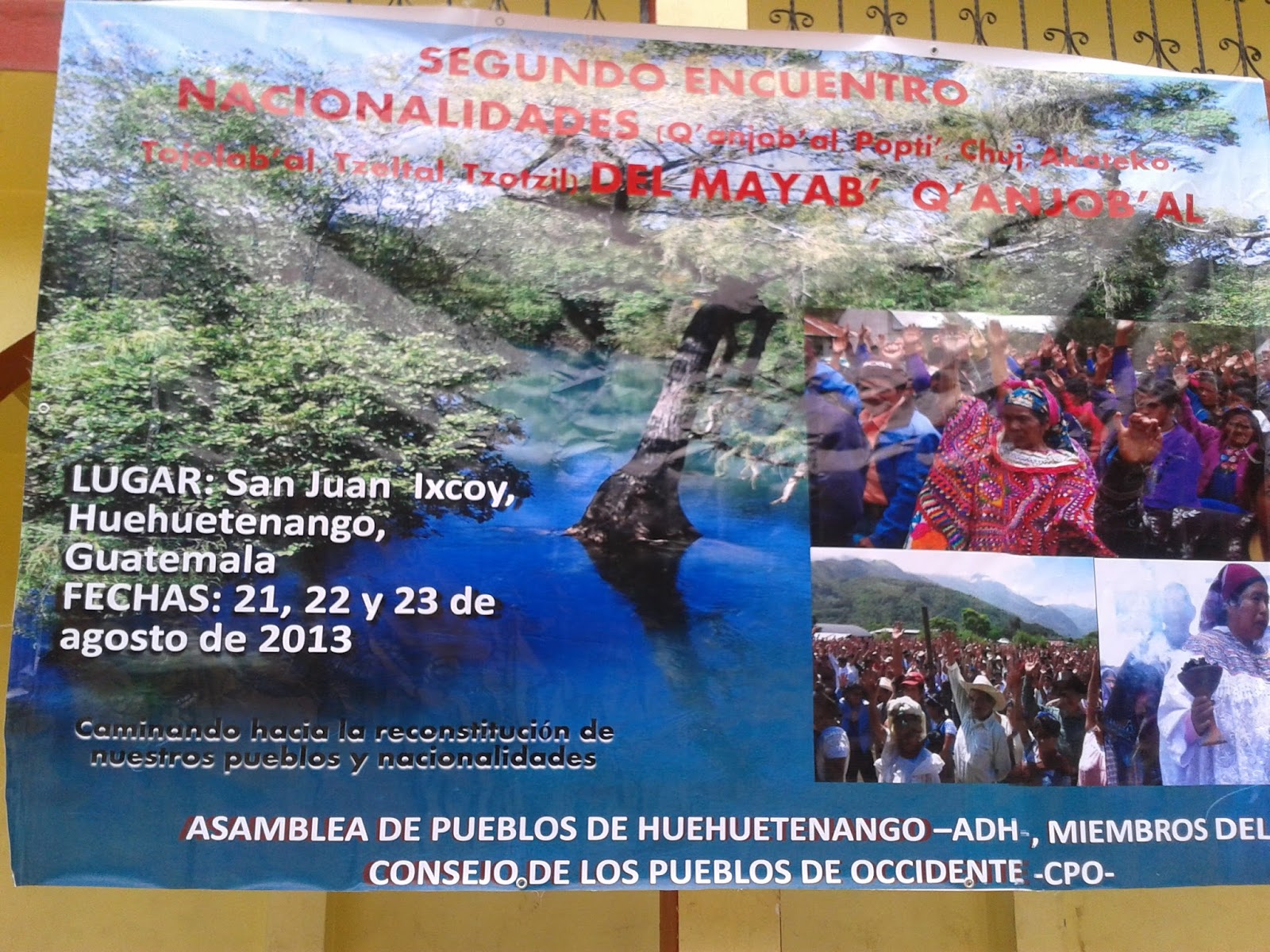
Declaration of the Second Gathering of the Q'anjob'al Nationalities


On August 21 – 23, leaders and representatives of twenty Maya Q'anjob'al communities in northern Huehuetenango and Chiapas, Mexico, gathered in San Juan Ixcoy, Huehuetenango to discuss the ongoing imposition of large-scale development projects on their territory and to continue generating strategies for unified resistance moving forward. The three day, cross-border event focused on the reconstitution and autonomy of the Q'anjob'al peoples through the strengthening of the cultural, social, economic and political ties that have historically linked indigenous communities in the border zone between Guatemala and Mexico.

In welcoming the community representatives Francisco Mateo Morales of the Departmental Assembly of Huehuetenango (ADH) explained the essence of the cross-border gathering: “Before we were divided and dispersed in towns, municipalities and countries, we were one, united people. Now our border communities are threatened by the same mega-projects – a new invasion armed with the discourse of false development. We are gathered here to continue the dialogue in order to construct new initiatives, new paths and alternatives for development.”

The gathering reiterated the legitimacy of the community consultation as an expression of cultural and political identity, and as an important tool by which indigenous peoples exercise their nationally and intentionally recognized right to free, prior and informed consent. In 2006 the Huehuetenango communities of Concepción Huista and Santa Eulalia were the first to carry out community consultations. In 2009, eight municipalities located in northern Huehuetenango, together with the Departmental Assembly of Huehuetenango and the Western Peoples' Council (CPO), were the first to declare their territory “free of mining and mega-projects”.


DECLARATION OF THE SECOND GATHERING OF THE Q'ANJOB'AL NATIONALITIES

We are decedents of the Maya Civilization, gathered together at the start of the New Era Jun Tun, Jun Katún, Jun B’aktunes, on the days Oxlajon Watan, Jun K'ana' y Kab' Ab'ak, in the place known as Oyeb’ Tx’o’ Konob’, at the foot of the Sacred Place Kab'tz’in, in Q'anjob'al territory, known today as the Municipality of San Juan Ixcoy. The leaders of Yalimox, Jolom konob', Oyeb Tx’o’ Konob’, Tz'unun Ha', Wajxaklajunh, Yaxb'atz', Hakatan, Tajlaq, Xajlaj, Concepción Huista, San Atonio Huista, Santa Ana Huista, Tila, San Juan Cancuc, Ixtapa Nibak, Las Margaritas, La Trinitaria, Ch'enalvo, San Cristóbal Jovel, Chanja' nationalities of the Q'anjob'al, Chuj, Akateka, Popti', Chol, Tojolab'al, Tzeltal y Tzotzil nation, come together at the Second Gathering of the Mayab' Q'anjob'al Nationalities to share our smiles, happiness and congratulations, and to unite our thoughts, ideas and words with strength and cosmic energy.

Despite the force with which the new invasion attempts to once again plunder our territory, our peoples have jointly worked to strengthen our political, social, economic, cultural and environmental struggles in order to continue our path toward the reconstitution of our nationality according to our cosmovision inherited from our ancestors.

Conscious of the role we play today before our families, our communities, our peoples, and the world, in this Second Encounter of the Mayab' Q'anjob'al Nationalities:

WE DECLARE:

Since the date of the First Gathering until today, the Nation States have increased the handing over of the natural resources of our territories to transnational companies and corporations. At the same time, the States have increased their servility in favor of the above-mentioned companies and corporations by militarizing communities. The justice system functions in support of mega-projects and the the States' public policies work in collaboration with business interests, resulting in the flagrant violation of our nationally and internationally recognized individual and collective rights.

The elements, natural resources and assets that exist in our territories are our treasure, our wealth and our invaluable ancestral inheritance, and it is up to us to administer these resources according to our cosmovision. Decisions regarding the administration of these resources belong to the original peoples, and not the government nor the companies. The governments and the companies only provoke conflict, pain, fear, anguish, persecution, imprisonment, abduction, torture and assassinations in our territories.

We reiterate our commitment to continue defending our mother earth, the sacred corn, the water, the forests, the mountains, our families, our communities and our people, making use of our own values, principles and ancestral practices with the firm conviction to maintain governability, strengthen democracy and to continue strengthening the unity of the Q'anjob'al nationalities. We will also base this effort on national and international legislation.

The Patq'um, the Q'umlb'ail, the Lajti', among others, are our peoples' social political systems based on our own consmovision through which we continue to practice the construction of consensus, agreements and actions in order to strengthen the Q'anjob'al nationalities.

We resume and strengthen political, economic, social and cultural exchange between our peoples, overcoming the obstacles of the administrative and political limits imposed by the States. We commit to continue working to re-establish the ancestral autonomy of our Q'anjob'al nationalities and not allow our small differences to convert into obstacles, but rather to recognize our diversity as our cultural wealth.

The Nationalities of the Q'anjob'al People are not represented by the Guatemalan or Mexican states; that is to say, we are a Nation without a State. Therefore, we will tirelessly fight with other nationalities of Maya descent for the construction of Plurinational States in order to no longer be a Q'anjob'al Nation without a State.

Oyeb Tx’o’ Konob’, Kab’ Ab’ak.
San Juan Ixcoy, August 23, 2013

Declaración del segundo encuentro de las nacionalidades Q'anjob'al

Durante el 21 - 23 de agosto, representantes de 20 comunidades Maya Q'anjob'al del norte de Huehuetenango y Chiapas, México se reunieron en San Juan Ixcoy, Huehuetenango para el Segundo Encuentro de las Nacionalidades Q'anjob'al. Los participantes discutieron la imposición de proyectos de desarrollo en sus territorios y estrategias para seguir adelante con una resistencia unida. El encuentro resaltó las consultas comunitarias como una expresión legitima de su identidad cultural y política.


En 2006, las comunidades de Concepción Huista y Santa Eulalia en el departamento de Huehuetenango se realizaron unos de los primeras consultas comunitarios. En 2009, 8 municipios en el norte de Huehuetenango, junto con la Asamblea de Pueblos de Huehuetenango por la Defensa del Territorio y el Consejo de Pueblos de Occidente, se declararon "libres de minería y de megaproyectos".


DECLARACIÓN DEL SEGUNDO ENCUENTRO DE LAS NACIONALIDADES Q'ANJOB'AL

Nosotras y nosotros descendientes de la Civilización Maya, en el inicio de la Nueva Era Jun Tun, Jun Katún, Jun B’aktunes, reunidos los días Oxlajon Watan, Jun K'ana' y Kab' Ab'ak, en el lugar denominado Oyeb’ Tx’o’ Konob’, al pie del Lugar Sagrado Kab'tz’in, del territorio Q'anjob'al, conocido hoy como Municipio de San Juan Ixcoy, lideresas y líderes de Yalimox, Jolom konob', Oyeb Tx’o’ Konob’, Tz'unun Ha', Wajxaklajunh, Yaxb'atz', Hakatan, Tajlaq, Xajlaj, Concepción Huista, San Atonio Huista, Santa Ana Huista, Tila, San Juan Cancuc, Ixtapa Nibak, Las Margaritas, La Trinitaria, Ch'enalvo, San Cristóbal Jovel, Chanja'; de las nacionalidades Q'anjob'al, Chuj, Akateka, Popti', Chol, Tojolab'al, Tzeltal y Tzotzil, de la Nación Q'anjob'al, venimos a compartir, nuestras sonrisas, alegrías y felicidades; a unir nuestros pensamientos ideas y palabras, con la fuerza y energía cósmica en el Segundo Encuentro de las Nacionalidades del Mayab’ Q'anjob'al.

A pesar de la fuerza con que la nueva invasión pretende saquear otra vez nuestro territorio, nuestros pueblos, de manera conjunta hemos fortalecido nuestras luchas en lo político, social, económico, cultural y ambiental, para seguir caminando hacia la reconstitución de nuestra nacionalidad conforme a nuestra Cosmovisión, heredada de nuestros ancestros.

Conscientes del rol que hoy jugamos ante nuestras familias, nuestras comunidades, nuestros pueblos, y ante el mundo, en este Segundo Encuentro de las Nacionalidades del Mayab’ Q'anjob'al:

DECLARAMOS:
Que del Primer Encuentro a la fecha, los Estados Nacionales han incrementado la entrega de los bienes de nuestro territorio a las empresas y corporaciones transnacionales. A su vez, los Estados han incrementado el servilismo a favor de las mencionadas empresas y corporaciones, militarizando las comunidades; el sistema de justicia actúa en apoya a los megaproyectos, las políticas públicas de los Estados se elaboran en congruencia con los intereses empresariales, violando de esta manera flagrantemente nuestros derechos individuales y colectivos, reconocidos por las legislaciones nacionales e internacionales.

Los elementos, recursos y bienes naturales existentes en nuestros territorios, son nuestro tesoro, nuestra riqueza y herencia ancestral invaluable y nos corresponde administrarlos de acuerdo a nuestra cosmovisión. Las decisiones para su administración corresponden a los pueblos originarios y no de los gobiernos ni las empresas. Los gobiernos y las empresas solamente han provocado conflictividades, dolor, miedo, angustia, persecución, encarcelamiento, secuestro, tortura y asesinato en nuestros territorios.

Reiteramos nuestro compromiso en seguir defendiendo nuestra madre tierra, el sagrado maíz, el agua, los bosques, las montañas, nuestras familias, nuestras comunidades, nuestros pueblos, haciendo uso de nuestros propios valores, principios y prácticas ancestrales, con la firme convicción de mantener la gobernabilidad, fortalecimiento de la democracia y seguir fortaleciendo la unidad de las nacionalidades Q'anjob'al, basándonos también en las legislaciones nacionales e internacionales.

El Patq'um, el Q'umlb'ail, el Lajti', entre otros, son sistemas sociopolíticos propios de nuestros pueblos desde nuestra propia cosmovisión, los que seguiremos practicando, construyendo consensos, acuerdos y acciones en el fortalecimiento de las nacionalidades Q'anjob'al.

Retomar y fortalecer el intercambio político, económico, social y cultural entre nuestros pueblos, sin que sean un obstáculo los límites administrativos y políticos impuestos por los Estados. Por lo que nos comprometemos a seguir trabajando para restablecer la autonomía ancestral de nuestras nacionalidades Q'anjob'al, sin que se constituyan como obstáculo nuestras pequeñas diferencias, por el contrario, nuestra diversidad es nuestra riqueza cultural.

Las Nacionalidades del Pueblo Q’anjob’al no están representadas ni en el Estado guatemalteco ni en el Estado mexicano, es decir, somos una Nación sin Estado, por lo tanto, lucharemos incansablemente con las otras nacionalidades de ascendencia Maya para la construcción de Estados Plurinacionales para dejar de ser Nación Q’anjob’al sin Estado.

Oyeb Tx’o’ Konob’, Kab’ Ab’ak
San Juan Ixcoy, 23 de agosto de 2013

Thursday, July 11, 2013

Indigenous organizations denounce proposed mining moratorium

In a televised program broadcast from outside Tahoe Resources’ conflictive Escobal mine project, President Otto Pérez Molina announced a proposed two-year moratorium on the granting of new mineral mining licenses. A similar moratorium put in place under the Colom presidency was lifted under the Molina administration, allowing for the issuance of roughly 100 exploration and exploitation licenses during the last year and a half. The President and Minister of Energy and Mines, Erick Archila, took care in assuring the public and Tahoe executives in particular, that the decision would not impact the Escobal project, approved for mineral exploitation in April of 2013.

He also explained that the purpose of the moratorium is to allow the government to pass reforms to the 1997 Mining Law. In a groundbreaking legal action filed in July 2012, this same law was denounced by the Western Peoples Council (CPO) as unconstitutional, as it fails to fulfill national and international mandates that require the State to consult with indigenous people regarding policies that will significantly impact their territories. In March, 2013, more than eight months after the action was filed, Guatemala's highest court upheld the Mining Law, rejecting the CPO appeal.

Indigenous and campesino organizations denounced the latest moratorium as a political show intended to calm widespread resistance to harmful mining projects, while pushing through reforms that do nothing to address the real issues including the lack of respect for communities' right to consultation on projects that impact their lives, livelihoods and territories.

Read NISGUA's translation of the declaration from the Western Peoples' Council and the Departmental Assembly of Huehuetenango below. See the original Spanish version here

THE ORIGINAL PEOPLES HAVE NEVER ASKED FOR A MORATORIUM; A DEMOCRATIC PRESIDENT SHOULD BE CONSISTENT WITH THE RESULTS OF THE GOOD FAITH COMMUNITY CONSULTATIONS

The announcement of the President of the Republic of Guatemala to present a law initiative to the Congress of the Republic to decree “a two year moratorium on the granting of additional licenses for mineral mining” in the country, while starting the debate for a new Mining Law in the legislative branch, is neither novel nor substantive for the Original Peoples of Guatemala. The current president’s predecessor, Mr. Alvaro Colom Caballeros, had already put this into practice.

To bring back a moratorium on the granting of mining licenses is more evidence of the hasty and improvised attitude of the current government in lifting the moratorium previously in place.

Furthermore, after the Original Peoples presented a legal action of unconstitutionality against the current Mining Law, the Executive Branch carried out two desperate actions: a) the suspension of the moratorium put in place by the previous president, and b) the presentation of a new initiative to reform the Mining Law.

The suspension of the first moratorium brought the massive granting of un-consulted licenses for mining in indigenous territories, while the Mining Law reform initiative demonstrates the lack of patriotic interest in protecting national sovereignty. This Machiavellian initiative makes clear that the  recently announced proposed moratorium would be repealed in the case of reforms to Mining Law Decree 48-97, or if a new law is created.

The moratorium law initiative - “suspension of the granting of licenses” - will not immediately go into effect as it must be read in the plenary, sent to the Commission of Energy and Mines for analysis and then sent back to Congress for discussion.

This initiative is a “smoke screen and a total show” that seeks to placate community resistance and conflicts as a result of the imposition of the mining model in the country. This proposal is contradictory because during the last year and a half the Executive has granted roughly 100 mineral mining licenses.

The people have not asked for a moratorium on community consultations; the people have demanded that the government respect the decisions of the good-faith community consultations that have overwhelmingly rejected this model of death disguised as mining activity.

Guatemala does not need to plunder the country in order to generate its own development. Mining activity is not the only alternative nor is it a priority for an integral development model.

Huehuetenango, July 2013

DEPARTMENTAL ASSEMBLY OF HUEHUETENANGO  -ADH-
MEMBERS OF THE WESTERN PEOPLES' COUNCIL  -CPO- 


Friday, May 31, 2013

Rubén Herrera Released from Prison!


Rubén Herrera and Cecilia Mérida moments after Rubén was liberated.
Yesterday, Rubén Herrera, unjustly imprisoned since March 15 for his resistance to the Cambalam hydro-electric project, was released from custody and cleared of all charges in one of two legal processes against him. The second process (176-2011) dating back to 2009, was provisionally closed at the request of the Public Prosecutor's office. Judge Miguel Gálvez of Guatemala City's High Risk Court “B” agreed with the prosecutor's assessment that the evidence against Herrera was imprecise and contradictory, and granted the prosecution a six month time frame to build a better case or present closing arguments. 

Beginning with Herrera's first hearing in Santa Eulalia, Huehuetenango, the Public Prosecutor's office has maintained that the case lacks evidence linking Herrera to the crimes. Despite these arguments the presiding judge in Santa Eulalia, at the request of co-plaintiffs Ecoener Hidralia Energía/Hidro Santa Cruz S.A, ordered the case forward. 

At the beginning of trial proceedings on Thursday, the Public Prosecutor reiterated its request to provisionally close both cases against Rubén Herrera citing a lack of evidence linking him to the accusations. What followed was an unusual scene, during which the lawyers at the prosecution table argued against each other. Lawyers for co-plaintiff Hidro Santa Cruz denounced the Public Prosecutor's “surprising” request and “passive attitude”, and requested that Judge Gálvez proceed to trial. Joining the Hidro Santa Cruz's legal team was a familiar face from the genocide trial, César Calderón, defense attorney for former director of military intelligence José Mauricio Rodríguez Sánchez. 

During the three hours that followed, the defense team representing Herrera argued the two separate cases, demonstrating both the political nature of the charges, the questionable behavior of representatives of the judicial system in Santa Eulalia, and the lack of concrete evidence against Herrera. 

In the 2012 case (65-2012), Judge Gálvez dismissed the charges outright. The case was permanently closed citing the fact that none of the testimonies provided by witnesses and victims in the case file even mention Rubén Herrera. In the 2009 case, Gálvez upheld the request from the Public Prosecutor to provisionally close the case stating that the accusations and arrest warrant were based on “two or three flimsy declarations”. Throughout the hearing, Judge Gálvez referenced his belief that social conflict in Barillas is the result of a lack of respect for international law protecting communities' right to consultation. 

In response to the provisional closure of the 2009 case, Cecilia Mérida, Rubén's life partner, stated that it will allow them more time to continue to disprove the allegations against Rubén; and more time to prove that he has been falsely accused by the company in order to undermine popular resistance to the hydro-electric project. Throughout the duration of his imprisonment, Herrera, Mérida and the Departmental Assembly of Huehuetenango (ADH) have continued their struggle in defense of territory in the face of rising repression and criminalization. Rubén declared soon after his release: "In prison I learned that it doesn't matter where you are, you can continue to fight.”

While the 2012 case against Rubén is closed, three of the 11 men unjustly imprisoned for eight months for their peaceful resistance to the Cambalam project continue to be linked to the same the May 1, 2012 incident and continue to await the permanent closure of their case. Likewise, 20 additional individuals still have arrest warrants pending against them related to the same event. 

Dozens of supporters packed the courtroom yesterday in support of Rubén and the struggle for communities' right to self determination. More than 2,800 people from the international community demonstrated their solidarity by signing the petition demanding Rubén's release and the end to persecution of community leaders, which was delivered to Guatemalan authorities last week

Supporters filled the seats and lined the aisles in support of Rubén.
The role of international solidarity continues to be important for the individuals, communities and organizations defending the right to consultation, particularly as criminalization of peaceful protest continues to intensify in Guatemala. In the words of the ADH: “In a very special way, we want to thank the show of solidarity with our cause. We are confident that this solidarity encourages and strengthens us to continue fighting.”


 NISGUA works closely with the Departmental Assembly of Huehuetenango (ADH) in their efforts to promote self-determination and alternative visions of development in the highland department of Huehuetenango. The ADH receives international human rights accompaniment from NISGUA through the ACOGUATE project and participated in NISGUA's 2010 tour.

Thursday, May 23, 2013

International community calls for Rubén Herrera's immediate release

More than one year after President Molina declared a state of siege in Santa Cruz de Barillas, repression continues against community leaders resisting the Cambalam hydroelectric project, operated by Spanish owned Hidro Santa Cruz. Violence and criminalization against leaders defending territory and the right to self determination has been on the rise in Barillas since the 2007 community consultation rejecting large-scale development projects in their territory.   

Since March, NISGUA has reported on the detention of Rubén Herrera, community leader and member of the Departmental Assembly of Huehuetenango for the Defense of Natural Resources (ADH). Herrera has been unjustly imprisoned for more than two months on trumped up charges related to resistance to the Cambalam project. Despite requests by Guatemala's Public Prosecutor to dismiss the case due to a lack of evidence, the judge ordered the case forward.

In response, NISGUA together with the Guatemala Human Rights Commission, gathered more than 2,800 signatures from 52 countries demanding Rubén's immediate release and an end to the criminalization of human rights defenders.  
Rubén Herrera, unjustly imprisoned since March 15
The signatures were delivered to Guatemala's Public Prosecutor's office in anticipation of  Rubén's May 30 pre-trial hearing. Originally slated to be heard in Santa Eulalia, Huehuetenango, Rubén's hearing was recently transferred to Guatemala City.

“The decision of the Supreme Court to transfer Rubén Herrera's case to Guatemala City is a favorable resolution because it is an opportunity for the case to be heard in a specialized court, which gives us greater confidence that the false accusations presented by the Hidro Santa Cruz will be disproven,” stated Alba Cecilia Mérida, Herrera's life partner and human rights activist. “It means that Rubén will have a greater possibility of due process in the application of justice.”

May 1 march in Huehuetenango: "No More Repression, Liberty for Rubén Herrera"
In April, the persecution of leaders resisting the Cambalam project continued with the kidnapping and murder of Daniel Pedro Mateo, cultural leader and prominent defender of the 2007 community consultation in Barillas. Community members from eight municipalities in northern Huehuetenango mobilized during three days in order to locate Pedro Mateo's remains.

Just a few weeks later, terror once again gripped residents of Barillas when community leader Mynor López was detained by plain clothed men, later determined to be police officers, and forced into an unmarked vehicle. Some residents, believing López was being abducted, mobilized to ensure his release. In response anti-riot police already in the community fired at the crowd with tear gas. In a press release, the ADH denounced the irregular detention of Mynor López as well as the ongoing criminalization of leaders.

The state's pattern of systematic criminalization and persecution of community leaders defending territory was demonstrated again in early April when President Molina implemented of another state of siege in four municipalities surrounding Tahoe Resources' Escobal project, located in San Rafael Las Flores, Santa Rosa. As in Barillas, leaders demanding the right to consultation have been targeted; 12 members of the committee organizing community referenda in San Rafael Las Flores had their homes raided and searched during the weeks long state of siege.

"Instead of listening to the legitimate demands of the people, the state and the companies have implemented a strategy to discredit and delegitimize peaceful community struggles in defense of life and territory," said Francisco Rocael Mateo of the ADH. "This criminalization is a strategy to demobilize community resistance."

Read NISGUA's full press release in English and Spanish.


NISGUA works closely with the Departmental Assembly of Huehuetenango (ADH) in their efforts to promote self-determination and alternative visions of development in the highland department of Huehuetenango. The ADH receives international human rights accompaniment from NISGUA through the ACOGUATE project and participated in NISGUA's 2010 tour.