Showing posts with label consultas comunitarias. Show all posts

Monday, September 8, 2014

Communities in Santa Rosa and Jalapa launch campaign to halt Tahoe Resources' expansion


"Water and life are worth more than silver or gold. You are intelligent, don't let them fool you." Community organized billboard campaign in Santa Rosa and Jalapa. Photo NISGUA

In February 2013, the community of San Juan Bosco, located just 8 miles from Tahoe Resources' massive Escobal silver mine, held a referendum in which 99% of people voted against mining. Local residents were not just concerned about impacts of the Escobal mine on their water and crops, but about another Tahoe exploration license, Juan Bosco, which is located, as the name suggests, right on top of the small farming community. Now, nine months after Tahoe announced a start to operations at Escobal, the Environmental Impact Assessment for the Juan Bosco license has been published for public comment, indicating an important step forward in the granting of the exploitation permit.

In an ongoing attempt to make their voices heard, communities of Santa Rosa and Jalapa announced last Monday the launch of a campaign to halt Tahoe's expansion. The company's plans to exploit at least 12 mineral veins in an area covering 2,398 square kilometers are moving swiftly ahead despite community opposition and more than a dozen referenda in which more than 53,000 people in six municipalities voted against mining in their territory. See the full press release from communities below.

Residents of Mataquescuintla map Tahoe mining licenses compared to the location of communities, local water sources and forests. Photo NISGUA
Tahoe's decision to move forward with the Juan Bosco license was met with concern and frustration by local residents. At a press conference in Guatemala City on September 1, one resident commented, “In San Juan Bosco we feel indignant because we already had our referenda. We are a community that depends on agriculture and this mine threatens our water. That is why we continue to oppose these projects.”

Likewise, representatives from 10 communities, including three Xinca indigenous communities impacted by Tahoe's expansion plans in the departments of Santa Rosa and Jalapa, expressed concern that neither Tahoe, nor the Guatemalan government respect their right to consultation and self-determination. They also denounced local mayors who are accepting mining royalties against the will of the people.

A representative from the municipality of Santa Rosa de Lima, where in 2012, more than 98% of the population voted against Tahoe Resources' Escobal mine explained: “Our mayor, and others in the region, accepted the royalties – but the money is only serving to line their own pockets... We demand that the government and the company respect our referendum. We may be farmers but we still deserve rights. The constitution applies to everyone.” A representative from San Juan Bosco, in the municipality of San Rafael las Flores where the mine is located agreed: “We haven't seen development. All we have seen are increased conflicts.”

Community representatives also addressed Tahoe Resources' statements contending that the company has social support for the project and that it consulted with local communities, stating “The company says that they consulted with us and that is a lie. What the company does is gather signatures by deceiving people and take advantage of their poverty. The company offers trees or fertilizer and so people give their signatures and ID number. That's not a real consultation.” 

A leader from the Xinca community of Jumaytepeque questioned the discourse of the government and the multinational companies stating, “When they come and tell us that mining brings development, I have to ask, 'then why are we in the same situation, or worse off, than we were 10 years ago?' Every day more and more people are living in poverty. And people living near the mines are faced with health problems they never had before.”

--------------------------------------------------------------------------------------------------------------
Press Release: Communities of Santa Rosa and Jalapa Organized in Defense of Territory and Nature 


Since 2012, we have held citizen requested municipal referendums, in which more than 53,000 residents have manifested, through the legitimate exercise of our rights as citizens, that WE DO NOT AGREE with chemical mineral mining in any part of our territory. According to the Constitutional Court, these consultations have been declared constitutionally legal and binding at the municipal level.

Despite the clear rejection of chemical mining of metals in our territory, and with the complicity of the [Guatemalan] government, the company, Minera San Rafael, continues actions focused on entering our municipalities through underhanded measures, knowing full well  that the only thing they achieve is the generation of increased conflict, while disturbing the peace and community tranquillity. Clear proof of this is the granting of the exploration licenses named Juan Bosco and Andres during the first quarter of 2012. These licenses affect municipalities located in [the departments of] Santa Rosa, Jalapa and Guatemala. Now, despite the evident opposition of our communities and in a demonstration of disrespect for the clear wishes of the people, the Ministry of the Environment and Natural Resources has published the Environmental Impact Assessment (2014-EIA-4413) for the  Juan Bosco Mine Exploitation License (LEXR-089-08), for public comment. 

According to a presentation and information presented to investors in June in Vancouver, Canada, Tahoe Resources Inc. (owner of the Minera San Rafael, S.A.) plans to exploit at least 12 mineral veins in our territory,  including gold, silver, zinc, etc. [According to Tahoe Resources] an area of 2,498 km2 will be exploited through various licenses, some that have already been obtained, others that are still in process. However, [the company] is selling this project to investors as though it already owns the land, arguing that the current government is pro-mining and that in Guatemala they pay an extremely low tax rate, making it a profitable business opportunity. 

Faced with this grave situation, we have expressed our opposition to the chemical metal mining in our territories through municipal and good-faith community referendums. Today we are launching a campaign that seeks to make clear to the pro-mining and sell-out Guatemalan government, as well as the mining companies and their investors, that our land is not for sale. We have a development model that respects the environment and Mother Earth. For us, water and life are worth more, much more, than silver or gold.

Therefore, on more than 100 km of highway in our municipalities we have placed signs so that those who enter our territories know that more than 98% of residents do not want the chemical mineral mining and that we are in constant peaceful resistance to these projects.

Guatemala, August 2014

NISGUA has accompanied communities in opposition to the Tahoe Resources Escobal mine since 2011.

Thursday, July 31, 2014

Court rules that Guatemala must recognize results of community consultations

In an historic resolution, a Guatemalan Appeals Court ruled last week that the government must take into account the right to free, prior and informed consent when granting mining licenses on the lands of indigenous communities.

The ruling came in response to a legal action presented by the Sipakapense People's Council in March 2014, arguing that the Ministry of Energy and Mines (MEM) failed to consider the results of a 2005 community consultation before granting the "Los Chocoyos" mining license to Entre Mares de Guatemala S.A., a subsidiary of Canadian mining company Goldcorp Inc. The 2005 referendum in Sipakapa overwhelming rejected mega-development projects on their territories, including mining, by a 99% margin.

The Sipakapense People's Council at a press conference after the Constitutional
Court ruled in their favor.
Photo: Consejo del Pueblo Maya


In their ruling, the court cited Convention 169 of the International Labor Organization (ILO 169), which grants indigenous communities the right of consultation before mega-development projects are constructed on their traditional lands. This international convention has been a vital resource for communities in Guatemala organizing in defense of their territories, especially when domestic law and the Guatemalan government has failed to provide legal pathways to reclaim rights to life and territory.

Community members commemorate the 8th
anniversary of the community consultation in Sipakapa, on June 18 2013.
Photo: SaraGuate

Since Guatemala ratified ILO 169 in 1996, legal uncertainty regarding the implementation of rights outlined in the international accord has left its application in a state of ambiguity. In previous rulings, the Constitutional Court established the legality of community consultations, however ruled that due to a lack of regulation regarding their implementation, the results do not have to be respected by state institutions - a tenuous position, as laws regarding the right to community referendum are outlined at the municipal level. This most recent ruling appears to strengthen the domestic standing of ILO 169 by requiring the government to recognize the results of community referendum when considering the allocation of mining licenses, but again stops short of making the results legally binding.

None the less, the court's latest decision represents an important victory for communities organizing in defense of life and territory, providing them with an important legal precedent that can be used in future court cases to compel the government to recognize the collective rights of indigenous peoples as well as their traditional forms of organization and representation.

The hillsides of Sipakapa, in north-western Guatemala.
Photo: James Rodríguez, mimundo.org


In accordance with the Constitutional Court's ruling, the results of the 2005 referendum will be handed over to MEM to be taken into account in their re-evaluation of the Los Chocoyos mining license, a process which the Ministry has six months to complete. The court has additionally ordered that MEM factor Guatemala's obligations as a signatory to ILO 169 into their consideration.

According to the Sipakapense People's Council, the implications of these rulings can only mean that the Los Chocoyos mining license is illegal and void, and as such all mining activity on Sipakapense territory must be immediately halted. To read the statement released by the Sipakapenses People's Council regarding the Constitutional Court's ruling, click here (in Spanish).

Tuesday, October 1, 2013

Comunicado denunciando agresiones en el Norte de Huehuetenango

A LA COMUNIDAD NACIONAL E INTERNACIONAL EXPRESAMOS:

La agresión actual a los pueblos Q’anjob’al, Akateko, Chuj y mestizo de la Región Norte del departamento de Huehuetenango, de parte del Presidente y comandante en Jefe del Ejército Nacional, General Otto Fernando Pérez Molina, quien en conferencia de prensa resaltó la importancia rica de los recursos hídricos, minerales, petrolero y forestales. Estas agresiones, son parte del nuevo proceso de invasión transnacional tutelado por los gobiernos que se turnan en el poder e implantan proyectos de saqueo en nombre de un Falso Desarrollo. Estas acciones, se enmarcan dentro de una estrategia de carácter contrainsurgente que hacen recordar y revivir el conflicto armado interno de los años ochenta, donde los militares orquestaban planes de agresión y violentaban derechos humanos fundamentales de la sociedad civil; los días 28, 29 y 30 de septiembre del presente año, han usado helicópteros a vuelo rasante, vehículos artillados, tropas del ejército y elementos de fuerzas especiales de la Policía Nacional Civil, para aterrorizar a la población. Toda la estrategia de invasión ha utilizado desproporcionadamente a los elementos policiales y militares con características de estado de Guerra, en la cual se ha ocasionado la muerte de ciudadanos y varios heridos; ésta, es una responsabilidad imperdonable del Estado. Estas conductas represivas y terroristas, pretenden paralizar las luchas pacíficas y legítimas en defensa del territorio de los pueblos. Las licencias han sido otorgadas a las empresas en territorios donde existimos, vivimos y que hemos cuidado por miles de años.y no permitiremos que nos destruyan.

POR LO TANTO: Hacemos un llamado a la comunidad nacional e internacional para que se pronuncie y se solidarice con los pueblos que conviven en Guatemala. Mantendremos una vigilancia y observancia permanente de los derechos humanos y derechos colectivos de los pueblos, porque los ataques continúan en contra de la población civil de Barillas.

EXIGIMOS:
1. Al Gobierno y sus Ministros que respeten los derechos humanos y colectivos de los pueblos así como dejar de mentir y confundir a la comunidad nacional e internacional.
2. El retiro de todas las tropas del ejército y fuerzas especiales de la PNC del Norte de Huehuetenango, garantizando la protección de los derechos humanos y no al servicio de las empresas transnacionales.
3. La cancelación de las licencias mineras, hidroeléctricas, petroleras y otros mega-proyectos otorgados en el departamento, que son las causas del socavamiento de la paz y la libertad de los pueblos.
4. El respeto a las consultas comunitarias expresadas desde el año 2,006 hasta la fecha.

LOS PUEBLOS Q'ANJOB'AL, CHUJ, AKATEKO Y MESTIZO HAN CUIDADO HISTORICAMENTE EL TERRITORIO PARA QUE TODOS Y LAS FUTURAS GENERACIONES. LOS PUEBLOS SOLO QUEREMOS QUE NOS TRATEN COMO PERSONAS Y QUE NOS DEJEN VIVIR EN PAZ Y EN ARMONÍA CON LA MADRE NATURALEZA.

ASAMBLEA DEPARTAMENTAL DE LOS PUEBLOS DE HUEHUETENANGO ADH. MIEMBROS DEL CONSEJO DE LOS PUEBLOS DE OCCIDENTE, CPO.

Huehuetenango, 30 de Septiembre del año 2,013.

Wednesday, August 28, 2013

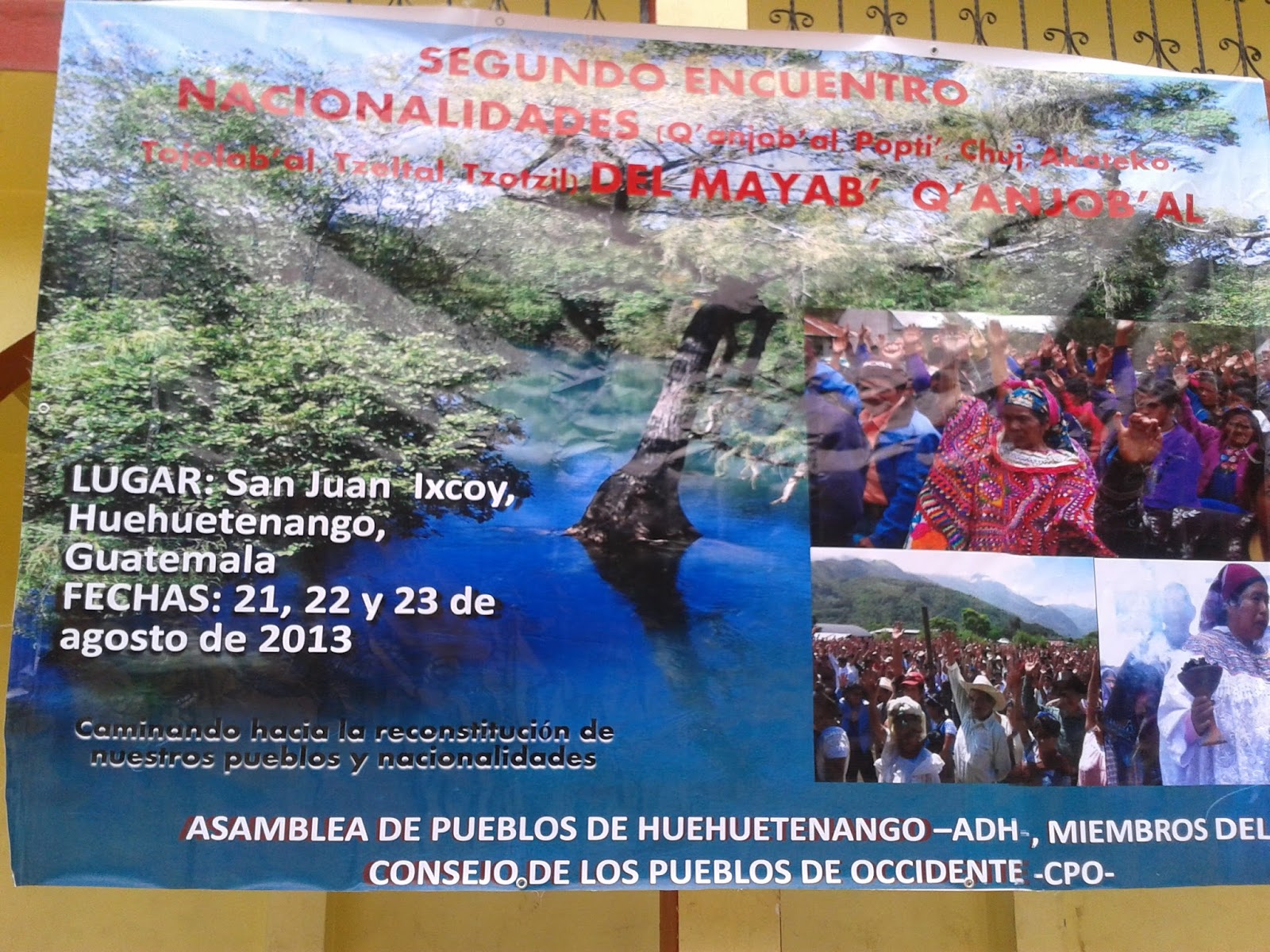
Declaración del segundo encuentro de las nacionalidades Q'anjob'al

Durante el 21 - 23 de agosto, representantes de 20 comunidades Maya Q'anjob'al del norte de Huehuetenango y Chiapas, México se reunieron en San Juan Ixcoy, Huehuetenango para el Segundo Encuentro de las Nacionalidades Q'anjob'al. Los participantes discutieron la imposición de proyectos de desarrollo en sus territorios y estrategias para seguir adelante con una resistencia unida. El encuentro resaltó las consultas comunitarias como una expresión legitima de su identidad cultural y política.


En 2006, las comunidades de Concepción Huista y Santa Eulalia en el departamento de Huehuetenango se realizaron unos de los primeras consultas comunitarios. En 2009, 8 municipios en el norte de Huehuetenango, junto con la Asamblea de Pueblos de Huehuetenango por la Defensa del Territorio y el Consejo de Pueblos de Occidente, se declararon "libres de minería y de megaproyectos".


DECLARACIÓN DEL SEGUNDO ENCUENTRO DE LAS NACIONALIDADES Q'ANJOB'AL

Nosotras y nosotros descendientes de la Civilización Maya, en el inicio de la Nueva Era Jun Tun, Jun Katún, Jun B’aktunes, reunidos los días Oxlajon Watan, Jun K'ana' y Kab' Ab'ak, en el lugar denominado Oyeb’ Tx’o’ Konob’, al pie del Lugar Sagrado Kab'tz’in, del territorio Q'anjob'al, conocido hoy como Municipio de San Juan Ixcoy, lideresas y líderes de Yalimox, Jolom konob', Oyeb Tx’o’ Konob’, Tz'unun Ha', Wajxaklajunh, Yaxb'atz', Hakatan, Tajlaq, Xajlaj, Concepción Huista, San Atonio Huista, Santa Ana Huista, Tila, San Juan Cancuc, Ixtapa Nibak, Las Margaritas, La Trinitaria, Ch'enalvo, San Cristóbal Jovel, Chanja'; de las nacionalidades Q'anjob'al, Chuj, Akateka, Popti', Chol, Tojolab'al, Tzeltal y Tzotzil, de la Nación Q'anjob'al, venimos a compartir, nuestras sonrisas, alegrías y felicidades; a unir nuestros pensamientos ideas y palabras, con la fuerza y energía cósmica en el Segundo Encuentro de las Nacionalidades del Mayab’ Q'anjob'al.

A pesar de la fuerza con que la nueva invasión pretende saquear otra vez nuestro territorio, nuestros pueblos, de manera conjunta hemos fortalecido nuestras luchas en lo político, social, económico, cultural y ambiental, para seguir caminando hacia la reconstitución de nuestra nacionalidad conforme a nuestra Cosmovisión, heredada de nuestros ancestros.

Conscientes del rol que hoy jugamos ante nuestras familias, nuestras comunidades, nuestros pueblos, y ante el mundo, en este Segundo Encuentro de las Nacionalidades del Mayab’ Q'anjob'al:

DECLARAMOS:
Que del Primer Encuentro a la fecha, los Estados Nacionales han incrementado la entrega de los bienes de nuestro territorio a las empresas y corporaciones transnacionales. A su vez, los Estados han incrementado el servilismo a favor de las mencionadas empresas y corporaciones, militarizando las comunidades; el sistema de justicia actúa en apoya a los megaproyectos, las políticas públicas de los Estados se elaboran en congruencia con los intereses empresariales, violando de esta manera flagrantemente nuestros derechos individuales y colectivos, reconocidos por las legislaciones nacionales e internacionales.

Los elementos, recursos y bienes naturales existentes en nuestros territorios, son nuestro tesoro, nuestra riqueza y herencia ancestral invaluable y nos corresponde administrarlos de acuerdo a nuestra cosmovisión. Las decisiones para su administración corresponden a los pueblos originarios y no de los gobiernos ni las empresas. Los gobiernos y las empresas solamente han provocado conflictividades, dolor, miedo, angustia, persecución, encarcelamiento, secuestro, tortura y asesinato en nuestros territorios.

Reiteramos nuestro compromiso en seguir defendiendo nuestra madre tierra, el sagrado maíz, el agua, los bosques, las montañas, nuestras familias, nuestras comunidades, nuestros pueblos, haciendo uso de nuestros propios valores, principios y prácticas ancestrales, con la firme convicción de mantener la gobernabilidad, fortalecimiento de la democracia y seguir fortaleciendo la unidad de las nacionalidades Q'anjob'al, basándonos también en las legislaciones nacionales e internacionales.

El Patq'um, el Q'umlb'ail, el Lajti', entre otros, son sistemas sociopolíticos propios de nuestros pueblos desde nuestra propia cosmovisión, los que seguiremos practicando, construyendo consensos, acuerdos y acciones en el fortalecimiento de las nacionalidades Q'anjob'al.

Retomar y fortalecer el intercambio político, económico, social y cultural entre nuestros pueblos, sin que sean un obstáculo los límites administrativos y políticos impuestos por los Estados. Por lo que nos comprometemos a seguir trabajando para restablecer la autonomía ancestral de nuestras nacionalidades Q'anjob'al, sin que se constituyan como obstáculo nuestras pequeñas diferencias, por el contrario, nuestra diversidad es nuestra riqueza cultural.

Las Nacionalidades del Pueblo Q’anjob’al no están representadas ni en el Estado guatemalteco ni en el Estado mexicano, es decir, somos una Nación sin Estado, por lo tanto, lucharemos incansablemente con las otras nacionalidades de ascendencia Maya para la construcción de Estados Plurinacionales para dejar de ser Nación Q’anjob’al sin Estado.

Oyeb Tx’o’ Konob’, Kab’ Ab’ak
San Juan Ixcoy, 23 de agosto de 2013