Showing posts with label Maya Q'anjob'al. Show all posts

Tuesday, April 14, 2015

Two more human rights defenders from Huehuetenango imprisoned for opposing megaprojects

Since 2011, communities in northern Huehuetenango have organized more than 50 peaceful protests and dozens of community referenda in which they have actively expressed their opposition to the expansion of hydroelectric dams and other megaprojects in their territories.

This demonstration of community strength and self-determination has been met with violence, state repression, criminalization, and re-militarization. Currently, there are seven community activists unjustly imprisoned for their opposition to these projects.

Most recently, on March 24, Rigoberto Juárez and Domingo Baltazar, two Q'anjob'al community leaders with the Plurinational Government of the Q'anjob'al, Chuj, Akateko, Popti' and Mestizo Peoples ("Gobierno Plurinacional") were arrested in Guatemala City. Juárez and Baltazar have joined thousands of others in speaking out against the imposition of hydroelectric dams in their territory despite community consultations rejecting them.

They were arrested on 16 charges including threats, coercion and illegal detention stemming from events that took place in 2013. After having many of their rights to due process violated, including the right to a preliminary hearing within 24 hours of arrest, a judge released them on bail. However, as they were leaving the courthouse, both men were re-arrested on new charges of abduction, kidnapping and inciting crime for events that took place on January 23, 2015. To this date, they remain in prison with no scheduled date for their first hearing - adding to the growing list of violations of speedy due process that have already occurred. 

Rigoberto Juárez awaits his preliminary hearing from a jail cell in
Guatemala City.  Photo credit: J. Abbott
The arrests of Rigoberto Juárez and Domingo Baltazar follow a pattern of criminalization of leaders who have been active in the movements to protect territory against the many threats of resource extraction and other mega-development projects in Guatemala. Leaders continue to face outlandish legal charges – occasionally for events in which they were not even present - in an effort to silence their voices and organizing capacities. As a result, movements are being forced to use much-needed resources to provide legal support to these leaders instead of using them to further strengthen the struggle in defense of life.

In a statement released after the most recent arrests, the Human Rights Convergence - a group of Guatemalan organizations working for social justice and an end to state and corporate impunity - points to a series of other incidences of criminalization that have taken place just in relation to hydroelectric projects in northern Huehuetenango, amongst which are:
  • Rubén Herrera, director of the Departmental Assembly of Huehuetenango (ADH): charged with kidnapping and terrorism related to events that transpired before the government implemented a state of siege in Barillas, in April 2012. After spending months in prison, he was absolved of all charges for lack of proof. Like him, 30 others have had to go through legal processes only to be absolved at the time of formal accusation. 
  • Rogelio Velásquez and Saúl Méndez, community leaders from Barillas: convicted of the murder of a man and woman in their community. In the verdict reached against them in December of last year, in which both men were sentenced to 33 years in prison, the judge argued, "We cannot prove how the woman was killed. But since they [Saúl and Rogelio] are community leaders, they are responsible." This illegal verdict seeks to hold the human rights defenders legally responsible for the activities that occur in their communities. 
  • Sotero Adalberto Villatoro, Francisco Juan Francisco and Arturo Pablo, community leaders from Barillas: indicted in February 2015 for a kidnapping allegedly committed during 2012, even after the Public Prosecutor asked that the charges be dropped for lack of proof. Not only were they indicted on charges, but also ordered to a prison in zone 18 of Guatemala City, taking them out of their community. The judge soon after withdrew from the bench, leaving those indicted without a trial judge to oversee their case and as a result, no date to appeal the indictment.
In addition to these cases and many more in which leaders have been criminalized for their roles within the movements for the defense of life and territory, at least two leaders have been murdered. Daniel Pedro Mateo, an active member within the ADH and a prominent defender of the 2007 community consultation in Barillas, was kidnapped and murdered in April, 2013. On March 27, 2015, the body of Pascual Pablo Francisco was found. He had been missing for three days, and was another prominent figure in the defense of life in Barillas.

In contrast to the disproportionate amount of charges laid against community leaders, the majority of cases of murder, assaults or threats against human rights defenders have failed to advance in the court system and remain in impunity.

In the department of Huehuetenango alone, communities are facing the expansion of the "Northern Corridor/Franja Transversal del Norte" (a mega-highway set to cut across the northern part of Guatemala), three hydroeletric dams (Cambalam of Hidro Santa Cruz in Barillas, Hidro San Luis of CM5 in Santa Eulalia and Ixquisis of the PDH, S.A., in San Mateo Ixtatán) and other possible mineral extraction in the area. In Huehuetenango, 28 of the 32 municipalities have held referenda in which communities have soundly rejected the presence of hydroelectric dams. Despite this clear message, the government continues to push these projects forward and to grant new licenses.

Given this reality, the Human Rights Convergence has called on the Guatemalan government and judicial system to respect due process and immediately halt the criminalization of community leaders. In a statement released in March, the Convergence urged the government to stop granting licenses for hydroelectric dams in the regions, and called on the companies who are already operating in the area to listen to and respect the decisions made by impacted communities.

It states, "The government of Otto Pérez Molina is using this violence to protect personal and corporate interests. The censorship and attacks - including assassinations - of journalists and other grassroots media is only one example. Indigenous communities who carry out referenda are met with racism and repression by government authorities and from company employees seeking to expand into their territories."

To read the full statement made by the Human Rights Convergence in Spanish, click here.

Friday, January 23, 2015

Freedom of expression at serious risk in Guatemala

Today, alternative and grassroots media in Guatemala denounced attacks against Radio Snuq' Jolom Konob', a community radio station in the department of Huehuetenango that regularly transmits voices of the Q'anjob'al people living in and around the municipality of Santa Eulalia. 

The department of Huehuetenango, like many other areas in Guatemala, has been the site of increased social conflict due to the presence of transnational extractive companies. Community radio stations play an important role in promoting access to information and freedom of expression, which are two major constitutional rights that are often violated by the Guatemalan government and transnational companies who obtain exploration and extraction licenses without the free, prior and informed consent of impacted communities. 

Today, members of the Radio Snuq' Jolom Konob' denounced the forced shut down of the radio and other attacks as a violation of freedom of expression and the cultural rights of indigenous communities who depend on the station to transmit radio programming in Q'anjob'al. 

For the original press release in Spanish click here.

January 23, 2015

In Guatemala, physical assaults, false accusations and the prosecution of community journalists is increasing, and the lack of support from the mass media in denouncing these intimidations is creating precarious conditions for the exercise of freedom of expression.

Furthermore, the concentration of the mass media in the hands of a few and their monopolistic practices are putting a crack in democracy.

The realities being faced by community radio stations right now in Guatemala show that the State is not fulfilling its obligation to respect, protect and promote the right to freedom of expression.

Alternative, popular and grassroots media continue to be repressed and attacked. Today, there is the case of Radio Snuq' Jolom Konob', who is transmitting information via radio and the internet from Santa Eulalia, Huehuetenango about the happenings that affect life in the Q'anjob'al municipality of Santa Eulalia.

On January 19, the radio denounced the persecution of community leaders and acts of aggression by the Mayor of Santa Eulalia, Huehuetenango, Diego Marcos Pedro. At dawn on January 20, a group of the Mayor's supporters shut down the radio, cutting off the electricity, and became violent with members of the radio team. All of this was done with the support of the Mayor. 

This hasn't been the first attack that Mr. Diego Marcos Pedro conducted against Radio Snuq' Jolom Konob'. In September, 2014, he shut down the building and suspended the electricity because the station was transmitting an event run by the community authorities in Santa Eulalia. Due to pressure from communities, he had to reinstate the electricity to the radio; there are already official complaints registered with the Public Prosecutor's Office under Crimes Against Journalists. In many cases, however, due to the criminalization of community journalists and the stigmatization against them, often these complaints are not followed through. 

It is both urgent and necessary to begin and expand a debate around exercising the rights to freedom of expression, as this right and privilege doesn't only extend to the mass media. 

In light of these threats and acts of aggression against our fellow journalists, reporters and member of the community press: 
  1. We demand: an end to the acts of aggression against community press, reporters and journalists. The act of filing criminal charges, the laws that criminalize the work of citizen journalists, the closing of radios and physical aggressions committed against journalists all constitute a policy of repression against freedom of expression.
  2. We ask: that Congress approves legislation that recognizes alternative and community media.
  3. We need: the Unit for Crimes Against Journalists to be strengthened in the Public Prosecutor's Office, as part of a general social need to strengthen the judicial system in the country.
  4. We demand: the Government of Guatemala provide clear reports on the advancements in the Program for the Protection of Journalists - an initiative offered by the Government since November 2013.
  5. We ask: the Human Right's Ombudsman to pay special attention to what is happening in the interior of the country, where community media are being intimidated by powerful local actors bent on ensuring they cannot fulfill their roles as information providers.
  6. We invite: fellow journalists to be responsible, committed and truthful in carrying out our work to provide the country with information, as democracy rests in our voices and our words.

Radio Comunitaria Snuq' Jolom Konob', Prensa Comunitaria, Red Tz'ikin, DEMOS, CEPPAS GT, AGHS, CERIGUA, Asociacion Sobrevivencia Cultura, Asociacion Mujb'ab'lyol, Asociacion de Radios Comunitarias Guatemala, Asociacion Luciernaga, Centro Civitas, Red Mesoamericana, OPAL Prensa, El Salmon, and Plaza Publica

Wednesday, March 5, 2014

ADH expresses solidarity with Santa Cruz Barillas political prisoners

We demand liberty for our leaders; they have not committed crimes
Photo: ADH

Departmental Assembly of Huehuetenango Communiqué in Solidarity with the Civil Society Movement of Santa Cruz Barillas

Today, March 4, 2014, we attended two hearings in which the cases would be presented of six leaders from Santa Cruz Barillas who are persecuted by Guatemalan injustice and Hidro Santa Cruz. We accompany the men and women who have dedicated themselves to their cause, our cause. The hearings were suspended, but that doesn’t mean that our presence or our voice is not useful. Saúl Méndez, Rogelio Velásquez, Adalberto “Don Tello” Villatoro, Francisco “Chico Palas” Juan, Arturo Pablo and Diego Marcos are each accused of different crimes by the Spanish company Hidro Cruz. The orchestrated “legal” cases form part of a strategy of criminalization in order to undermine the defense of territory.

The persecution, criminalization and repression carried out by Otto Pérez Molina’s military government and the Guatemalan state aim to minimize or put an end to the opposition to the implementation of mining exploitation projects, like in the cases of the resistances at San José del Golfo, San Rafael las Flores or in other cases of natural resources like water in hydroelectric projects like Cambalan I and Cambalan II in Santa Cruz Barillas.

We, as indigenous peoples, have never understood the Guatemala justice system because it is blind, mute and deaf when it deals with defending our rights. The historic aggression that is once again emphasized by the Guatemalan state against the Chuj, Q’anjob’al, Akateko and Mestizo people in northern Huehuetenango is no more than the continued utilization of all the institutional resources that political actors have at their reach to continue with the pillaging and plundering of our territories. Our history, our territory and our lives are in danger and that is why we respond pacifically at the outrageous concept that to national and foreign companies we are objects.

We, the people, have not called the companies to our territories, nor have we needed the state, because it has always abandoned us, what we want is to live in peace and continue constructing our own path toward the good life (el buen vivir).

This government, like others, will not stop us; the struggle of Barrillas and its leaders is everyone’s struggle. No to criminalization; yes to the liberation of our political prisoners.

Departmental Assembly of Huehuetenango

March 4, 2014

La ADH expresa su solidaridad con presos políticos de Santa Cruz Barillas


Foto: ADH

Comunicado Asamblea de Pueblos de Huehuetenango, ADH, en Solidaridad con el Movimiento fe la Sociedad Civil de Santa Cruz Barillas

El día de hoy, 4 de marzo de 2014, acudimos a dos audiencias en las que se ventilan los casos de seis líderes de Santa Cruz Barillas, que son perseguidos por la injusticia guatemalteca e hidro santa cruz. Los acompañamos mujeres y hombres que hacemos de su causa, nuestra causa. Las audiencias fueron suspendidas, pero no por ello deja de tener sentido nuestra presencia y palabra. Saúl Méndez, Rogelio Velásquez, Adalberto “Don Tello” Villatoro, Francisco “Chico Palas” Juan, Arturo Pablo y Diego Marcos, son acusados de diferentes delitos por la empresa española hidro cruz. Son casos “legales” orquestados que forman parte de una estrategia de criminalización para debilitar la defensa del territorio. 

La persecución, criminalización y represión por parte del gobierno militar de Otto Pérez Molina y del Estado guatemalteco, tiene como objetivo minimizar y o acabar con la oposición a la implantación de proyectos de explotación minera, como los casos de resistencia en San José del Golfo y San Rafael Las Flores o el de otros bienes naturales como el agua en el caso de proyectos hidroeléctricos como Cambalan I y Cambalan II en Santa Cruz Barillas. 

Nosotros, como Pueblos nunca hemos entendido a la justicia guatemalteca porque es ciega, muda y sorda cuando de defender nuestros derechos se trata. La agresión histórica y que hoy nuevamente se acentúa en contra de los Pueblos Chuj, Q´anjob´al, Akateko y Mestizo del Norte de Huehuetenango por parte del Estado guatemalteco, no es más que la continuidad de la utilización de todos los recursos institucionales que sus operadores políticos tienen a su alcance para continuar con el saqueo y despojo de nuestros territorios. Nuestra historia, nuestra tierra y nuestra Vida están en peligro y por ello es que respondemos pacíficamente al atropello de que somos objeto por parte de empresarios nacionales y extranjeros. 

Nosotros los Pueblos no hemos llamado a las empresas a nuestros territorios, ni nunca hemos necesitado al Estado, porque éste siempre nos abandonó, lo que queremos es vivir en paz y seguir construyendo nuestro propio camino hacia el buen vivir. 

Este gobierno como otros no nos detendrá, la lucha del pueblo de Barillas y sus líderes es de todos. No a la criminalización y sí a la liberación de nuestros presos políticos. 

Asamblea de Pueblos de Huehuetenango, ADH. 

4 de marzo de 2014 

Friday, February 7, 2014

ADH denounces World Bank and Inter-American Development Bank

The Departmental Assembly of Huehuetenango in Defense of Territory and for the Autonomy and Free Determination of the People – ADH – informs the national and international community:


During 1981, 1982, 1983, the Guatemalan Army massacred the Achí communities that lived on the banks of the Chixoy River; 444 people, including youth, children, men and women were executed. The justification of the massacre was the existence of an internal armed conflict, but in reality, they carried out this strategy in order to clean the zone and implant the construction of the Chixoy hydro-electric project. The National Electrification Institute – INDE – was responsible for the execution of this project, having received a loan from the World Bank and the Inter-American Development Bank for almost 1 billion dollars. In 2012, the Inter-American Court on Human Rights condemned the State of Guatemala for the massacres of Rio Negro and called for fulfillment of the reparations to the victims' family members for the damages caused, including the expropriation of land, crops, animals, identity and culture.

On January 17, 2014, after a 32-year community struggle, the Congress and President of the United States made a declaration demanding that the State of Guatemala and Otto Pérez Molina should pay the $154,000,000 in damages to the victims. The response of “ Mr. President “ was immediate: “To give these communities $154,000,000, is like saying that we are going to privilege these communities and leave others out.”  “Mr. President” this is a historic debt owed by the Guatemalan State to the victims of the massacres and the civilized world. The communities of Río Negro continue living in extreme poverty and in inhumane conditions. Your response, “Mr. President”, is irresponsible and aberrant.

Today, February 7, 2014, the Departmental Assembly of Huehuetenango – ADH – and the people of Santa Cruz Barillas, demand that the military government of Otto Pérez Molina respond responsibly and quickly to resolve once and for all the conflict in Barillas. 31 years later, the same methods are being repeated by Hidralia-Hidro Santa Cruz. It is time to end the conflict created by the Spanish company in its attempt to implant two hydro-electric projects in the Q’am’balam River. The conflict has gone on for five years and has resulted in the persecution, intimidation, and co-opting of community leaders. There have been assassinations, imprisonment; there is fear and terror. “Mr. President,” it is necessary to stop these companies.

The sad and terrifying story of Chixoy is related to the current persecution in Barillas through international financial institutions. The World Bank and the Inter- American Development Bank are financing Hidro Santa Cruz through the Inter-American Corporation for Infrastructure Financing (CIFI), which in 2010 provided financing for the Canbalam hydroelectric dam. In 2008, CIFI received an $80,000,000 loan from the International Financial Corporation of the World Bank Group.  In 2001, CIFI received $10,000,000 from the Inter-American Investment Corporation of the Inter-American Development Bank. We believe that these investments are responsible for the human rights violations and the damages suffered by the communities of Barillas.

Mr. Otto Pérez Molina, do you want to continue protecting companies that act illegally? What do you and your government stand to gain? Will you continue to repress the Q’anjob’al and Mestizo communities of Santa Cruz Barillas? Or what are your plans for this region that has been abandoned by the state of Guatemala?

For all of the previous reasons, as the ADH we demand:

A: The end to persecution, repression and criminalization of community leaders.
B: That the Spanish company Hidralia-Hidro Santa Cruz be expelled from the country given the harm it has caused to the communities of Barillas.
C: That Hidralia-Hidro Santa Cruz pay material, physical, physiological and cultural damages to the victims.

We call on:
  • International organizations and the Inter American Commission on Human Rights – IACDH to visit in order to investigate the damages caused by Hidralia-Hidro Santa Cruz and that they issue a public statement.
  • The governments of Europe, Canada and Latin America to investigate and make a public statement against the improper use given to funds provided by the World Bank and Inter-American Development Bank. 
  • International solidarity organizations to denounce these acts and remain vigilant to the evolution of Otto Pérez Molina’s military government so that he upholds his responsibilities and that the persecution, repression and criminalization ends. 
  • National organization to close our ranks in solidarity and unity of the People.

We demand liberty for our political prisoners.

The people of Barillas are not responsible for the violence; they are the object of a dark plan of repression and criminalization.

We are all Barillas
Life and Territory have no owner

Departmental Assembly of Huehuetenango – ADH – February 7, 2014

ADH denuncia al Banco Mundial y el Banco Interamericano de Desarrollo


La Asamblea de los Pueblos de Huehuetenango en Defensa del Territorio y por la Autonomía y La Libre Determinación de los Pueblos – ADH- a la comunidad nacional e internacional INFORMAMOS:


Que en los años 1981, 1982, 1983, las comunidades del pueblo Achi que vivían en las orillas del Rio Chixoy fueron masacradas y 444 personas entre adultos, jóvenes y niños, mujeres y hombres fueron ejecutados por el ejercito de Guatemala. Con la justificación de la existencia de un conflicto armado interno, llevaron a cabo la estrategia de limpiar la zona para implantar la construcción del proyecto hidroeléctrico Chixoy. El Instituto Nacional de Electrificación-INDE- es el responsable de la ejecución de este proyecto habiendo recibido créditos del Banco Mundial y del Banco Interamericano del Desarrollo por un monto de casi un mil millón de dólares. En el año 2012 la Corte Interamericana de Derechos Humanos condenó al Estado de Guatemala por las masacres de Rio Negro y exigían el resarcimiento a los familiares de las victimas por los daños ocasionados en expropiación de tierras, cultivos, animales, identidad y cultura.

Después de 32 años de lucha de las comunidades, el Congreso y el Presidente de los Estados Unidos, el 17 de enero del 2014, se pronunció y exigió al Estado Guatemalteco y a Otto Pérez Molina que debe de pagar 1,200 millones de quetzales en daños a las victimas. La respuesta del “Señor Presidente” no se hizo esperar: “Darles a estas comunidades 1.2 millardos, es como decir que vamos a privilegiar a estas comunidades y las otras se van a quedar por un lado.” “Señor Presidente”, esta es una deuda histórica del Estado Guatemalteco a las victimas de las masacres y al mundo civilizado. Las comunidades del Río Negro continúan viviendo en extrema pobreza en condiciones infrahumanas. Su respuesta, “Señor Presidente”, es irresponsable y aberrante.

Hoy, 7 de febrero de 2014, como Asamblea de Pueblos de Huehuetenango – ADH – y como pueblo de Santa Cruz Barillas, exigimos al gobierno militar de Otto Pérez Molina una respuesta responsable y a tiempo para resolver de una vez por todas el conflicto Barillense. Se están repitiendo los mismos métodos después de 31 años y ya es tiempo de terminar el conflicto generado por la empresa Española, Hidralia-Hidro Santa Cruz que en su intención de implantar dos proyectos hidroeléctricas en el Rio Q’am’balam, lleva cinco años de estar persiguiendo, intimidando, cooptando a lideres y lideresas comunitarias. Ya hay asesinados, encarcelados, hay miedo y terror. “Señor Presidente” es necesario parar a estas empresas.

La triste y aterradora historia de Chixoy se vincula a la actual persecución en Barillas a través de las instituciones financieras internacionales. El Banco Mundial y el Banco Interamericano de Desarrollo son las financistas de Hidro Santa Cruz a través de la Corporación Interamericana para el Financiamiento de Infraestructura (CIFI) quien en el año 2010, financió la represa Canbalam. La CIFI recibió una inversión de US$80 millones en 2008, por parte de la Corporación Financiera Internacional (CFI) del Grupo del Banco Mundial, y otra inversión de US$10 millones en 2001 por parte de la Corporación Interamericana de Inversión del Banco Interamericano de Desarrollo. Consideramos que estas inversiones también son responsable de violaciones de derechos fundamentales y los daños provocados a las comunidades Barillenses.

Señor Otto Pérez Molina, quiere seguir protegiendo a las empresas con conductas delincuenciales? Que gana usted y su gobierno? Seguirá reprimiendo a las comunidades Q’anjob’ales y Mestizas de Santa Cruz Barillas, o cuales son los planes para esta región tan abandonada por el Estado Guatemalteco?

Por todo la anterior, como ADH exigimos:

A: Que cese la persecución, la represión y la criminalización contra lideres y lideresas comunitarias.
B: Que se expulse del país a la empresa Española Hidralia-Hidro Santa Cruz por todo lo que ha hecho y actuado en contra de las comunidades en Barillas.
C: Que se paguen todos los daños a las victimas: materiales, físicos, psicológicas, identitarias y culturales por parte de Hidralia-Hidro Santa Cruz.

Hacemos un llamado a:

  • Organismos internacionales y a la Comisión Interamericana de Derechos Humanos – CIDH, para que visiten e investiguen los daños ocasionados por la empresa Hidralia-Hidro Santa Cruz y que se pronuncie.
  • Los gobiernos de Europa, EEUU, Canadá y América Latina para que investiguen y se pronuncian en contra del mal uso que le dan a los fondos del Banco Mundial y Banco Interamericano de Desarrollo.
  • Las organizaciones solidarias internacionales para que denuncien estos hechos y que estén vigilantes, para ver como evoluciona este gobierno militar de Otto Pérez Molina y para que cumpla con su deber y que cese con la persecución, represión, y criminalización.
  • Las organizaciones nacionales hermanas y cercanas para que cerremos filas en la solidaridad y unidad de los Pueblos.

Exigimos la libertad de nuestros presos políticos.

Los Barillenses no son responsables de la violencia, son objeto de un plan tenebroso de represión y criminalización.

Todos y Todas Somos Barillas
La Vida y el Territorio no Tienen Dueño

Asamblea de los Pueblos de Huehuetenango -ADH- 7 de febrero de 2014

Tuesday, October 1, 2013

Comunicado denunciando agresiones en el Norte de Huehuetenango

A LA COMUNIDAD NACIONAL E INTERNACIONAL EXPRESAMOS:

La agresión actual a los pueblos Q’anjob’al, Akateko, Chuj y mestizo de la Región Norte del departamento de Huehuetenango, de parte del Presidente y comandante en Jefe del Ejército Nacional, General Otto Fernando Pérez Molina, quien en conferencia de prensa resaltó la importancia rica de los recursos hídricos, minerales, petrolero y forestales. Estas agresiones, son parte del nuevo proceso de invasión transnacional tutelado por los gobiernos que se turnan en el poder e implantan proyectos de saqueo en nombre de un Falso Desarrollo. Estas acciones, se enmarcan dentro de una estrategia de carácter contrainsurgente que hacen recordar y revivir el conflicto armado interno de los años ochenta, donde los militares orquestaban planes de agresión y violentaban derechos humanos fundamentales de la sociedad civil; los días 28, 29 y 30 de septiembre del presente año, han usado helicópteros a vuelo rasante, vehículos artillados, tropas del ejército y elementos de fuerzas especiales de la Policía Nacional Civil, para aterrorizar a la población. Toda la estrategia de invasión ha utilizado desproporcionadamente a los elementos policiales y militares con características de estado de Guerra, en la cual se ha ocasionado la muerte de ciudadanos y varios heridos; ésta, es una responsabilidad imperdonable del Estado. Estas conductas represivas y terroristas, pretenden paralizar las luchas pacíficas y legítimas en defensa del territorio de los pueblos. Las licencias han sido otorgadas a las empresas en territorios donde existimos, vivimos y que hemos cuidado por miles de años.y no permitiremos que nos destruyan.

POR LO TANTO: Hacemos un llamado a la comunidad nacional e internacional para que se pronuncie y se solidarice con los pueblos que conviven en Guatemala. Mantendremos una vigilancia y observancia permanente de los derechos humanos y derechos colectivos de los pueblos, porque los ataques continúan en contra de la población civil de Barillas.

EXIGIMOS:
1. Al Gobierno y sus Ministros que respeten los derechos humanos y colectivos de los pueblos así como dejar de mentir y confundir a la comunidad nacional e internacional.
2. El retiro de todas las tropas del ejército y fuerzas especiales de la PNC del Norte de Huehuetenango, garantizando la protección de los derechos humanos y no al servicio de las empresas transnacionales.
3. La cancelación de las licencias mineras, hidroeléctricas, petroleras y otros mega-proyectos otorgados en el departamento, que son las causas del socavamiento de la paz y la libertad de los pueblos.
4. El respeto a las consultas comunitarias expresadas desde el año 2,006 hasta la fecha.

LOS PUEBLOS Q'ANJOB'AL, CHUJ, AKATEKO Y MESTIZO HAN CUIDADO HISTORICAMENTE EL TERRITORIO PARA QUE TODOS Y LAS FUTURAS GENERACIONES. LOS PUEBLOS SOLO QUEREMOS QUE NOS TRATEN COMO PERSONAS Y QUE NOS DEJEN VIVIR EN PAZ Y EN ARMONÍA CON LA MADRE NATURALEZA.

ASAMBLEA DEPARTAMENTAL DE LOS PUEBLOS DE HUEHUETENANGO ADH. MIEMBROS DEL CONSEJO DE LOS PUEBLOS DE OCCIDENTE, CPO.

Huehuetenango, 30 de Septiembre del año 2,013.

Thursday, August 29, 2013

Urgent Communique: Detention of Leaders from Santa Cruz Barillas


On Tuesday, August 27, Saúl Aurelio Méndez Muñoz and Antonio Rogelio Velásquez López, community leaders opposed to the imposition of the Cambalam hydroelectric project, operated by Hidro Santa Cruz, property of Spanish company Hidralia S.A., were arrested outside of a Guatemala City courthouse. Saúl and Antonio had traveled to the capital from Santa Cruz Barillas for a hearing regarding the permanent closure of a previous legal process against them, for which they were arbitrarily detained in May 2012 and unjustly imprisoned for eight months.

Their detention is the continuation of the systematic persecution and criminalization of community leaders defending their right to consultation and self determination. Earlier this year we reported on the unjust detention and imprisonment of Rubén Herrera, another Barillas leader criminalized due to his opposition to the hydroelectric project. Thanks in part to your support, Rubén was released and his case was provisionally closed in May. Today NISGUA stands in solidarity with Saúl and Antonio, and join partner organizations and communities in demanding their immediate release!

Read the NISGUA translation of the urgent communique below. See the original Spanish version here.


TO NATIONAL AND INTERNATIONAL PUBLIC OPINION:

Despite repression and human rights violations, the Q'anjobal people of Santa Cruz Barillas have defended their territory through community consultations on the installation of a hydroelectric dam, property of the Spanish company Hidralia S.A.

However, the state does not respect community consultations. As a result, the community has lived through diverse moments of struggle, among those the murder of Barillas resident, Andrés Pedro Miguel, on May 1, 2012, the same day the local population generated a series of disturbances.

The next day, the following people were captured: Antonio Rogelio Velásquez López, Saúl Aurelio Méndez Muñoz, Marcos Mateo Miguel, Ventura Juan, Amado Pedro Miguel, Pedro Nuñez, Joel Gaspar Mateo, Diego Juan Sebastián, Andrés León Andrés.

The nine leaders were illegally detained, an act that has been sufficiently proven in the press, as well as in an international complaint presented in Geneva to the working group on illegal detention, case number 46/2012, which called on the state to liberate the detained. The case also called for the  documentation of all the human rights abuses to which the detained were subjected. As a result the  Human Rights Ombudsman emitted the resolution Ref. Exp. Ord. Gua. 7245-2012/DCP. On January 9, the legal process was provisionally closed and the men were released from prison.

On August 27, the nine men were to appear in front of High Risk Crimes Court A to close the process. While entering the courthouse, Saúl Aurelio Méndez Muñoz and Antonio Rogelio Velásquez López were detained by people dressed as civilians who identified themselves as agents of the Specialized Division for Criminal Investigation (DEIC) of the National Civil Police. The detained were moved outside of the courthouse and sent to the offices of the DEIC where they were photographed, supposedly for the press. However, these actions do not address the situation of their illegal detention.

This act forms part of a constant persecution against the leaders of the resistance in Barillas, Huehuetenango. At its heart, the persecution is the result of political opinions regarding development in the municipality where the population has opposed the extractive model imposed by the state and transnational companies.


WE DENOUNCE:

The capture of Saúl Aurelio Méndez Muñoz and Antonio Rogelio Velásquez López on August 27, 2013 when they entered the High Risk Crimes Court A in order to conclude their legal process.

The human rights violations against the leaders of Barillas for their legitimate opposition to the installation of the hydroelectric project.

The granting by the Ministry of Energy and Mines of the license for the installation of the hydroelectric dam without the consent of communities that have the legitimate right to determine their own development.

WE DEMAND:

The immediate liberation of Saúl Aurelio Méndez and Antonio Rogelio Velásquez.

An end to the repression against the population of Barillas who are struggling to defend their territory.

The cancellation of the license granted to Hidro Santa Cruz S.A. for the repression that they have carried out against the communities.


COORDINATION AND NATIONAL CONVERGENCE MAYA WAQIB'KEJ

Guatemala, August 28, 2013

Comunicado urgente por detención a lideres de Santa Cruz Barillas

A LA OPINIÓN PÚBLICA NACIONAL E INTERNACIONAL MANIFESTAMOS:

El pueblo Q'anjobal de Santa Cruz Barillas a pesar de la represión y violación a sus derechos humanos a defendido su territorio a través de las consultas comunitarias ante la instalación de la hidroeléctrica propiedad de la empresa española Hidralia S.A.

No obstante el Estado no respeta la consulta comunitaria, y a raíz de ello han vivido diversos momentos de lucha, entre los cuales han pasado por el asesinato de uno de los pobladores de Barillas, Andrés Pedro Miguel el día 1 mayo del 2012 ese mismo día se dieron una serie de disturbios generados por la población.

Al día siguiente, fueron capturados: Antonio Rogelio Velásquez López, Saúl Aurelio Méndez Muñoz, Marcos Mateo Miguel, Ventura Juan, Amado Pedro Miguel, Pedro Nuñez, Joel Gaspar Mateo, Diego Juan Sebastián, Andrés León Andrés.

Luego que los 9 líderes fueron detenidos ilegalmente, de lo cual ha quedado suficiente constancia en los medios de comunicación e incluso en una denuncia internacional en Ginebra ante el Grupo de trabajo de detenciones ilegales, opinión 46/2012 en la cual se instaba al Estado a liberar a los detenidos, asimismo se documentó todas las violaciones de Derechos Humanos de los que fueron objetos los detenidos, por lo que el Procurador de Derechos Humanos emitió su resolución Ref. Exp. Ord. Gua. 7245-2012/DCP. El pasado 09 de enero fueron dejados en libertad al clausurar el proceso.

Hoy se presentaron hoy ante el Juzgado de Mayor Riesgo A, para concluir el proceso, al ingresar a la torre de tribunales fueron detenidos dos de ellos: Saúl Aurelio Méndez Muñoz y Antonio Rogelio Velásquez López, por personas vestidas de civil que se identificaron como agentes del DEIC de la Policía Nacional Civil, quienes los trasladaron fuera de la torre de tribunales y luego a las oficinas del DEIC, donde fueron fotografiados supuestamente por prensa. Pero a través de esta acción no lograron solventar su situación por su detención ilegal.

Este hecho se inscribe como una persecución constante en contra de los líderes de la resistencia de Barillas, Huehuetenango; siendo el fondo, una persecusión por sus opiniones políticas acerca del desarrollo en su municipio en la que la población se ha opuesto al modelo extractivo impuesto por el Estado y las empresas transnacionales.


DENUNCIAMOS:

La captura de los compañeros Saúl Aurelio Méndez Muñoz y Antonio Rogelio Velásquez López. El día 27 de agosto de 2013 cuando ingresaban al tribunal de Mayor Riesgo A, para concluir el proceso.

Las violaciones a los derechos humanos de líderes y lideresas del pueblo de Barillas al oponerse legítimamente a la instalación de la hidroeléctrica.

El otorgamiento de la licencia por parte del Ministerio de Energía y Minas para la instalación de la hidroeléctrica sin el consentimiento de las comunidades que tienen el legítimo derecho a decidir por su desarrollo.


EXIGIMOS:

La inmediata liberación de los compañeros Saúl Aurelio Méndez y Antonio Rogelio Velásquez.

El cese de la represión en contra de la población Barrillense que lucha en defensa de su territorio.

La cancelación de la licencia otorgada a la empresa Hidro Santa Cruz S. A. por la represión que han ejercido en contra de las comunidades.


COORDINACIÓN Y CONVERGENCIA NACIONAL MAYA WAQIB´ KEJ

Guatemala, 28 de agosto de 2013

Wednesday, August 28, 2013

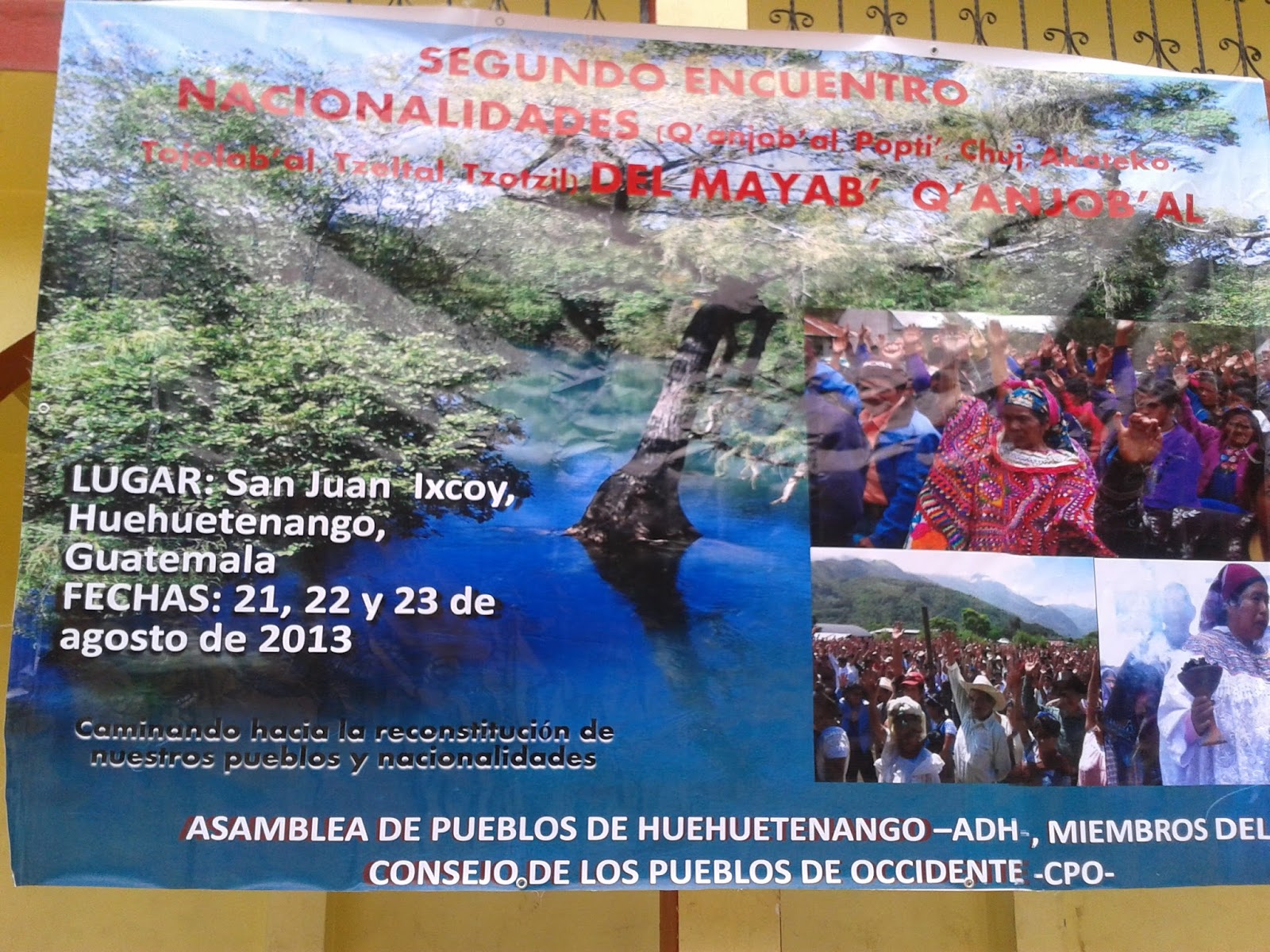
Declaration of the Second Gathering of the Q'anjob'al Nationalities


On August 21 – 23, leaders and representatives of twenty Maya Q'anjob'al communities in northern Huehuetenango and Chiapas, Mexico, gathered in San Juan Ixcoy, Huehuetenango to discuss the ongoing imposition of large-scale development projects on their territory and to continue generating strategies for unified resistance moving forward. The three day, cross-border event focused on the reconstitution and autonomy of the Q'anjob'al peoples through the strengthening of the cultural, social, economic and political ties that have historically linked indigenous communities in the border zone between Guatemala and Mexico.

In welcoming the community representatives Francisco Mateo Morales of the Departmental Assembly of Huehuetenango (ADH) explained the essence of the cross-border gathering: “Before we were divided and dispersed in towns, municipalities and countries, we were one, united people. Now our border communities are threatened by the same mega-projects – a new invasion armed with the discourse of false development. We are gathered here to continue the dialogue in order to construct new initiatives, new paths and alternatives for development.”

The gathering reiterated the legitimacy of the community consultation as an expression of cultural and political identity, and as an important tool by which indigenous peoples exercise their nationally and intentionally recognized right to free, prior and informed consent. In 2006 the Huehuetenango communities of Concepción Huista and Santa Eulalia were the first to carry out community consultations. In 2009, eight municipalities located in northern Huehuetenango, together with the Departmental Assembly of Huehuetenango and the Western Peoples' Council (CPO), were the first to declare their territory “free of mining and mega-projects”.


DECLARATION OF THE SECOND GATHERING OF THE Q'ANJOB'AL NATIONALITIES

We are decedents of the Maya Civilization, gathered together at the start of the New Era Jun Tun, Jun Katún, Jun B’aktunes, on the days Oxlajon Watan, Jun K'ana' y Kab' Ab'ak, in the place known as Oyeb’ Tx’o’ Konob’, at the foot of the Sacred Place Kab'tz’in, in Q'anjob'al territory, known today as the Municipality of San Juan Ixcoy. The leaders of Yalimox, Jolom konob', Oyeb Tx’o’ Konob’, Tz'unun Ha', Wajxaklajunh, Yaxb'atz', Hakatan, Tajlaq, Xajlaj, Concepción Huista, San Atonio Huista, Santa Ana Huista, Tila, San Juan Cancuc, Ixtapa Nibak, Las Margaritas, La Trinitaria, Ch'enalvo, San Cristóbal Jovel, Chanja' nationalities of the Q'anjob'al, Chuj, Akateka, Popti', Chol, Tojolab'al, Tzeltal y Tzotzil nation, come together at the Second Gathering of the Mayab' Q'anjob'al Nationalities to share our smiles, happiness and congratulations, and to unite our thoughts, ideas and words with strength and cosmic energy.

Despite the force with which the new invasion attempts to once again plunder our territory, our peoples have jointly worked to strengthen our political, social, economic, cultural and environmental struggles in order to continue our path toward the reconstitution of our nationality according to our cosmovision inherited from our ancestors.

Conscious of the role we play today before our families, our communities, our peoples, and the world, in this Second Encounter of the Mayab' Q'anjob'al Nationalities:

WE DECLARE:

Since the date of the First Gathering until today, the Nation States have increased the handing over of the natural resources of our territories to transnational companies and corporations. At the same time, the States have increased their servility in favor of the above-mentioned companies and corporations by militarizing communities. The justice system functions in support of mega-projects and the the States' public policies work in collaboration with business interests, resulting in the flagrant violation of our nationally and internationally recognized individual and collective rights.

The elements, natural resources and assets that exist in our territories are our treasure, our wealth and our invaluable ancestral inheritance, and it is up to us to administer these resources according to our cosmovision. Decisions regarding the administration of these resources belong to the original peoples, and not the government nor the companies. The governments and the companies only provoke conflict, pain, fear, anguish, persecution, imprisonment, abduction, torture and assassinations in our territories.

We reiterate our commitment to continue defending our mother earth, the sacred corn, the water, the forests, the mountains, our families, our communities and our people, making use of our own values, principles and ancestral practices with the firm conviction to maintain governability, strengthen democracy and to continue strengthening the unity of the Q'anjob'al nationalities. We will also base this effort on national and international legislation.

The Patq'um, the Q'umlb'ail, the Lajti', among others, are our peoples' social political systems based on our own consmovision through which we continue to practice the construction of consensus, agreements and actions in order to strengthen the Q'anjob'al nationalities.

We resume and strengthen political, economic, social and cultural exchange between our peoples, overcoming the obstacles of the administrative and political limits imposed by the States. We commit to continue working to re-establish the ancestral autonomy of our Q'anjob'al nationalities and not allow our small differences to convert into obstacles, but rather to recognize our diversity as our cultural wealth.

The Nationalities of the Q'anjob'al People are not represented by the Guatemalan or Mexican states; that is to say, we are a Nation without a State. Therefore, we will tirelessly fight with other nationalities of Maya descent for the construction of Plurinational States in order to no longer be a Q'anjob'al Nation without a State.

Oyeb Tx’o’ Konob’, Kab’ Ab’ak.
San Juan Ixcoy, August 23, 2013

Declaración del segundo encuentro de las nacionalidades Q'anjob'al

Durante el 21 - 23 de agosto, representantes de 20 comunidades Maya Q'anjob'al del norte de Huehuetenango y Chiapas, México se reunieron en San Juan Ixcoy, Huehuetenango para el Segundo Encuentro de las Nacionalidades Q'anjob'al. Los participantes discutieron la imposición de proyectos de desarrollo en sus territorios y estrategias para seguir adelante con una resistencia unida. El encuentro resaltó las consultas comunitarias como una expresión legitima de su identidad cultural y política.


En 2006, las comunidades de Concepción Huista y Santa Eulalia en el departamento de Huehuetenango se realizaron unos de los primeras consultas comunitarios. En 2009, 8 municipios en el norte de Huehuetenango, junto con la Asamblea de Pueblos de Huehuetenango por la Defensa del Territorio y el Consejo de Pueblos de Occidente, se declararon "libres de minería y de megaproyectos".


DECLARACIÓN DEL SEGUNDO ENCUENTRO DE LAS NACIONALIDADES Q'ANJOB'AL

Nosotras y nosotros descendientes de la Civilización Maya, en el inicio de la Nueva Era Jun Tun, Jun Katún, Jun B’aktunes, reunidos los días Oxlajon Watan, Jun K'ana' y Kab' Ab'ak, en el lugar denominado Oyeb’ Tx’o’ Konob’, al pie del Lugar Sagrado Kab'tz’in, del territorio Q'anjob'al, conocido hoy como Municipio de San Juan Ixcoy, lideresas y líderes de Yalimox, Jolom konob', Oyeb Tx’o’ Konob’, Tz'unun Ha', Wajxaklajunh, Yaxb'atz', Hakatan, Tajlaq, Xajlaj, Concepción Huista, San Atonio Huista, Santa Ana Huista, Tila, San Juan Cancuc, Ixtapa Nibak, Las Margaritas, La Trinitaria, Ch'enalvo, San Cristóbal Jovel, Chanja'; de las nacionalidades Q'anjob'al, Chuj, Akateka, Popti', Chol, Tojolab'al, Tzeltal y Tzotzil, de la Nación Q'anjob'al, venimos a compartir, nuestras sonrisas, alegrías y felicidades; a unir nuestros pensamientos ideas y palabras, con la fuerza y energía cósmica en el Segundo Encuentro de las Nacionalidades del Mayab’ Q'anjob'al.

A pesar de la fuerza con que la nueva invasión pretende saquear otra vez nuestro territorio, nuestros pueblos, de manera conjunta hemos fortalecido nuestras luchas en lo político, social, económico, cultural y ambiental, para seguir caminando hacia la reconstitución de nuestra nacionalidad conforme a nuestra Cosmovisión, heredada de nuestros ancestros.

Conscientes del rol que hoy jugamos ante nuestras familias, nuestras comunidades, nuestros pueblos, y ante el mundo, en este Segundo Encuentro de las Nacionalidades del Mayab’ Q'anjob'al:

DECLARAMOS:
Que del Primer Encuentro a la fecha, los Estados Nacionales han incrementado la entrega de los bienes de nuestro territorio a las empresas y corporaciones transnacionales. A su vez, los Estados han incrementado el servilismo a favor de las mencionadas empresas y corporaciones, militarizando las comunidades; el sistema de justicia actúa en apoya a los megaproyectos, las políticas públicas de los Estados se elaboran en congruencia con los intereses empresariales, violando de esta manera flagrantemente nuestros derechos individuales y colectivos, reconocidos por las legislaciones nacionales e internacionales.

Los elementos, recursos y bienes naturales existentes en nuestros territorios, son nuestro tesoro, nuestra riqueza y herencia ancestral invaluable y nos corresponde administrarlos de acuerdo a nuestra cosmovisión. Las decisiones para su administración corresponden a los pueblos originarios y no de los gobiernos ni las empresas. Los gobiernos y las empresas solamente han provocado conflictividades, dolor, miedo, angustia, persecución, encarcelamiento, secuestro, tortura y asesinato en nuestros territorios.

Reiteramos nuestro compromiso en seguir defendiendo nuestra madre tierra, el sagrado maíz, el agua, los bosques, las montañas, nuestras familias, nuestras comunidades, nuestros pueblos, haciendo uso de nuestros propios valores, principios y prácticas ancestrales, con la firme convicción de mantener la gobernabilidad, fortalecimiento de la democracia y seguir fortaleciendo la unidad de las nacionalidades Q'anjob'al, basándonos también en las legislaciones nacionales e internacionales.

El Patq'um, el Q'umlb'ail, el Lajti', entre otros, son sistemas sociopolíticos propios de nuestros pueblos desde nuestra propia cosmovisión, los que seguiremos practicando, construyendo consensos, acuerdos y acciones en el fortalecimiento de las nacionalidades Q'anjob'al.

Retomar y fortalecer el intercambio político, económico, social y cultural entre nuestros pueblos, sin que sean un obstáculo los límites administrativos y políticos impuestos por los Estados. Por lo que nos comprometemos a seguir trabajando para restablecer la autonomía ancestral de nuestras nacionalidades Q'anjob'al, sin que se constituyan como obstáculo nuestras pequeñas diferencias, por el contrario, nuestra diversidad es nuestra riqueza cultural.

Las Nacionalidades del Pueblo Q’anjob’al no están representadas ni en el Estado guatemalteco ni en el Estado mexicano, es decir, somos una Nación sin Estado, por lo tanto, lucharemos incansablemente con las otras nacionalidades de ascendencia Maya para la construcción de Estados Plurinacionales para dejar de ser Nación Q’anjob’al sin Estado.

Oyeb Tx’o’ Konob’, Kab’ Ab’ak
San Juan Ixcoy, 23 de agosto de 2013