Showing posts with label solidarity. Show all posts

Thursday, October 15, 2015

Expression of solidarity with the Duwamish Tribe in their struggle for tribal recognition

When Víctor Caal Tzuy from ACODET came to the U.S. last year on NISGUA's "Rivers for Life" tour, he met with Ken Workman, Duwamish Tribal Council Member and direct descendent of Chief Si'ahl. Both men shared common experiences as indigenous people, fighting for their communities and the health of their rivers in the face of displacement. While Víctor described the devastating effects the proposed Xalalá Dam would have on his community, Ken reflected on the ongoing injustices committed against the Duwamish Tribe as they struggle to obtain the rights and recognition due to them under the Point Elliot Treaty. 

On July 2, 2015, the Bureau of Indian Affairs denied Federal Tribal Recognition to the Duwamish Tribe. 

ACODET and NISGUA condemn this decision, and call on President Obama and other related authorities to immediate restore recognition to the Duwamish people. We are grateful for the warm welcome the Duwamish Tribal Council and the Duwamish Longhouse and Cultural Center gave to ACODET and NISGUA during our 2014 tour, and we continue to stand with them in their struggle for recognition and self-determination.

Please read the full letter below and considering adding your name. Send to bridget[at]nisgua.org and we will ensure its delivery to the appropriate authorities and Duwamish Longhouse.

Víctor Caal Tzuy and Ken Workman meet on the 2014
"Rivers for Life" speaking tour. Photo credit: NISGUA

******

16 September, 2015

To Whom It May Concern:

On behalf of the Network in Solidarity with the People of Guatemala (NISGUA), we write to express our support to the Duwamish Tribe in their ongoing struggle to obtain the rights and recognition due to them under the Point Elliott Treaty, signed by Chief Si’ahl. NISGUA is a grassroots organization that builds ties between North America and Guatemala, supporting human rights advocates, survivors of genocide, and indigenous communities defending their rights to life and territory. As such, we feel driven to condemn the July, 2, 2015 decision by the Bureau of Indian Affairs to deny Federal Tribal Recognition to the Duwamish Tribe.

In August of last year, we had the immense privilege to be received by tribal representatives at the Duwamish Longhouse & Cultural Center in Seattle, along with Víctor Caal Tzuy, a Maya Q’eqchi’ leader of the Association of Communities for Development, Defense of Territory and Natural Resources (ACODET). On his U.S. tour, entitled “Rivers for Life: Cultural Resistance to the Xalalá” dam, Víctor spoke about the threats posed to his community by a proposed hydroelectric project, which the Guatemalan government has attempted to impose without prior, informed consent from local indigenous communities.

At the Duwamish Longhouse, Víctor met Ken Workman, Duwamish Tribal Council Member and direct descendent of Chief Si’ahl. Víctor and Ken found common ground as indigenous people with shared legacies of river stewardship and common experiences of displacement from colonization. “Ken and I have much in common–we both live on the shores of rivers, and we will defend our rivers,” reflected Víctor. Ken drew connections between past suffering of the Duwamish people and the current situation facing Q'eqchi' communities opposing the Xalalá Dam. “The potential effects on culture and environment that Victor describes are exactly what occurred here in Seattle 100 years ago."

In his conversation with Víctor Caal Tuzy, Tribal Council Member Workman described the historical injustices perpetrated against the Duwamish people, including the draining of the Black River, the channeling of the Duwamish River, the burning of Duwamish Longhouses by settlers, city ordinances banning indigenous people from living within Seattle city limits, and many others. At the time, we hoped that the Duwamish Tribe might soon win a small measure of reparation by finally achieving Federal Tribal Recognition. Instead, the Obama Administration and its representatives in the Department of the Interior and the Bureau of Indian Affairs are perpetuating the long legacy of colonial injustice faced by the Duwamish.

We call on President Obama, Secretary of the Interior Sally Jewell, Assistant Secretary of the Interior Kevin Washburn, and the U.S. Congress to immediately act to restore Federal Tribal Recognition to the Duwamish.

We thank the Duwamish Tribal Council and the Duwamish Longhouse & Cultural Center for welcoming Víctor Caal Tzuy of ACODET and members of NISGUA on their territory.

In heartfelt solidarity with the Duwamish Tribe in their struggle for justice,

NISGUA
ACODET

Tuesday, January 6, 2015

Genocide retrial: Recusal of judge leads to suspension of proceedings

"We know that genocide took place. The whole world knows it, but the truth has been denied." Juventino Caal, member of the Association for Justice and Reconciliation (AJR)

Yesterday, a new trial against Jose Efraín Ríos Montt and José Mauricio Rodriguez Sánchez opened in Guatemalan courts and once again the survivors and witnesses were left clamoring for justice. The retrial came after the Constitutional Court annulled the 2013 proceedings, which had resulted in the conviction of Ríos Montt for genocide and crimes against humanity.

"It's unfortunate that we have to return to trial because a sentence was already dictated," said Julia Cortez, representative of the Association for Justice and Reconciliation (AJR).

As predicted, trial proceedings on January 5th provided observers, lawyers and survivors a glimpse into the delay-tactic strategies and, quite possibly, back-room dealings that are overshadowing the possibility of timely and impartial access to justice in Guatemalan national courts.
Now, with all the games they are playing, the justice system has not assumed its responsibility. This demonstrates the weakness of the Guatemalan state. The political position is clear: they will not guarantee our [the survivors and witnesses] lives… they don’t guarantee us anything. They put our lives, the victims’ lives, in danger.  (Anselmo Roldán, President of the AJR) 
The marathon day began with survivors, lawyers and observers arriving as early as 7 am to enter into the small room assigned for the day. Over 100 survivors and their supporters who were unable to get into the courtroom gathered outside the building to listen to a live broadcast amidst banners and posters.


When the proceedings began 20 minutes after the appointed 8:30 am start time, a two-hour delay was announced to await the transfer of the case file. Said file was still with the Appeals Court charged with deciding amnesty. After resuming again at 11 am, the President of the three-judge tribunal decided that Ríos Montt, so far absent from proceedings, must appear in person. She rejected the medical excuse presented on December 30th and stated he had one hour to appear in court or he would be held in contempt. Court was adjourned until 1 pm. The former head of state was finally wheeled into the courtroom on a gurney amid a voracious crowd of journalists lined up six deep at the front of the courtroom.

Montt was situated on the prosecution’s side of the gallery due to the need to accommodate the gurney. Judge Jeannette Valdés moved immediately to rule on the defense’s motion calling for her recusal. Analysts have asked why the judge did not address the issue of Ríos Montt’s health. The accused former general, who was wearing cataract sunglasses and was strapped to a gurney, was not asked to indicate his presence in the court and indeed showed no signs of being conscious.

The defense argument centered on a thesis written by the lead judge in 2004 on the legal application of the crime of genocide.

Valdés initially rejected the recusal on grounds that the thesis did not make her partial, rather it was an academic study that focused on doctrine and the application of the law. She also pointed to the late filing of the motion by the defense as an intentional stall tactic, highlighting that the tribunal and her participation in it has been public knowledge since June 2013. However, the two other judges on the tribunal - Judges Sara Yoc Yoc and Judge Maria Eugenia Castellanos – voted in favor of Valdés’ recusal. Further court dates remain to be seen as all proceedings are stalled until a new judge is named. There is no legal consensus on the timeline for the formation of a new tribunal.

"We thought that the process was going well," said AJR President Anselmo Roldán. "It seemed that in the beginning, the judges wanted to act impartially and in favor of justice… But we also saw their weakness… and maybe they received threats, we don’t know."
The survivors and witnesses represented by the Association for Justice and Reconciliation are disappointed that the Constitutional Court did not respect the first genocide verdict and sentence. However, they remain committed to the legal processes in national courts. As a testament to their ongoing sacrifices in the search for justice and dignity for their loved ones, a flood of AJR survivors and supporters traveled from points throughout the country to bear witness to the proceedings in the gallery and outside the courthouse.

"We have been denied [justice] many times, but we have not lost hope…We are grateful for international accompaniment so people realize we are not alone." Juventino Caal, AJR

You can show your support for the AJR in this difficult and uncertain time by reading our solidarity statement and taking a photo of yourself holding up a sign that reads "Justice for Genocide: We are still with you!" Stay tuned for up to date coverage on the proceedings in the genocide case through our twitter account: NISGUA_Guate.

Monday, September 8, 2014

Communities in Santa Rosa and Jalapa launch campaign to halt Tahoe Resources' expansion


"Water and life are worth more than silver or gold. You are intelligent, don't let them fool you." Community organized billboard campaign in Santa Rosa and Jalapa. Photo NISGUA

In February 2013, the community of San Juan Bosco, located just 8 miles from Tahoe Resources' massive Escobal silver mine, held a referendum in which 99% of people voted against mining. Local residents were not just concerned about impacts of the Escobal mine on their water and crops, but about another Tahoe exploration license, Juan Bosco, which is located, as the name suggests, right on top of the small farming community. Now, nine months after Tahoe announced a start to operations at Escobal, the Environmental Impact Assessment for the Juan Bosco license has been published for public comment, indicating an important step forward in the granting of the exploitation permit.

In an ongoing attempt to make their voices heard, communities of Santa Rosa and Jalapa announced last Monday the launch of a campaign to halt Tahoe's expansion. The company's plans to exploit at least 12 mineral veins in an area covering 2,398 square kilometers are moving swiftly ahead despite community opposition and more than a dozen referenda in which more than 53,000 people in six municipalities voted against mining in their territory. See the full press release from communities below.

Residents of Mataquescuintla map Tahoe mining licenses compared to the location of communities, local water sources and forests. Photo NISGUA
Tahoe's decision to move forward with the Juan Bosco license was met with concern and frustration by local residents. At a press conference in Guatemala City on September 1, one resident commented, “In San Juan Bosco we feel indignant because we already had our referenda. We are a community that depends on agriculture and this mine threatens our water. That is why we continue to oppose these projects.”

Likewise, representatives from 10 communities, including three Xinca indigenous communities impacted by Tahoe's expansion plans in the departments of Santa Rosa and Jalapa, expressed concern that neither Tahoe, nor the Guatemalan government respect their right to consultation and self-determination. They also denounced local mayors who are accepting mining royalties against the will of the people.

A representative from the municipality of Santa Rosa de Lima, where in 2012, more than 98% of the population voted against Tahoe Resources' Escobal mine explained: “Our mayor, and others in the region, accepted the royalties – but the money is only serving to line their own pockets... We demand that the government and the company respect our referendum. We may be farmers but we still deserve rights. The constitution applies to everyone.” A representative from San Juan Bosco, in the municipality of San Rafael las Flores where the mine is located agreed: “We haven't seen development. All we have seen are increased conflicts.”

Community representatives also addressed Tahoe Resources' statements contending that the company has social support for the project and that it consulted with local communities, stating “The company says that they consulted with us and that is a lie. What the company does is gather signatures by deceiving people and take advantage of their poverty. The company offers trees or fertilizer and so people give their signatures and ID number. That's not a real consultation.” 

A leader from the Xinca community of Jumaytepeque questioned the discourse of the government and the multinational companies stating, “When they come and tell us that mining brings development, I have to ask, 'then why are we in the same situation, or worse off, than we were 10 years ago?' Every day more and more people are living in poverty. And people living near the mines are faced with health problems they never had before.”

--------------------------------------------------------------------------------------------------------------
Press Release: Communities of Santa Rosa and Jalapa Organized in Defense of Territory and Nature 


Since 2012, we have held citizen requested municipal referendums, in which more than 53,000 residents have manifested, through the legitimate exercise of our rights as citizens, that WE DO NOT AGREE with chemical mineral mining in any part of our territory. According to the Constitutional Court, these consultations have been declared constitutionally legal and binding at the municipal level.

Despite the clear rejection of chemical mining of metals in our territory, and with the complicity of the [Guatemalan] government, the company, Minera San Rafael, continues actions focused on entering our municipalities through underhanded measures, knowing full well  that the only thing they achieve is the generation of increased conflict, while disturbing the peace and community tranquillity. Clear proof of this is the granting of the exploration licenses named Juan Bosco and Andres during the first quarter of 2012. These licenses affect municipalities located in [the departments of] Santa Rosa, Jalapa and Guatemala. Now, despite the evident opposition of our communities and in a demonstration of disrespect for the clear wishes of the people, the Ministry of the Environment and Natural Resources has published the Environmental Impact Assessment (2014-EIA-4413) for the  Juan Bosco Mine Exploitation License (LEXR-089-08), for public comment. 

According to a presentation and information presented to investors in June in Vancouver, Canada, Tahoe Resources Inc. (owner of the Minera San Rafael, S.A.) plans to exploit at least 12 mineral veins in our territory,  including gold, silver, zinc, etc. [According to Tahoe Resources] an area of 2,498 km2 will be exploited through various licenses, some that have already been obtained, others that are still in process. However, [the company] is selling this project to investors as though it already owns the land, arguing that the current government is pro-mining and that in Guatemala they pay an extremely low tax rate, making it a profitable business opportunity. 

Faced with this grave situation, we have expressed our opposition to the chemical metal mining in our territories through municipal and good-faith community referendums. Today we are launching a campaign that seeks to make clear to the pro-mining and sell-out Guatemalan government, as well as the mining companies and their investors, that our land is not for sale. We have a development model that respects the environment and Mother Earth. For us, water and life are worth more, much more, than silver or gold.

Therefore, on more than 100 km of highway in our municipalities we have placed signs so that those who enter our territories know that more than 98% of residents do not want the chemical mineral mining and that we are in constant peaceful resistance to these projects.

Guatemala, August 2014

NISGUA has accompanied communities in opposition to the Tahoe Resources Escobal mine since 2011.

Wednesday, April 9, 2014

Guatemalan organization express their solidarity with Yassmín Barrios


OUR SUPPORT FOR THE DIGNITY AND PROFESSIONALISM of HONORABLE JUDGE YASSMÍN BARRIOS

To the people of Guatemala and to the international community, we express our total indignation of the decision emitted by the ethics tribunal of the Guatemalan Bar Association that attempts to penalize Judge Yassmín Barrios Aguilar.

The Political Constitution of the Republic of Guatemala establishes in Article 203 that "The magistrates and judges are independent in carrying out his or her duties and are subject only to the Constitution of the Republic and the Law..." In the same article it indicates that: "No other authority can intervene in the administration of justice." We thus believe that the above-mentioned decision [of the Bar Association] goes against the Constitutional principles and puts the Guatemalan justice system at great risk.

By ignoring the principle of judicial independence and condemning a judge for exercising her constitutional duty, one of the fundamental pillars of the Rule of Law is made vulnerable.

Guatemala bore witness that during the trial for genocide and crimes against humanity, Judge Yassmín Barrios Aguilar was respectful of the law, despite the constant instances of disrespect and threats publicly expressed against her. Newspaper, television and radio publications provide evidence of who lacked respect and ethics, not only for the court and its presiding judge, but also for the people of the Republic of Guatemala, to whom justice is rendered.

We express our solidarity and recognition of Judge Yassmín Barrios Aguilar for her exemplary service to the Guatemalan justice system, as well as her long trajectory and hard work in defense of judicial independence.

We call on all judges to not give in to the intimidations, pressures and persecutions from sectors which, feeling powerful, want their actions to remain in impunity, and therefore seek the complicity of institutions that should be at the service of the nation and not [at the service of] perverse interests. 

The victims and survivors of genocide urge lawyers, professionals and the general public to speak out against this resolution.

Guatemala, April 7, 2014.


Association for Justice and Reconciliation - AJR, Association for the Integral Development of the Victims of Violence in the Vera Paz Provinces, Maya-Achí -ADIVIMA, Families of the Detained and Disappeared of Guatemala - FAMDEGUA, Truth and Justice Association - AVEJA, Truth and Life Association, Sanjuaneras Women's Association - AGIMS, Maya Lawyers Association of Guatemala, Departmental Association of Youth from Sololá -KAJI B'ATZ', Political Association of Maya Women - MOLOJ, Human Rights Law Office of Guatemala, Center for Forensic Anthropology and Applied Sciences - CAFCA, International Center for Human Rights Research - CIIDH, Center for Environmental and Social Legal Action - CALAS, Center for Human Rights Legal Action - CALDH, Collective Artesana, Campesino Unity Committee - CUC, National Coordination of Widows - CONAVIGUA, Genocide Never Again Coalition, National Convergence Maya Waqib'Kej, Religious Confederation of Guatemala - CONFREGUA, Christian Women's Council, Community Studies and Psychosocial Action Team - ECAP, Amancio Villatorio Foundation, Guilermo Toriello Foundation, Rigoberta Menchú Tum Foundation, HIJOS Guatemala, Guatemalan Institute of Comparative Penal Studies - ICCPG, DEMOS Institute, Monseñor Gerardi Movement, Maya Youth Movement - MOJOMAYAS, Women Transforming the World, Security and Democracy - SEDEM, The Human Rights Defenders Protection Unit - UDEFEGUA, National Guatemalan Women's Union - UNAMG

Tuesday, July 2, 2013

Hundreds accompany the Ixil people on their Day of Dignity

Several hundred traveled from Guatemala City to Nebaj on June 21-22 with the
"Caravan for the Dignity of the Ixil People and Against Genocide". Photo: NISGUA

Ixil authorities welcome organizations to Nebaj. Photo: NISGUA

Each year on June 22, the Ixil people remember their martyrs and heroes. The day commemorates seven principal Ixil leaders who rose up in resistance and called for the dignity of their people in the face of forced labor under the Jorge Ubico dictatorship. On the morning of June 22, 1936, military troops arrived from Santa Cruz Quiché and Sacapulas to squash the resistance and soldiers shot and killed the seven Ixil leaders. The Ixil people have reclaimed June 22 as their Day of Dignity. For a more detailed account of the 1936 rebellion and massacre, see this article (in Spanish).

This year, in mark of the historic verdict for the Ixil people in the genocide case, a caravan of activists and supporters traveled from Guatemala City to Nebaj to celebrate the Day of Dignity and commemorate the seven massacred leaders with the Ixil people. In a moving demonstration of the lasting importance of the genocide sentence, regardless of the trial annulment, the Center for Human Rights Legal Action and the Association for Justice and Reconciliation presented Ixil leaders with three bound copies of the genocide sentence for the people of Nebaj, Chajul and Cotzal.


CALDH and the AJR present the genocide sentence in Nebaj.
Foreground sign "To tell the truth is not a crime". Photo: NISGUA

Ixil leaders proudly hold the genocide sentence.
Photo: Marcha indígena campesina y popular
Indigenous leaders from all over Guatemala also joined the Day of Dignity activities in solidarity with the Ixil people. In addition, an assembly of indigenous authorities formed in Nebaj to concretely plan activities for August 9, the International Day of Indigenous Peoples. Together, the authorities drafted a declaration based on their meetings. Below we share our translation of the declaration. Read the Spanish version here.


The Ancestral Indigenous Maya and Xinka Authorities of the 48 Communities of Totonicapán, the Mam Nation, the Xinka People, the Pokoman, Kaqchikel, Uspanteko, and Ixil Peoples


We are gathered together in the heart of the Ixil region, specifically in Nebaj, first to commemorate the 1936 uprising of the principal leaders of the Ixil people, of which 7 were shot by the Jorge Ubico dictatorship, and then to share our experiences, our struggles, our resistance and resilience, our joys, our sadness, our laughing, our weeping, our dreams, our frustrations, our past and our future:


WE HAVE AGREED TO CARRY OUT THE FOLLOWING DECLARATION FROM NEBAJ


To reaffirm that we are not the descendants of defeated or subjected people and heroes. Throughout the last five centuries, thousands of uprisings in defense of life and territory have been recorded, such as those of our ancestors Atanasio Tzul, Lucas Akiral, Aj Poop B’atz’, Manuel Tot, and the principal leaders of the Ixil people in 1936, among many others.


To value the struggle, resistance and participation of women, rural farmworkers, students, professionals, people defending their rights, their natural resources and territories in the face of extractive policies such as those in San José El Golfo, San Pedro Ayampuc, Rio Hondo Zacapa, the Chorti People, among others.


To continue the resistance of our people and communities based on our common history, looking towards the future in the construction of the good life in a plurinational, democratic and just state.


To celebrate the International Day of Indigenous Peoples on August 9 of the present year, together with the rest of the Guatemalan people and as peoples with the same past, present and future.


To strengthen our community authorities, our processes of organizing, our thoughts, feelings and community decision-making practices and to act in a collective manner for the satisfaction of our needs and defense of our rights.


To call on all of Guatemala's ancestral indigenous authorities and social organizations that already participate in defense of our rights and territory, as well as the Garífuna people to participate in the celebration on the International Day of Indigenous Peoples, and to support other actions that our peoples' authorities put forward.


We reject all resolutions, attempts, proposals or initiatives that attempt to declare invalid, or try to regulate from a Western viewpoint, the community consultations which have been carried out, are carried out, and will continue to be carried out by our peoples.


We reject any measure stemming from the government which exclude and repudiate our right to decide over the future of our peoples and our country.

"May the dawn break, may the first light arrive, 

may the people have life and useful existence"


Council of Maya Ixil Authorities, Board of Directors of the Communal Mayors of the 48 Communities of Totonicapán, the Council of the Maya Mam Nation, Xinka Parliament, Kaqchikel, Uspanteka and Pokomam Indigenous Authorities, and the National Council of Ancestral Authorities.

Nebaj, waq’ib’ aq’b’al, junab’ jun iq’, jun katún, kajlajuj b’aqtun


Nebaj, June 22, 2013

Thursday, June 20, 2013

NISGUA's genocide trial coverage: the complete collection

While we await the next steps of the genocide trial, we are honored to provide an accessible archive of the daily coverage we provided from day 1 of the trial. Please read and share this historic collection.


Wednesday, June 12, 2013

Speculation around genocide trial restart; Ríos Montt back under house arrest

Guatemalan civil society reacted to the May 20 annulment of the genocide trial verdict through public actions, marches and vigils overwhelmingly rejecting the decision. On May 24, an impromptu march that some activists reported to be the largest in recent history organized in the name of memory in Guatemala. An estimated 5,000 people filled the streets of the capital to denounce impunity and call for justice. Supporters throughout the world also organized solidarity protests outside Guatemalan embassies to echo the message: Yes, it was Genocide. Sí Hubo Genocidio.


"The truth is told, justice was sentenced. Yes it was genocide."
See more photos from the May 24 march via CPR Urbana

While public opinion on the genocide trial annulment has been expressed in the media and on the streets, the answers to the legal questions necessary to clarify the future of the trial are only slowly being untangled.

Following the decision of the Constitutional Court (CC) to annul trial proceedings after April 19, the Guatemalan Supreme Court faced the challenge of composing a three-judge Appelate Court to carry out the CC decision. Possibly fearing a black mark on their record and the condemnation of the multitudes of national and international bodies calling for an end to impunity in Guatemala, at least 61 judges excused themselves from the case.

Finally, on May 27 the Appellate Court was formed and rapidly carried out the CC decision to annul the trial. Shortly thereafter, Judge Yassmin Barrios excused all three members of her presiding tribunal from future genocide trial proceedings, the inevitable outcome of having already issued a verdict.

On June 4, the Appellate Court assigned the case to the First High Risk Crimes Court "B", made up of Judges Irma Jeannette Valdés Rodas, María Eugenia Castellanos and Sara Griselda Yoc Yoc. The tribunal has presided over other high profile cases for justice including the conviction of Pujujiles gang members for the 2010 murder of Maya artist and community leader, Lisandro Leonardo Guarcax González, and 32 other victims. Judge Irma Jeannette Valdés Rodas also led the tribunal responsible for the conviction of ex-general Pedro Pimental for his involvement in the Dos Erres massacre.

While news reports quickly spread that the trial would not resume until April 2014, an official restart date for the genocide trial has not been determined. The First High Risk Crimes Court "B" has only confirmed their case list extends through March 2014.

Ríos Montt was transferred to the Military Hospital on May 13, after spending only 3 nights in prison. He stayed in the hospital until the early hours of June 12, when he was ordered to return home under house arrest, as he was ordered in January 2012. José Mauricio Rodríguez Sánchez, who was acquitted of all charges, is back in police custody and remains in the Military Hospital, according to Guatemalan newspaper El Periódico.

Meanwhile, Ríos Montt and Rodríguez Sánchez' lawyers continue to argue that the former generals should be granted amnesty. However, Article 8 of the National Reconciliation Law, passed as part Guatemala's 1996 Peace Accords, invalidates amnesty in the cases of genocide, torture and forced disappearance. Regardless, the defense lawyers continue to claim the law cannot be applied retroactively - that is to say that  it cannot be applied to crimes committed in 1982 and 1983. The lawyers originally made the case for amnesty in December 2012, and were denied by Judge Miguel Ángel Gálvez. Naturally the defense appealed, and now it's up to the Constitutional Court to make a final ruling. Ramón Cadena, expert in international law, declared in his testimony on day 15 of the genocide trial: "Genocide can't be forgiven, it can't be granted amnesty."

Friday, May 31, 2013

Rubén Herrera Released from Prison!


Rubén Herrera and Cecilia Mérida moments after Rubén was liberated.
Yesterday, Rubén Herrera, unjustly imprisoned since March 15 for his resistance to the Cambalam hydro-electric project, was released from custody and cleared of all charges in one of two legal processes against him. The second process (176-2011) dating back to 2009, was provisionally closed at the request of the Public Prosecutor's office. Judge Miguel Gálvez of Guatemala City's High Risk Court “B” agreed with the prosecutor's assessment that the evidence against Herrera was imprecise and contradictory, and granted the prosecution a six month time frame to build a better case or present closing arguments. 

Beginning with Herrera's first hearing in Santa Eulalia, Huehuetenango, the Public Prosecutor's office has maintained that the case lacks evidence linking Herrera to the crimes. Despite these arguments the presiding judge in Santa Eulalia, at the request of co-plaintiffs Ecoener Hidralia Energía/Hidro Santa Cruz S.A, ordered the case forward. 

At the beginning of trial proceedings on Thursday, the Public Prosecutor reiterated its request to provisionally close both cases against Rubén Herrera citing a lack of evidence linking him to the accusations. What followed was an unusual scene, during which the lawyers at the prosecution table argued against each other. Lawyers for co-plaintiff Hidro Santa Cruz denounced the Public Prosecutor's “surprising” request and “passive attitude”, and requested that Judge Gálvez proceed to trial. Joining the Hidro Santa Cruz's legal team was a familiar face from the genocide trial, César Calderón, defense attorney for former director of military intelligence José Mauricio Rodríguez Sánchez. 

During the three hours that followed, the defense team representing Herrera argued the two separate cases, demonstrating both the political nature of the charges, the questionable behavior of representatives of the judicial system in Santa Eulalia, and the lack of concrete evidence against Herrera. 

In the 2012 case (65-2012), Judge Gálvez dismissed the charges outright. The case was permanently closed citing the fact that none of the testimonies provided by witnesses and victims in the case file even mention Rubén Herrera. In the 2009 case, Gálvez upheld the request from the Public Prosecutor to provisionally close the case stating that the accusations and arrest warrant were based on “two or three flimsy declarations”. Throughout the hearing, Judge Gálvez referenced his belief that social conflict in Barillas is the result of a lack of respect for international law protecting communities' right to consultation. 

In response to the provisional closure of the 2009 case, Cecilia Mérida, Rubén's life partner, stated that it will allow them more time to continue to disprove the allegations against Rubén; and more time to prove that he has been falsely accused by the company in order to undermine popular resistance to the hydro-electric project. Throughout the duration of his imprisonment, Herrera, Mérida and the Departmental Assembly of Huehuetenango (ADH) have continued their struggle in defense of territory in the face of rising repression and criminalization. Rubén declared soon after his release: "In prison I learned that it doesn't matter where you are, you can continue to fight.”

While the 2012 case against Rubén is closed, three of the 11 men unjustly imprisoned for eight months for their peaceful resistance to the Cambalam project continue to be linked to the same the May 1, 2012 incident and continue to await the permanent closure of their case. Likewise, 20 additional individuals still have arrest warrants pending against them related to the same event. 

Dozens of supporters packed the courtroom yesterday in support of Rubén and the struggle for communities' right to self determination. More than 2,800 people from the international community demonstrated their solidarity by signing the petition demanding Rubén's release and the end to persecution of community leaders, which was delivered to Guatemalan authorities last week

Supporters filled the seats and lined the aisles in support of Rubén.
The role of international solidarity continues to be important for the individuals, communities and organizations defending the right to consultation, particularly as criminalization of peaceful protest continues to intensify in Guatemala. In the words of the ADH: “In a very special way, we want to thank the show of solidarity with our cause. We are confident that this solidarity encourages and strengthens us to continue fighting.”


 NISGUA works closely with the Departmental Assembly of Huehuetenango (ADH) in their efforts to promote self-determination and alternative visions of development in the highland department of Huehuetenango. The ADH receives international human rights accompaniment from NISGUA through the ACOGUATE project and participated in NISGUA's 2010 tour.

Thursday, May 30, 2013

NISGUA in NYC with the Association for Justice and Reconciliation: Listen live to our special event


Live transmission of event in NYC with the AJR. Tramission will begin at approximately 7:15pm EST, May 30, and last for one hour.

Transmisión en vivo de la actividad en la ciudad de Nueva York con la AJR. Transmisión de 1 hora, 30 de mayo, empezando a las 7:15pm EST (aproximadamente).

Alternate link: here

Wednesday, May 22, 2013

AJR Declaration to the United Nations Permanent Forum on Indigenous Issues

The Association for Justice and Reconciliation addressed the United Nations Permanent Forum on Indigenous Issues in New York City today. We are honored to provide the exclusive English translation of the declaration. Read the Spanish version here.

 Association for Justice and Reconciliation
Declaration to the United Nations Permanent Forum on Indigenous Issues, 12th Session
New York, NY, May 22, 2013

Brothers and sisters of the indigenous peoples of the world and members of the Permanent Forum:

We, as indigenous peoples, stand on the threshold of a new era of shared struggle. In this spirit, we come to ask that the Assembly recommends to the state of Guatemala that justice for our people prevails and that a strong foundation be built to construct new, more just, and harmonious relations for all.

On May 10, Guatemala set an example for the world by being the first country to emit a sentence for genocide against a former head of state in a national court.  We, the plaintiffs and members of the Association for Justice and Reconcilation, have seen this process as an opportunity to recuperate the truth that has been denied to our families and to Guatemalan society in general. It is an opportunity to confront the past and address the root causes of the discrimination we suffer as indigenous peoples in Guatemala today.

However, the sentence has just been annuled by the highest court in the country. This takes place in a context where business elites and groups linked to the military who carried out the extermination rejected the sentence and sought to create terror by encouraging social polarization and calling for society to deny the truth. What happened this week in Guatemala is not coincidence, but part of a political structure that denies us justice. We have spent 12 years preparing evidence and arguments, dealing with all manner of obstacles. The moment we begin to move forward, the legitimacy of judicial processes is questioned and we hear officials threatening lawyers and judges. Despite all of this, our cause does not end here.

Today, more than ever, it is imperative we continue to demand justice and face the past to ensure acts of genocide never again take place in Guatemala and the Guatemalan state respects, protects and promotes the rights of indigenous peoples. As long as this does not happen, the state will continue to deny our rights and facilitate the dispossession of the lands and natural resources that are fundamental to the material and spiritual life of indigenous peoples. Brothers and sisters: we must stop the continuation of genocide in Guatemala.

Not in Guatemala nor any other place in the world: Genocide, never again


Tuesday, May 21, 2013

Genocide trial sentence overturned; CALDH press conference called sentence, "An opportunity for peace"

The Guatemalan Constitutional Court emitted a resolution late Monday evening to annul the genocide trial verdict and revert proceedings back to April 19. Judge Barrios of the First Court for High Risk Crimes "A" has 24 hours after being notified of the resolution this morning to comply with the Constitutional Court. The full impact of this decision is yet to be determined.

Yesterday morning, the Center for Human Rights Legal Action called a press conference to publicly share the genocide trial sentence. A cross-section of Guatemalan society gathered to celebrate the sentence as a fundamental step in achieving peace.

See our full translation of yesterday's press release below.

"Yes, it was genocide. Guatemala walks firmly toward peace"

The Genocide Sentence
An Opportunity for Peace

Today Guatemala has a new opportunity for peace, an opportunity that is constructed on the foundation of memory and truth of the Maya Ixil people and on the foundation of justice and strengthening the rule of law.

The First Court for High Risk Crimes "A" has condemned General José Efraín Ríos Montt for genocide and crimes against humanity. The sentence against Ríos Montt verifies that the crime of genocide was committed in Guatemala and situates his participation in grave human rights violations committed during the internal armed conflict.

With this historic sentence, the Court has given evidentiary value to the brave testimonies of the Ixil men and women, who after 31 years have been heard and had their suffering recognized by the Guatemalan justice system.

Through these testimonies, as well as scientific and documentary evidence, the court proved the evidentiary value and demonstrated the intention to destroy the Ixil who were identified as the internal enemy, "the violent actions committed against the Ixil weren't spontaneous but rather the concretization of previously elaborated plans that formed part of state policy aimed at eliminating a specific ethnic group… Having proved to society that they were civilians, dedicated to agriculture."

The sexual violence was a systematic attack against women, which contributed to the destruction of the social fabric and whose objective was to eliminate the Maya Ixil ethnic group. Women suffered intentional violence and humiliation, not only as a means to inflict mental and physical harm, but also as a means to impede the physical and cultural reproduction of the group.

The prevailing racism in Guatemala was "the machinery of extermination," and was the foundation for genocide. "Racism expresses itself in the conduct, imagery, and racist practices and ideologies that occupy distinct spaces and reach society as a whole… Racism profoundly affects, provokes, collaborates and contributes to the genocide that occurred in Guatemala." Historically, a stereotype of an "indian" has been constructed as an inferior, as "a bad person, thief, ugly and who smells bad." The elites have historically presented the idea of "their elimination" or the necessity to "improve the race". This was what was put into practice in the Genocide.

Through this trial, networks of impunity have been uncovered which are still deeply entrenched in the justice system. There are also powerful groups that continue to deny the possibility of living in a full democracy with true rule of law. We've witnessed illegal resolutions; malicious litigation and the attempt to discredit actors within the justice system through various means. It is important to reiterate, that during this trial, it is the public oral debate which determines if the means of evidence reached their evidentiary value. This is what gives force and credibility to the rule of law and not the hundreds of appeals submitted to delay and obstruct justice.

The survivors of the genocide have taught Guatemalan society a lesson; It is possible to move forward and resolve controversies through established democratic means. Those who invoke hate and violence or those who are afraid of democratic processes are those who have never believed in peace or democracy.

We call upon Guatemalan society to not be convinced by these violent, racist and discriminatory messages of those sectors that threaten actions, and even violence if the ruling is not revoked.

We share the idea that this sentence is part of a watershed moment in the history of Guatemala, as it opens up the opportunity for us to once again ask ourselves as a society what it is we desire for the present and future of our country. Guatemala has a new opportunity, shaped by the long path toward justice that the victims undertook decades ago. This path symbolizes the claims and recognition of true reality, not only for the Maya people but also for the thousands of the victims arbitrarily executed, disappeared and massacred in our territory.


Association for Justice and Reconciliation, AJR; Ancestral Maya Authorities of the Ixil Region, Victims Movement Association for the Integral Development of Northern Quiche; Departmental Youth Association of Sololá Kaji Batz; Association for Development and Recovery of Alta Verapaz, AJODER; Caja Lúdica Association; The Association of Family Members of the Detained and Disappeared of Guatemala, FAMDEGUA; Community Studies and Psychosocial Action Team, ECAP; Center for Human Rights Legal Action, CALDH; Collective We the Women; National Coordination of Guatemalan Widows, CONAVIGUA; Coordination of Ixil Women "Baxil B'atz"; Committee of Victims of the Ixcán; Coordination of Youth for Guatemla, CJG;  Coordination Genocide Never Again; Coordination and National Convergence Waqib Kej; the Guatemalan Religious Confederation, CONFREGUA; Relatives in Search of Truth and Justice for the Victims of the Military Diary; Rigoberta Menchú Foundation; HIJOS Guatemala; Institute for Comparative Studies in Criminal Science, ICCPG; Institute for Sustainable Development Teaching, IEPADES; Julio Solorzano Fopa; Women Transforming the World, MTM; Movement of Maya Youth, MOJOMAYAS; Archbishop's Office on Human Rights, ODHAG;  Pastoral Youth Ministry of San Marcos, Network of Ixil Youth "Chemol Txumb'al"; Security in Democracy, SEDEM; Women's Sector; Civil Society for Youth Development/ Foundation for the Youth; National Unity of Guatemalan Women, UNAMG

Read the complete sentence here:
www.caldh.org
www.paraqueseconozca.blogspot.com

Tuesday, May 14, 2013

Sentence of Dignified Reparations for the Ixil People


On May 10, Efraín Ríos Montt was found guilty of the crimes of genocide and crimes against humanity, in an historic ruling that sentenced him to 80 years in prison. As ordered during the verdict, yesterday Judge Yassmín Barrios heard the reparations requests of the Association for Justice and Reconciliation and the Center for Human Rights Legal Action. Below we have translated a summary of the petitions granted to the plaintiffs.

The representatives of the survivors put forth an extensive list of petitions and made special mention of the women who suffered sexual and gender violence. In a trial filled with moving and powerful moments, the day in which women bravely spoke to an open courtroom stands out for many. Read more about their courage here

In a notable link between the crimes of the past and violence occurring in Guatemala today, the plaintiffs asked the government be ordered to respect Convention 169, the International Labor Organization convention stating indigenous peoples have the right to free, prior and informed consent on any projects taking place in their territories.
This and other petitions were not granted because the crimes and subsequent verdict relate to an individual –Ríos Montt- and not the state. Therefore, Judge Barrios highlighted, while certain mechanisms of the state will be used to carry out reparations, these are not state reparations.

Another denied request was the restitution of land taken from displaced Ixil victims, the only economic petition made by the plaintiffs. CALDH lawyer noted, 
Defense lawyers and social media hate speech have repeatedly accused the victims of being involved in this case for the purposes of financial remuneration.

Below we share the “dignified reparations” granted to the Ixil people, as mandated under the Guatemalan penal code.


Sentence of Dignified Reparations for the Ixil People

Today, May 13, three days after having issued the historic sentence condemning Ríos Montt, the High Risk Sentencing Tribunal A held a hearing to listen to petitions for reparations. The petitions were for dignified reparations for the victims of genocide and crimes against humanity for the Ixil people. The judges ruled the following:
  1. That the Executive Branch, through the Ministry of Culture, make a request to the Congress of the Republic that a law declare Mach 23 as the National Day Against Genocide. In addition, the Executive Branch must develop a program to disseminate the verdict, as well as respect for cultural diversity.
  2. The President, Minister of Defense, Presidential Secretary for Women’s Issues and others, must publicly apologize to the victims, in particular to the women who were victims of sexual violence. The apologies will be written on a parchment to be submitted to each of the municipal mayors in the Ixil region.
  3. Monuments honoring and remembering the victims of genocide will be erected in Santa María Nebaj, San Gaspar Chajul and San Juan Cotzal, in particular for the women victims of sexual and gender violence and the children who were victims of the genocide.
  4. Respect and recognition of cultural diversity, training on human rights and international human rights are to be incorporated into the training programs  of all prevention and security [institutions], such as military and police. 
  5. Create schools and study center in all three municipalities of the Ixil region. 
  6. The Attorney General’s office, in the form of a mural, will reaffirm their commitment to creating a system of justice that is respectful of cultural diversity.
  7. The Ministry of Education will create a moving museum that promotes respect for all peoples and peaceful coexistence. 
  8. Create a cultural center for the promotion of Maya Ixil culture. 
  9. The study of the Ixil genocide will be incorporated into education curriculum. 
  10. The National Reparations Plan will incorporate in their programs the category of genocide and crimes against humanity, so that victims may access [financial] reparations.
  11. It is ordered that the plaintiff’s institutions will follow-up on the content and compliance of the [reparations] sentence.
 Association for Justice and Reconciliation – AJR
Center for Human Rights Legal Action – CALDH

Friday, May 10, 2013

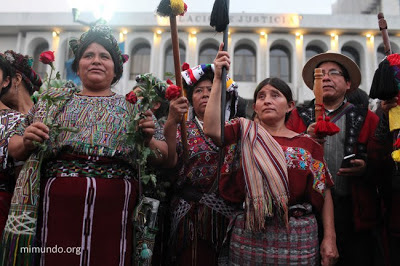
Ríos Montt: Guilty of genocide and crimes against humanity

MiMundo.org

Today in Guatemala, Judge Yazmin Barrios found former dictator Efraín Ríos Montt guilty of genocide and crimes against humanity. The court ratified all the elements of genocide described by witness and expert testimony, concluding that Ríos Montt had both command authority and "full knowledge of what was happening and did nothing to stop it."  Ríos Montt was sentenced of 80 years in prison and is now in police custody. Former intelligence director Rodriguez Sánchez was acquitted of all charges.

The historic sentence was greeted by cries of "Justice!", the singing of hymns, and emotional displays of appreciation by Ixil witnesses and other members of the public. "After so much struggle, we've finally achieved our goal," said a member of the Association for Justice and Reconciliation.

Although the court's ruling is sure to be subjected to ongoing challenges, now is not the moment for doubt. Now is a moment to fill our hearts in celebration of the years of dedication and toil that have led to this victory. It is a time for solemn remembrance of the many who have not lived to see justice, but in whose names this struggle has been carried forward.

Today proves that the bonds of solidarity and memory can triumph over violence and forgetting, that the humblest commitment to truth and justice can in time tear down the wall of impunity.

From the bottom of our hearts we thank you for your constant vigilance and accompaniment of the survivors, witnesses, and human rights defenders that have made today possible. We ask you to deepen your support in the coming weeks, months, and years as struggles for justice and self-determination in Guatemala continue in the face of threats both new and old.

Above all, we ask that you join us in celebration, in raising our voices worldwide in a chorus of justice.

In enduring and grateful solidarity,

The entire NISGUA team, now and over three decades in solidarity with the people of Guatemala.

Genocide on Trial, Day 27: Genocide trial closes and moves to deliberations

NISGUA continues live coverage of the trial in Guatemala of Efraín Ríos Montt and José Mauricio Rodríguez Sánchez for genocide and crimes against humanity.

Read our previous summaries: Day 1, 2, 3, 4/5, 6, 7, 8, 9, 10, 11-14, 12, 13/14, 15/16, 17/18, 19, 20-1, 20-2, 21, Constitutional Court decisions, trial suspension, Day 22, 23, 24/25, 26-1, 26-2 and our full archive of ongoing live Twitter coverage.

The final day of the genocide trial began at 8am, as Judge Yassmín Barrios convened earlier in order to accommodate a hearing in Judge Carol Patricia Flores’ court at 8:15am.

The proceedings were short, as expected. José Mauricio Rodríguez Sánchez was given the opportunity to make a request to the court and he made a brief statement. He
stated his innocence, reiterating his defense attorney arguments that he did not have the position or power of command to be responsible for the acts of genocide and crimes against humanity.


Judge Barrios then declared the public oral debate of the genocide case trial conclude
d, marking the end of proceedings with a resounding pound of her gavel. She announced the verdict would be given at 4pm MDT today. Judges Barrios, Pablo Xitumul and Patricia Bustamante then left for deliberations. Many members of the press and observers in the public gallery decided to remain in the courtroom throughout the day, in order to be assured of seating for the 4pm verdict.

As the judges began their deliberations, Judge Carol Patricia Flores held a parallel hearing at 8:15am, in accordance with a Constitutional Court resolution ordering her to reconsider her April 18 decision. She affirmed her prior decision
to roll-back the genocide trial process to November 2011. Representatives of CALDH stated the ruling would not have an impact on the scheduled verdict.

Right now, approximately two hours before the scheduled verdict, the courtroom is already filling up with survivors, supporters, media and human rights observers, all awaiting the outcome of this historic trial. Join us for live tweeting as we broadcast the play-by-play of the verdict: 3pm Pacific, 4pm Mountain, 5pm Central and 6pm Eastern.


NISGUA has provided human rights accompaniment to the witness organization, the Association for Justice and Reconciliation, and their lawyers, the Center for Human Rights Legal Action since 2000. We will continue to bear witness to the truth and bravery of these survivors throughout this historic trial. To bear witness with us, stay tuned to our ongoing live Twitter coverage @NISGUA_Guate, like our Facebook page and sign up for email updates

Wednesday, May 8, 2013

Genocide on Trial, Day 24/25: Defense incensed and exposed, Judge moves to concluding arguments

NISGUA continues live coverage of the trial in Guatemala of Efraín Ríos Montt and José Mauricio Rodríguez Sánchez for genocide and crimes against humanity.

Read our previous summaries: Day 1, 2, 3, 4/5, 6, 7, 8, 9, 10, 11-14, 12, 13/14, 15/16, 17/18, 19, 20-1, 20-2, 21, Constitutional Court decisions, trial suspension, Day 22 and our full archive of ongoing live Twitter coverage.

A complex entanglement of legal motions in lower and higher courts has plagued the genocide trial proceedings since they were halted on April 19. For great legal background we recommend RiosMontt-Trial.org, in particular the postings on legal battles during the temporary trial suspension, appeals court rulings earlier this week and Constitutional rulings yesterday. Expect analysis on additional rulings issued today on the RiosMontt-Trial blog tomorrow.

Yesterday, May 7, the genocide trial proceedings were the shortest yet, clocking in at just under 30 minutes due to the absence of Ríos Montt defense lawyer Francisco García Gudiel. García Gudiel called in sick to the courtroom, telling the court secretary he was "gravely ill".

Today started with the reappearance of two lawyers who participated in the April 19 walkout: Cesar Calderón for José Mauricio Rodríguez Sánchez and Francisco Palomo for Efraín Ríos Montt. Despite multiple requests to be removed from the case once Calderón was reinstated as Rodríguez Sánchez' lawyer, public defender Otto Ramírez was not removed from the defense. Judge Barrios indicated the need to ensure continuity in the event Calderón abandoned the defense once again.

Proceedings continued with a long and heated argument by Gudiel, touching on legal points ranging from the recusal of Judges Barrios and Xitumal to the annulment of yesterday's proceedings because he was not present due to illness.

Before the judges could move to deliberations, public prosecutor Orlando López interjected with a surprising announcement:

The audience then viewed date/time-stamped videos and stills showing Gudiel walking without difficulty. The prosecution argued against Gudiel's motion to annul yesterday's proceedings, as well as the point of recusal.

After deliberating, the judges ruled against Gudiel stating the trial proceedings would move forward. What followed was a tirade from Gudiel that stunned courtroom observers and later prompted a complaint to be filed before the Guatemalan Bar Association.


The judges, after calmly listening to Gudiel, address the court.

After deliberating Judge Barrios stated, "It’s important to state we don’t accept threats of any kind...We don't accept threats of any kind because we believe in judicial independence." They once again reject Gudiel's motion and order the trial to continue after the lunch recess.

Upon return from the lunch hour, Judge Barrios asked for the defense to present their final witnesses. Habitually unable to provide them when called upon, the defense once again offered reasons why they didn't have witnesses ready, asking for a continuance until the morning. The judges did not accept the requests attempting to delay the trial further, stating the defense has had ample opportunities to present their witnesses as well as an obligation to have their evidence ready starting at the beginning of the trial. It is important to note 94 Ixil survivors travelled great distances to give their testimony at the start of the trial, without delaying the proceedings.

Then, incredibly, Judge Barrios asked the public prosecutor's office to present their closing arguments. After almost three weeks of delays, dashed and then revitalized hopes, legal battles and suspended hearings, the genocide trial moved into the conclusions phase, a stage in the trial process many had both expected and doubted would ever happen.

Public prosecutor Orlando López' closing arguments began by outlining Ríos Montt's consolidation of state power, with an analysis particularly relevant to current events taking place in Guatemala.

A presentation displayed to the court provided analysis of the military's Counterinsurgency Manual, Plan Victoria 82 and Plan Sofía documents, the National Development Plan and defense witness Quilo Ayuso's testimony. This included an outline of the military's structure and chain of command, high military command's planning and operations strategies, as well as communications structures to show the defendants were aware of the implementation of their plans. The public prosecutor discussed the military's definition of the Ixil people as an internal enemy of state, the use of sexual violence and the forced transfer of Ixil children. In addition to document evidence, López provided a summary of the 94 eyewitness testimonies heard during the first weeks of the trial and the forensic anthropology evidence submitted.

We will be publishing in-depth coverage of the prosecution's concluding arguments soon; stay tuned.

The public prosecutor's arguments concluded with the request that Efraín Ríos Montt and José Mauricio Rodríguez Sánchez be found guilty of genocide and crimes against humanity and given the maximum sentence of 75 years.

Tomorrow civil plaintiffs from the survivor organization AJR (Association for Justice and Reconciliation) and CALDH (Center for Human Rights Legal Action) will each have two hours to provide their closing arguments, at which time the concluding statements from the defense will be heard. After conclusions, the plaintiffs and defendants will be given the opportunity to make requests of the court. It is anticipated that AJR President Benjamin Jerónimo will make a statement on behalf of the victims and survivors.


NISGUA has provided human rights accompaniment to the witness organization, the Association for Justice and Reconciliation, and their lawyers, the Center for Human Rights Legal Action since 2000. We will continue to bear witness to the truth and bravery of these survivors throughout this historic trial. To bear witness with us, stay tuned to our ongoing live Twitter coverage @NISGUA_Guate, like our Facebook page and sign up for email updates