The following letter was originally sent on October 14, 2014
Ambassador Todd Robinson U.S. Embassy
Guatemala City, Guatemala
Dear Ambassador Robinson:
We write to congratulate you on your recent appointment as the United States ambassador to Guatemala, and we recognize your extensive experience and service in country as well as throughout the Western hemisphere. As U.S.-based human rights and policy organizations, we closely follow the human rights situation in Guatemala and the impacts of U.S. policy in the region.
We appreciate the steps the U.S. Embassy has taken in recent years to support justice and accountability in Guatemala and fervently believe that the protection of human rights must continue to be a top priority.
Unfortunately, over the last two years, the human rights situation has been deteriorating. As you are well aware, Guatemala currently suffers from increasing violence, organized criminal activity, intense conflict over land and natural resources, high rates of poverty and unemployment, and minimal social spending. When addressing these challenges, the Guatemalan government should implement policies that improve the common good; its institutions and public officials should act within the rule of law, and be held accountable when they do not. However, the Guatemalan government, through militarized policies and ineffective mechanisms for civil society dialogue, has exacerbated social conflict. Impunity rates for all crimes remains high –particularly in cases relating to human rights defenders, indigenous peoples, women, and LGBTQ individuals–and corruption within the government has not been effectively addressed.

Showing posts with label human rights. Show all posts
Showing posts with label human rights. Show all posts
Friday, December 19, 2014


Thursday, July 31, 2014
Court rules that Guatemala must recognize results of community consultations
In an historic resolution, a Guatemalan Appeals Court ruled last week that the government must take into account the right to free, prior and informed consent when granting mining licenses on the lands of indigenous communities.
The ruling came in response to a legal action presented by the Sipakapense People's Council in March 2014, arguing that the Ministry of Energy and Mines (MEM) failed to consider the results of a 2005 community consultation before granting the "Los Chocoyos" mining license to Entre Mares de Guatemala S.A., a subsidiary of Canadian mining company Goldcorp Inc. The 2005 referendum in Sipakapa overwhelming rejected mega-development projects on their territories, including mining, by a 99% margin.
In their ruling, the court cited Convention 169 of the International Labor Organization (ILO 169), which grants indigenous communities the right of consultation before mega-development projects are constructed on their traditional lands. This international convention has been a vital resource for communities in Guatemala organizing in defense of their territories, especially when domestic law and the Guatemalan government has failed to provide legal pathways to reclaim rights to life and territory.
Since Guatemala ratified ILO 169 in 1996, legal uncertainty regarding the implementation of rights outlined in the international accord has left its application in a state of ambiguity. In previous rulings, the Constitutional Court established the legality of community consultations, however ruled that due to a lack of regulation regarding their implementation, the results do not have to be respected by state institutions - a tenuous position, as laws regarding the right to community referendum are outlined at the municipal level. This most recent ruling appears to strengthen the domestic standing of ILO 169 by requiring the government to recognize the results of community referendum when considering the allocation of mining licenses, but again stops short of making the results legally binding.
None the less, the court's latest decision represents an important victory for communities organizing in defense of life and territory, providing them with an important legal precedent that can be used in future court cases to compel the government to recognize the collective rights of indigenous peoples as well as their traditional forms of organization and representation.
In accordance with the Constitutional Court's ruling, the results of the 2005 referendum will be handed over to MEM to be taken into account in their re-evaluation of the Los Chocoyos mining license, a process which the Ministry has six months to complete. The court has additionally ordered that MEM factor Guatemala's obligations as a signatory to ILO 169 into their consideration.
According to the Sipakapense People's Council, the implications of these rulings can only mean that the Los Chocoyos mining license is illegal and void, and as such all mining activity on Sipakapense territory must be immediately halted. To read the statement released by the Sipakapenses People's Council regarding the Constitutional Court's ruling, click here (in Spanish).
The ruling came in response to a legal action presented by the Sipakapense People's Council in March 2014, arguing that the Ministry of Energy and Mines (MEM) failed to consider the results of a 2005 community consultation before granting the "Los Chocoyos" mining license to Entre Mares de Guatemala S.A., a subsidiary of Canadian mining company Goldcorp Inc. The 2005 referendum in Sipakapa overwhelming rejected mega-development projects on their territories, including mining, by a 99% margin.
 | |
| The Sipakapense People's Council at a press conference after the Constitutional Court ruled in their favor. Photo: Consejo del Pueblo Maya |
In their ruling, the court cited Convention 169 of the International Labor Organization (ILO 169), which grants indigenous communities the right of consultation before mega-development projects are constructed on their traditional lands. This international convention has been a vital resource for communities in Guatemala organizing in defense of their territories, especially when domestic law and the Guatemalan government has failed to provide legal pathways to reclaim rights to life and territory.
 |
| Community members commemorate the 8th anniversary of the community consultation in Sipakapa, on June 18 2013. Photo: SaraGuate |
Since Guatemala ratified ILO 169 in 1996, legal uncertainty regarding the implementation of rights outlined in the international accord has left its application in a state of ambiguity. In previous rulings, the Constitutional Court established the legality of community consultations, however ruled that due to a lack of regulation regarding their implementation, the results do not have to be respected by state institutions - a tenuous position, as laws regarding the right to community referendum are outlined at the municipal level. This most recent ruling appears to strengthen the domestic standing of ILO 169 by requiring the government to recognize the results of community referendum when considering the allocation of mining licenses, but again stops short of making the results legally binding.
None the less, the court's latest decision represents an important victory for communities organizing in defense of life and territory, providing them with an important legal precedent that can be used in future court cases to compel the government to recognize the collective rights of indigenous peoples as well as their traditional forms of organization and representation.
 | |
| The hillsides of Sipakapa, in north-western Guatemala. Photo: James Rodríguez, mimundo.org |
In accordance with the Constitutional Court's ruling, the results of the 2005 referendum will be handed over to MEM to be taken into account in their re-evaluation of the Los Chocoyos mining license, a process which the Ministry has six months to complete. The court has additionally ordered that MEM factor Guatemala's obligations as a signatory to ILO 169 into their consideration.
According to the Sipakapense People's Council, the implications of these rulings can only mean that the Los Chocoyos mining license is illegal and void, and as such all mining activity on Sipakapense territory must be immediately halted. To read the statement released by the Sipakapenses People's Council regarding the Constitutional Court's ruling, click here (in Spanish).
Tuesday, September 3, 2013
The Council of Maya and Xinca Peoples denounces the Guatemalan State in the IACHR
 |
| The Council presents their demand on September 3, 2013. Photo: CPO |
THE COUNCIL OF MAYA AND XINCA PEOPLES DENOUNCES THE GUATEMALAN STATE IN THE INTER-AMERICAN COMMISSION ON HUMAN RIGHTS
On February 28, 2013, the Guatemalan Constitutional Court dismissed the Council’s challenge of unconstitutionality filed against the mining law on March 12, 2012.
As a result of leaving the current Mining Law in force, the State of Guatemala violates its responsibilities under international law, under which it is obliged to guarantee the effective exercise of our rights to political participation, consultation and consent regarding such legislation.
The collective and individual human rights that have been violated by the State of Guatemala are:
a. Political Rights – the rights to participation, consultation and consent as recognized in article 23.1 of the American Convention on Human Rights (The Convention).
b. Right to equality under the law as recognized in article 24 of the Convention.
c. Right to legal guarantees and judicial protection – right to access to justice – as per articles 8.1 and 25.1 of the Convention, in relation to articles 1.1 and 2 of the Convention.
Based on the description of the facts and declaration of the rights that have been violated; we request that the Inter-American Commission on Human Rights:
a. Proceed with the analysis of our case and request the relevant observations from the state of Guatemala;
b. Emit the pertinent report regarding admissibility of the case;
c. Determine the responsibility of the state of Guatemala for violation of articles 23.1.a., 24, 8.1, and 25.1, related to articles 1.1 y 2 of the Convention through the elaboration of an in-depth report.
Guatemala City, September 3, 2013
Thursday, July 25, 2013
Guatemalan complainants celebrate effective suspension of Tahoe Resources license
 |
| CALAS and the Xinca Parliament announce the suspension of Tahoe Resources' mining license on Wednesday morning. Photo: Prensa Libre |
(Ottawa/Guatemala City) On Tuesday, the Civil and Mercantile Division of Guatemala’s First Court of Appeals notified the Centre for Environmental and Social Legal Action (CALAS) that it is upholding an appeal associated with Tahoe Resources' production license for the Escobal project.
Quelvin Jimenez of the indigenous Xinka Parliament presented the appeal in May with legal support from CALAS, claiming lack of due process regarding a complaint he filed against the company's license prior to it being granted on April 3, 2013. The Xinca Parliament, the San Rafael Las Flores Committee in Defense of Life and Peace, and the Santa Rosa Diocese Council for the Defence of Nature (CODIDENA) supported the appeal process.
The Appeals Court found in favour of Jimenez and ordered the Ministry of Energy and Mines to adequately attend to his complaint, which was based on concerns over negative impacts on water supplies in the area of Tahoe’s Escobal silver project, currently under construction.
CALAS lawyer Rafael Maldonaldo remarked, “This is a historic sentence for the rights of all Guatemalans. The decision means the suspension of Tahoe Resources’ exploitation licence, preventing the company from putting the mine into production.”
Since November 2011, Jimenez and more than 200 other affected community members presented formal objections to Tahoe’s request for a licence from the Ministry of Energy and Mines. Less than an hour before the Ministry announced that it had granted Tahoe its license, Jimenez and others were notified that their objections would not be heard.
Jimenez regards the decision as a sign of hope for the affected communities where tensions have run high in recent months. During a press conference Wednesday morning he remarked, “The only thing the Escobal mine is currently producing in the area is conflict.”
Tahoe Resources’ Escobal mine has been mired in controversy given broad community opposition and incidents of violence, the most recent of which has been linked to company personnel. Then Security Manager of the Escobal mine, Alberto Rotondo, is under house arrest awaiting trial for alleged participation in an April 27 shooting against people protesting outside the mine that left six wounded.
Goldcorp owned the Escobal silver project until 2010 and currently holds 40% of Tahoe Resources’ common shares. Most of Tahoe’s directors have prior or current connections back to the gold producer whose Marlin mine in northwestern Guatemala has been a site of permanent conflict, given lack of respect for community consent and ongoing concerns over impacts on water supplies and the health of indigenous communities.
Contacts:
- Rafael Maldonado, Centre for Environmental and Social Legal Action (CALAS), (502) 5307 4250
- Jen Moore, Latin America Program Coordinator, MiningWatch Canada, (613) 569-3439
- Lisa Rankin, Coordinator, Maritimes-Guatemala Breaking the Silence Network, (502) 5071 4164
Friday, July 5, 2013
Communities of Santa Rosa and Jalapa denounce criminalization of leaders opposing Tahoe Resources' Escobal mine
During the last year, there have been more than 70 legal processes against individuals peacefully opposing Tahoe's Escobal mine. Many of those singled out have participated in the Committee in Defense of Life and Peace and have been leaders in the organization of the 12 community consultations carried out in the region since 2011. In each of the consultations, the population voted overwhelmingly against mining projects in their territory.
Criminalization continued during the May state of siege when Judge Carol Patricia Flores, who attempted to annul the historic genocide trial before the Constituional Court did so officially on May 20, issued at least 18 arrest warrants in a legal process filled with anomalies. Among the five arrested was Guillermo Carrera, community leader and member of the Committee in Defense of Life and Peace. After almost two months in prison, a judge in Jalapa has only just been assigned to hear Carrera's case. All of the accused are implicated in crimes related to the robbery of mine explosives in November 2012 and the detention of police officers in Santa Maria Xalapán in April 2013.
 |
| Supporter calls for due process at the peaceful protest outside the Public Prosecutor's office. A photo of Guillermo Carrera, unjustly imprisoned for almost 2 months, hangs around his neck. (Photo: NISGUA) |
On June 19, the Campesino Unity Committee (CUC) and the Xinca Parliament filed an appeal against High Risk Court “A” judge, Carol Patricia Flores. The legal action denounced the loss of the court audio, considered to be critical pretrial evidence. According to Sergio Beltetón, legal counsel for CUC, “It is a violation of the Penal Process, which requires that all judicial hearings be electronically recorded... the judge's excuse is that the audio was lost, and that it wasn't recorded on a CD or a hard drive on the computer.”
Today, families, friends and supporters of the criminalized and jailed gathered outside Guatemala's Public Prosecutor's office to demand an end to criminalization and respect for due process. NISGUA joins our Guatemalan partners in denouncing the persecution of community and indigenous leaders legitimately defending their territory, self-determination and the right to live in a healthy environment.
 |
| Rudy Pivaral's mother calls for due process in the case against her son. (Photo: NISGUA) |
NISGUA has been accompanying the consultation processes in the communities surrounding the Tahoe Resources mine site since 2011.
Thursday, June 20, 2013
NISGUA's genocide trial coverage: the complete collection
While we await the next steps of the genocide trial, we are honored to
provide an accessible archive of the daily coverage we provided from day
1 of the trial. Please read and share this historic collection.
- Genocide on Trial, Day 1: Ixil witnesses speak
- Genocide on Trial, Day 2: Ixil Voices in the Halls of Justice
- Genocide on Trial, Day 3: "...justice for everything we lived through."
- Juan Raymundo Maton: "...they destroyed everything, not just our crops but our culture."
- Genocide on Trial, Days 4 & 5: "This is how my heart feels, thank you for asking me."
- Genocide on Trial, Day 6: "What I came here to share, I felt it in the living flesh, in my bones."
- Genocide on Trial, Day 7: "I am telling this to the eyes and ears of the world."
- Genocide on Trial, Day 8: Women survivors of sexual violence, "Your truth is our truth"
- Genocide on Trial, Day 9: "We were the first ones to fall..."
- Genocide on Trial, Day 10: Expert witnesses testify, “Racism facilitated the extermination of the Ixil...”
- Exclusive Interview with the AJR: "It is our right to demand justice and reveal the truth"
- Genocide on Trial, Day 12: Beatriz Manz, author of "Paradise in Ashes"
- Genocide on Trial, Days 11-14: Forensic experts testify
- Genocide on Trial, Days 13 & 14: Defense experts testify, "There was never intention to commit genocide"
- Genocide on Trial, Days 15 & 16: Experts testify, "The Ixil social fabric was destroyed in the attack against their culture"
- Genocide on Trial, Days 17 & 18: AJR Responds to efforts to delegitimize the trial
- Genocide on Trial, Day 19: Defense delays resting their case; Statements outside courtroom multiply
- Genocide on Trial, Day 20: Defense grandstands; Trial proceedings at risk
- Genocide on Trial, Day 20 part 2: AJR survivors respond to dramatic events
- Genocide Trial, Day 21: Trial will continue, Proceedings await decision from Constitutional Court
- Constitutional Court issues rulings, ongoing questions about how they impact genocide trial proceedings
- Genocide trial still suspended: Supporters remain hopeful, public dialogue continues
- Genocide on Trial, Day 22: Trial reconvenes and attempts to move forward
- Genocide on Trial, Day 23: Proceedings continue, trial will reconvene on May 7
- Genocide on Trial, Day 24/25: Defense incensed and exposed, Judge moves to concluding arguments
- Genocide on Trial, Day 26: Concluding arguments, "You cannot deny the undeniable"
- Genocide on Trial, Day 26 part 2: Benjamin Jerónimo on behalf of AJR, "I ask that justice be done... so the survivors can feel peace"
- Genocide on Trial, Day 27: Genocide trial closes and moves to deliberations
- Ríos Montt: Guilty of genocide and crimes against humanity
- Sentence of Dignified Reparations for the Ixil People
- Genocide trial sentence overturned; CALDH press conference called sentence, "An opportunity for peace"
Monday, June 17, 2013
Criminal case against Alberto Rotondo, security manager for Tahoe Resources, moves forward in Guatemalan courts
On Friday June 7, Alberto Rotondo, former security manager for Tahoe Resources, was summoned to appear for the second time in a Guatemalan court. During the first hearing on May 7, Rotondo was charged with assault and obstruction of justice in connection to the April 27 attack outside Tahoe's Escobal project in which mine security opened fire on community members, seriously injuring six. The purpose of the hearing was to formally register the six victims as co-plaintiffs in the case.
 |
| Co-plaintiffs and their lawyers at the second hearing in the case against Alberto Rotondo. Barbarena, Santa Rosa, June 7, 2013 (Photo: Giles Clarke) |
 |
| Alberto Rotondo (center) and his legal team at the defense table. Barbarena, Santa Rosa, June 7, 2013 (Photo: Karla Solórzano) |
In early May, Juan Pablo Oliva Trejo, former Tahoe employee and security advisor to Rotondo, was also arrested, and on May 15 was charged with concealing evidence in connection to the April incident. While Rotondo and Oliva Trejo are said to no longer work for Tahoe Resources, both were employees when the alleged crimes took place. Wire tap evidence collected by Guatemala's Public Prosecutor is believed to implicate Rotondo and Oliva Trejo in the crimes and both are currently under house arrest.
Despite repeated claims by Tahoe Resources and Guatemalan officials that only non-lethal rubber bullets were used to disperse the protesters, the injuries suggest otherwise. One victim explained to NISGUA staff that while the wounds he suffered from the rubber bullets have faded, the injuries caused by live ammunition have yet to fully heal. The photos below were taken more than a month after the attack.
++and+father+Adolfo+Augustin+Garcia.jpg) | ||
| Two victims of the April 27 attack. Barbarena, Santa Rosa June 7, 2013 (Photo: Giles Clarke) |
Since Rotondo was captured on April 30, Tahoe Resources spokespeople, including head of investor relations Ira Gostin and CEO Kevin McArthur have made misleading statements in an attempt to downplay the seriousness of the incidents and the charges filed against Tahoe employees. See Tahoe's May 1 press release.
As a result, on May 31 the Justice and Corporate Accountability Project (JCAP) submitted a complaint to the Ontario Securities Commission regarding Tahoe Resources’ poor disclosure about violence in connection with the company’s only mine project. In its June 4 press response, Tahoe failed to reply to the specific concerns expressed in the complaint, including the ongoing criminal investigation of former Tahoe employees in connection with the escalating and persistent violence around the mine site.
While the state of siege declared in four municipalities around the Escobal mine is officially over, the tension and fear it produced remains palpable, especially for those who continue to peacefully resist the project. The April 27 attack was carried out just steps away from the non-violent encampment erected to demonstrate the community's ongoing opposition to the project. Below, one of the men shot in the April attack holds up the banner previously used to mark the entrance to the protest site.
 |
| "Communities in Peaceful Resistance: El Escobal. The Defense our Territories is our Right" San Rafael las Flores, Santa Rosa, June 9 (Photo: Giles Clarke) |
Despite twelve community consultations to date in Santa Rosa and Jalapa rejecting mining in their territories, on April 3 the Ministry of Energy and Mines approved the exploitation license for Tahoe Resources' Escobal project. With commercial production of silver expected to begin in early 2014,
community members remain concerned about the social and environmental
impacts of the massive project, located alarmingly close to homes, crops
and livestock.
 |
| Horses and cows graze in the shadow of the Escobal mine. Los Planes, Santa Rosa, June 9 (Photo: Giles Clarke) |
+above+the+Tahoe+mine.jpg) |
| Looking down on Escobal mine and town of San Rafael las Flores, June 9 (Photo: Giles Clarke) |
International solidarity with the communities of Santa Rosa and Jalapa continues defending their right to consultation and self determination. Today NISGUA and Breaking the Silence presented President Otto Pérez Molina with an open letter signed by thirty organizations calling for the revocation of Tahoe's exploitation license. The letter outlines numerous concerns, including "the lack of consultation, broad local opposition to the project,
the irregularities in the approval process, the pending criminal
investigation against Minera San Rafael for industrial contamination,
and the context of violence, intimidation and criminalization against
human rights and environmental defenders." Read the full letter on our website.
For further background on Tahoe's dangerous investment, see our May 8 Investor Alert here.
NISGUA has been accompanying the consultation processes in the
communities surrounding the Tahoe Resources mine site since 2011.
Wednesday, June 12, 2013
Speculation around genocide trial restart; Ríos Montt back under house arrest
Guatemalan civil society reacted to the May 20 annulment of the genocide trial
verdict through public actions, marches and vigils overwhelmingly rejecting the decision. On May 24, an impromptu march that some activists reported to be the largest in recent history organized in the name of memory in Guatemala. An estimated 5,000 people filled the streets of the capital to denounce impunity and call for justice. Supporters throughout the world also organized solidarity protests outside Guatemalan embassies to echo the message: Yes, it was Genocide. Sí Hubo Genocidio.
 |
| "The truth is told, justice was sentenced. Yes it was genocide." See more photos from the May 24 march via CPR Urbana |
While public opinion on the genocide trial annulment has been expressed in the media and on the streets, the answers to the legal questions necessary to clarify the future of the trial are only slowly being untangled.
Following the decision of the Constitutional Court (CC) to annul trial proceedings after April 19, the Guatemalan Supreme Court faced the challenge of composing a three-judge Appelate Court to carry out the CC decision. Possibly fearing a black mark on their record and the condemnation of the multitudes of national and international bodies calling for an end to impunity in Guatemala, at least 61 judges excused themselves from the case.
Finally, on May 27 the Appellate Court was formed and rapidly carried out the CC decision to annul the trial. Shortly thereafter, Judge Yassmin Barrios excused all three members of her presiding tribunal from future genocide trial proceedings, the inevitable outcome of having already issued a verdict.
On June 4, the Appellate Court assigned the case to the First High Risk Crimes Court "B", made up of Judges Irma Jeannette Valdés Rodas, María Eugenia Castellanos and Sara Griselda Yoc Yoc. The tribunal has presided over other high profile cases for justice including the conviction of Pujujiles gang members for the 2010 murder of Maya artist and community leader, Lisandro Leonardo Guarcax González, and 32 other victims. Judge Irma Jeannette Valdés Rodas also led the tribunal responsible for the conviction of ex-general Pedro Pimental for his involvement in the Dos Erres massacre.
While news reports quickly spread that the trial would not resume until April 2014, an official restart date for the genocide trial has not been determined. The First High Risk Crimes Court "B" has only confirmed their case list extends through March 2014.
Ríos Montt was transferred to the Military Hospital on May 13, after spending only 3 nights in prison. He stayed in the hospital until the early hours of June 12, when he was ordered to return home under house arrest, as he was ordered in January 2012. José Mauricio Rodríguez Sánchez, who was acquitted of all charges, is back in police custody and remains in the Military Hospital, according to Guatemalan newspaper El Periódico.
Meanwhile, Ríos Montt and Rodríguez Sánchez' lawyers continue to argue that the former generals should be granted amnesty. However, Article 8 of the National Reconciliation Law, passed as part Guatemala's 1996 Peace Accords, invalidates amnesty in the cases of genocide, torture and forced disappearance. Regardless, the defense lawyers continue to claim the law cannot be applied retroactively - that is to say that it cannot be applied to crimes committed in 1982 and 1983. The lawyers originally made the case for amnesty in December 2012, and were denied by Judge Miguel Ángel Gálvez. Naturally the defense appealed, and now it's up to the Constitutional Court to make a final ruling. Ramón Cadena, expert in international law, declared in his testimony on day 15 of the genocide trial: "Genocide can't be forgiven, it can't be granted amnesty."
Following the decision of the Constitutional Court (CC) to annul trial proceedings after April 19, the Guatemalan Supreme Court faced the challenge of composing a three-judge Appelate Court to carry out the CC decision. Possibly fearing a black mark on their record and the condemnation of the multitudes of national and international bodies calling for an end to impunity in Guatemala, at least 61 judges excused themselves from the case.
Finally, on May 27 the Appellate Court was formed and rapidly carried out the CC decision to annul the trial. Shortly thereafter, Judge Yassmin Barrios excused all three members of her presiding tribunal from future genocide trial proceedings, the inevitable outcome of having already issued a verdict.
On June 4, the Appellate Court assigned the case to the First High Risk Crimes Court "B", made up of Judges Irma Jeannette Valdés Rodas, María Eugenia Castellanos and Sara Griselda Yoc Yoc. The tribunal has presided over other high profile cases for justice including the conviction of Pujujiles gang members for the 2010 murder of Maya artist and community leader, Lisandro Leonardo Guarcax González, and 32 other victims. Judge Irma Jeannette Valdés Rodas also led the tribunal responsible for the conviction of ex-general Pedro Pimental for his involvement in the Dos Erres massacre.
While news reports quickly spread that the trial would not resume until April 2014, an official restart date for the genocide trial has not been determined. The First High Risk Crimes Court "B" has only confirmed their case list extends through March 2014.
Ríos Montt was transferred to the Military Hospital on May 13, after spending only 3 nights in prison. He stayed in the hospital until the early hours of June 12, when he was ordered to return home under house arrest, as he was ordered in January 2012. José Mauricio Rodríguez Sánchez, who was acquitted of all charges, is back in police custody and remains in the Military Hospital, according to Guatemalan newspaper El Periódico.
Meanwhile, Ríos Montt and Rodríguez Sánchez' lawyers continue to argue that the former generals should be granted amnesty. However, Article 8 of the National Reconciliation Law, passed as part Guatemala's 1996 Peace Accords, invalidates amnesty in the cases of genocide, torture and forced disappearance. Regardless, the defense lawyers continue to claim the law cannot be applied retroactively - that is to say that it cannot be applied to crimes committed in 1982 and 1983. The lawyers originally made the case for amnesty in December 2012, and were denied by Judge Miguel Ángel Gálvez. Naturally the defense appealed, and now it's up to the Constitutional Court to make a final ruling. Ramón Cadena, expert in international law, declared in his testimony on day 15 of the genocide trial: "Genocide can't be forgiven, it can't be granted amnesty."
Monday, June 3, 2013
Complaint asks for investigation into Tahoe Resources after wiretap evidence implicates employees in violence at Escobal mine
On Saturday April 27, mine security at Tahoe Resources' Escobal project opened fire on community members peacefully gathered outside the mine site. Six men were shot and seriously injured. This incident set of a chain of events, eventually resulting in the declaration of a state of siege in four municipalities surrounding the Escobal mine.
On April 30, Alberto Rotondo, Security Manager for Tahoe Resources was arrested and on May 7 Rotondo was charged with obstruction of justice and assault. On May 4, another Tahoe employee, Juan Pablo Oliva Trejo, was arrested and later charged with concealment of evidence for his role in helping Rotondo mobilize during the days following the attack. Wire tap evidence gathered by Guatemala's Public Prosecutor's office implicates both men in the crimes.
According to Canadian law, Tahoe Resources is obligated to inform their shareholders and the public in general of any events that may impact the project. Tahoe has only released one statement regarding the concerning events on April 27, downplaying the seriousness of the incident and criminal implications for their employees. On May 31, the Justice and Corporate Accountability Project, in coordination with local partners, submitted a complaint to the Ontario Securities Commission regarding Tahoe's lack of disclosure. Please see the press release below.
For further background on Tahoe's dangerous investment, see our May 8 Investor Alert here.
FOR IMMEDIATE RELEASE
June 3, 2013
COMPLAINT ASKS ONTARIO SECURITIES COMMISSION TO INVESTIGATE TAHOE RESOURCES AFTER WIRETAP EVIDENCE IMPLICATES EMPLOYEES IN VIOLENCE AT GUATEMALA MINE
(Toronto/Ottawa) Friday, the Justice and Corporate Accountability Project (JCAP) submitted a complaint to the Ontario Securities Commission regarding Tahoe Resources’ (TSX: THO; NYSE: TAHO) poor disclosure about violence in connection with the company’s only mine project in southeast Guatemala.
On April 27, security personnel shot and wounded six people gathered outside of the Escobal mine site. Wiretap evidence gathered under orders of the Guatemalan public prosecutor’s office has implicated company employees.
According to the wiretap evidence, Tahoe’s Security Manager Alberto Rotondo ordered the mine security to attack the protestors. Mr. Rotondo has been charged with causing serious and minor injuries and obstructing justice, which included tampering with evidence at the site of the crime. He is currently under house arrest and awaiting an evidentiary hearing in July 2013.
The security advisor for the company, Juan Pablo Oliva Trejo, has also been apprehended in connection to the attack and charged with concealing a crime. According to wiretap evidence, he helped Mr. Rotondo mobilize in the days following the attack, warning him to leave the country to avoid facing legal problems.
According to Securities Commission requirements, Tahoe Resources must file material changes “forthwith”. Company disclosure, however, has been both insufficient and inaccurate.
“We are concerned that Tahoe Resources has downplayed the serious crimes for which its employees have been accused in comments to the press and that it has not issued an official statement since the wiretap evidence came to light that would correct earlier errors,” stated lawyer Shin Imai of JCAP at Osgoode Hall Law School in Toronto.
JCAP has requested that the Commission undertake an investigation based on section 75(1) of the Securities Act. JCAP filed the complaint on behalf of MiningWatch Canada and its Guatemalan partner, the Committee for the Defence of Peace and Life of San Rafael Las Flores.
“As the company’s only mine project, investors, and the public in general, need to know about the implication of its employees in such an egregious attack, as well as widespread and ongoing opposition to the mine,” remarked Jen Moore for MiningWatch Canada.
Local communities have resoundingly rejected the Escobal mining project in 12 community consultations to date and have sustained a peaceful resistance to the mine for three years. Goldcorp Inc. owned the Escobal project until 2010 and currently owns 40% of the shares in Tahoe Resources. As of March 2012, the Canadian Pension Plan held $9 million CDN worth of shares in the company.
A copy of the letter submitted to the Ontario Securities Commission on May 30 can be accessed here. Refer to an Investor Alert from May 8 for further background here.
Contact:
Shin Imai, Justice and Corporate Accountability Project, Osgoode Hall Law School, York University, (tel) 647-524-2312
Jennifer Moore, Latin America Program Coordinator, MiningWatch Canada, (tel) 613-569-3439, jen(@)miningwatch.ca
The Justice and Corporate Accountability Project (JCAP) is made up of volunteer lawyers and law students who provide research and advice on corporate accountability in Latin America.
MiningWatch Canada is a pan-Canadian initiative supported by environmental, social justice, Aboriginal and labour organisations from across the country. It addresses the urgent need for a co-ordinated public interest response to the threats to public health, water and air quality, fish and wildlife habitat and community interests posed by irresponsible mineral policies and practices in Canada and around the world.
Thursday, May 30, 2013
NISGUA in NYC with the Association for Justice and Reconciliation: Listen live to our special event


Live transmission of event in NYC with the AJR. Tramission will begin at approximately 7:15pm EST, May 30, and last for one hour.
Transmisión en vivo de la actividad en la ciudad de Nueva York con la AJR. Transmisión de 1 hora, 30 de mayo, empezando a las 7:15pm EST (aproximadamente).
Alternate link: here
Wednesday, May 22, 2013
AJR Declaration to the United Nations Permanent Forum on Indigenous Issues
The Association for Justice and Reconciliation addressed the United
Nations Permanent Forum on Indigenous Issues in New York City today. We are honored to provide the exclusive English translation of the declaration. Read the Spanish version here.
Association for Justice and Reconciliation
Declaration to the United
Nations Permanent Forum on Indigenous Issues, 12th Session
New
York, NY, May 22, 2013
Brothers and sisters of
the indigenous peoples of the world and members of the Permanent Forum:
We, as indigenous
peoples, stand on the threshold of a new era of shared struggle. In this
spirit, we come to ask that the Assembly recommends to the state of Guatemala
that justice for our people prevails and that a strong foundation be built to
construct new, more just, and harmonious relations for all.
On May 10, Guatemala
set an example for the world by being the first country to emit a sentence for
genocide against a former head of state in a national court. We, the plaintiffs and members of the
Association for Justice and Reconcilation, have seen this process as an
opportunity to recuperate the truth that has been denied to our families and to
Guatemalan society in general. It is an opportunity to confront the past and
address the root causes of the discrimination we suffer as indigenous peoples
in Guatemala today.
However, the sentence
has just been annuled by the highest court in the country. This takes place in
a context where business elites and groups linked to the military who carried
out the extermination rejected the sentence and sought to create terror by
encouraging social polarization and calling for society to deny the truth. What
happened this week in Guatemala is not coincidence, but part of a political
structure that denies us justice. We have spent 12 years preparing evidence and
arguments, dealing with all manner of obstacles. The moment we begin to move
forward, the legitimacy of judicial processes is questioned and we hear
officials threatening lawyers and judges. Despite all of this, our cause does
not end here.
Today, more than ever,
it is imperative we continue to demand justice and face the past to ensure acts
of genocide never again take place in Guatemala and the Guatemalan state
respects, protects and promotes the rights of indigenous peoples. As long as
this does not happen, the state will continue to deny our rights and facilitate
the dispossession of the lands and natural resources that are fundamental to
the material and spiritual life of indigenous peoples. Brothers and sisters: we
must stop the continuation of genocide in Guatemala.
Not
in Guatemala nor any other place in the world: Genocide, never again
Tuesday, May 21, 2013
Genocide trial sentence overturned; CALDH press conference called sentence, "An opportunity for peace"
The Guatemalan Constitutional Court emitted a resolution late Monday evening to annul the genocide trial verdict and revert proceedings back to April 19. Judge Barrios of the First Court for High Risk Crimes "A" has 24 hours after being notified of the resolution this morning to comply with the Constitutional Court. The full impact of this decision is yet to be
determined.
Yesterday morning, the Center for Human Rights Legal Action called a press conference to publicly share the genocide trial sentence. A cross-section of Guatemalan society gathered to celebrate the sentence as a fundamental step in achieving peace.
See our full translation of yesterday's press release below.
Yesterday morning, the Center for Human Rights Legal Action called a press conference to publicly share the genocide trial sentence. A cross-section of Guatemalan society gathered to celebrate the sentence as a fundamental step in achieving peace.
See our full translation of yesterday's press release below.
 |
| "Yes, it was genocide. Guatemala walks firmly toward peace" |
The Genocide Sentence
An Opportunity for Peace
Today Guatemala has a new opportunity for peace, an opportunity that is constructed on the foundation of memory and truth of the Maya Ixil people and on the foundation of justice and strengthening the rule of law.
The First Court for High Risk Crimes "A" has condemned General José Efraín Ríos Montt for genocide and crimes against humanity. The sentence against Ríos Montt verifies that the crime of genocide was committed in Guatemala and situates his participation in grave human rights violations committed during the internal armed conflict.
With this historic sentence, the Court has given evidentiary value to the brave testimonies of the Ixil men and women, who after 31 years have been heard and had their suffering recognized by the Guatemalan justice system.
Through these testimonies, as well as scientific and documentary evidence, the court proved the evidentiary value and demonstrated the intention to destroy the Ixil who were identified as the internal enemy, "the violent actions committed against the Ixil weren't spontaneous but rather the concretization of previously elaborated plans that formed part of state policy aimed at eliminating a specific ethnic group… Having proved to society that they were civilians, dedicated to agriculture."
The sexual violence was a systematic attack against women, which contributed to the destruction of the social fabric and whose objective was to eliminate the Maya Ixil ethnic group. Women suffered intentional violence and humiliation, not only as a means to inflict mental and physical harm, but also as a means to impede the physical and cultural reproduction of the group.
The prevailing racism in Guatemala was "the machinery of extermination," and was the foundation for genocide. "Racism expresses itself in the conduct, imagery, and racist practices and ideologies that occupy distinct spaces and reach society as a whole… Racism profoundly affects, provokes, collaborates and contributes to the genocide that occurred in Guatemala." Historically, a stereotype of an "indian" has been constructed as an inferior, as "a bad person, thief, ugly and who smells bad." The elites have historically presented the idea of "their elimination" or the necessity to "improve the race". This was what was put into practice in the Genocide.
Through this trial, networks of impunity have been uncovered which are still deeply entrenched in the justice system. There are also powerful groups that continue to deny the possibility of living in a full democracy with true rule of law. We've witnessed illegal resolutions; malicious litigation and the attempt to discredit actors within the justice system through various means. It is important to reiterate, that during this trial, it is the public oral debate which determines if the means of evidence reached their evidentiary value. This is what gives force and credibility to the rule of law and not the hundreds of appeals submitted to delay and obstruct justice.
The survivors of the genocide have taught Guatemalan society a lesson; It is possible to move forward and resolve controversies through established democratic means. Those who invoke hate and violence or those who are afraid of democratic processes are those who have never believed in peace or democracy.
We call upon Guatemalan society to not be convinced by these violent, racist and discriminatory messages of those sectors that threaten actions, and even violence if the ruling is not revoked.
We share the idea that this sentence is part of a watershed moment in the history of Guatemala, as it opens up the opportunity for us to once again ask ourselves as a society what it is we desire for the present and future of our country. Guatemala has a new opportunity, shaped by the long path toward justice that the victims undertook decades ago. This path symbolizes the claims and recognition of true reality, not only for the Maya people but also for the thousands of the victims arbitrarily executed, disappeared and massacred in our territory.
Association for Justice and Reconciliation, AJR; Ancestral Maya Authorities of the Ixil Region, Victims Movement Association for the Integral Development of Northern Quiche; Departmental Youth Association of Sololá Kaji Batz; Association for Development and Recovery of Alta Verapaz, AJODER; Caja Lúdica Association; The Association of Family Members of the Detained and Disappeared of Guatemala, FAMDEGUA; Community Studies and Psychosocial Action Team, ECAP; Center for Human Rights Legal Action, CALDH; Collective We the Women; National Coordination of Guatemalan Widows, CONAVIGUA; Coordination of Ixil Women "Baxil B'atz"; Committee of Victims of the Ixcán; Coordination of Youth for Guatemla, CJG; Coordination Genocide Never Again; Coordination and National Convergence Waqib Kej; the Guatemalan Religious Confederation, CONFREGUA; Relatives in Search of Truth and Justice for the Victims of the Military Diary; Rigoberta Menchú Foundation; HIJOS Guatemala; Institute for Comparative Studies in Criminal Science, ICCPG; Institute for Sustainable Development Teaching, IEPADES; Julio Solorzano Fopa; Women Transforming the World, MTM; Movement of Maya Youth, MOJOMAYAS; Archbishop's Office on Human Rights, ODHAG; Pastoral Youth Ministry of San Marcos, Network of Ixil Youth "Chemol Txumb'al"; Security in Democracy, SEDEM; Women's Sector; Civil Society for Youth Development/ Foundation for the Youth; National Unity of Guatemalan Women, UNAMG
Read the complete sentence here:
www.caldh.org
www.paraqueseconozca.blogspot.com
Read the complete sentence here:
www.caldh.org
www.paraqueseconozca.blogspot.com
Tuesday, May 14, 2013
Sentence of Dignified Reparations for the Ixil People
On May 10, Efraín Ríos Montt was found guilty of the crimes
of genocide and crimes against humanity, in an historic ruling that sentenced
him to 80 years in prison. As ordered during the verdict, yesterday Judge
Yassmín Barrios heard the reparations requests of the Association for Justice and Reconciliation and the Center for Human Rights Legal Action. Below we
have translated a summary of the petitions granted to the plaintiffs.
The representatives of the survivors put forth an extensive
list of petitions and made special mention of the women who suffered sexual and
gender violence. In a trial filled with moving and powerful moments, the day in
which women bravely spoke to an open courtroom stands out for many. Read more
about their courage here
In a notable link between the crimes of the past and
violence occurring in Guatemala today, the plaintiffs asked the government be
ordered to respect Convention 169, the International Labor Organization
convention stating indigenous peoples have the right to free, prior and
informed consent on any projects taking place in their territories.
Plaintiffs ask exec branch to consult indigenous ppl in all actions affecting their territories & natural resources
— NISGUA (@NISGUA_Guate) May 13, 2013
This and other petitions were not granted because the crimes
and subsequent verdict relate to an individual –Ríos Montt- and not the state.
Therefore, Judge Barrios highlighted, while certain mechanisms of the state
will be used to carry out reparations, these are not state reparations.
Another denied request was the restitution of land taken
from displaced Ixil victims, the only economic petition made by the plaintiffs.
CALDH lawyer noted,
Reyes: When victims were asked what they want of the state they said, "What we want is justice." This was never for financial reasons.
— NISGUA (@NISGUA_Guate) May 13, 2013
Defense lawyers and social media hate speech have repeatedly
accused the victims of being involved in this case for the purposes of
financial remuneration.
Below we share the “dignified reparations” granted to the Ixil people, as mandated under the Guatemalan penal code.
Below we share the “dignified reparations” granted to the Ixil people, as mandated under the Guatemalan penal code.
Sentence of Dignified Reparations for the Ixil People
Today, May 13, three days after having issued the historic
sentence condemning Ríos Montt, the High Risk Sentencing Tribunal A held a
hearing to listen to petitions for reparations. The petitions were for
dignified reparations for the victims of genocide and crimes against humanity
for the Ixil people. The judges ruled the following:
- That the Executive Branch, through the Ministry of Culture, make a request to the Congress of the Republic that a law declare Mach 23 as the National Day Against Genocide. In addition, the Executive Branch must develop a program to disseminate the verdict, as well as respect for cultural diversity.
- The President, Minister of Defense, Presidential Secretary for Women’s Issues and others, must publicly apologize to the victims, in particular to the women who were victims of sexual violence. The apologies will be written on a parchment to be submitted to each of the municipal mayors in the Ixil region.
- Monuments honoring and remembering the victims of genocide will be erected in Santa María Nebaj, San Gaspar Chajul and San Juan Cotzal, in particular for the women victims of sexual and gender violence and the children who were victims of the genocide.
- Respect and recognition of cultural diversity, training on human rights and international human rights are to be incorporated into the training programs of all prevention and security [institutions], such as military and police.
- Create schools and study center in all three municipalities of the Ixil region.
- The Attorney General’s office, in the form of a mural, will reaffirm their commitment to creating a system of justice that is respectful of cultural diversity.
- The Ministry of Education will create a moving museum that promotes respect for all peoples and peaceful coexistence.
- Create a cultural center for the promotion of Maya Ixil culture.
- The study of the Ixil genocide will be incorporated into education curriculum.
- The National Reparations Plan will incorporate in their programs the category of genocide and crimes against humanity, so that victims may access [financial] reparations.
- It is ordered that the plaintiff’s institutions will follow-up on the content and compliance of the [reparations] sentence.
Association for Justice and Reconciliation – AJR
Center for Human Rights Legal Action – CALDH
Center for Human Rights Legal Action – CALDH
Friday, May 10, 2013
Ríos Montt: Guilty of genocide and crimes against humanity
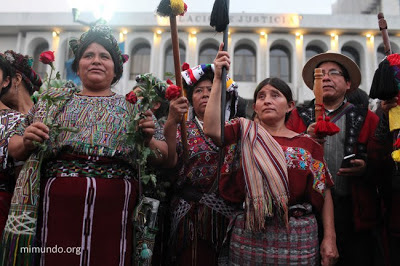 |
The historic sentence was greeted by cries of "Justice!", the singing of hymns, and emotional displays of appreciation by Ixil witnesses and other members of the public. "After so much struggle, we've finally achieved our goal," said a member of the Association for Justice and Reconciliation.
Although the court's ruling is sure to be subjected to ongoing challenges, now is not the moment for doubt. Now is a moment to fill our hearts in celebration of the years of dedication and toil that have led to this victory. It is a time for solemn remembrance of the many who have not lived to see justice, but in whose names this struggle has been carried forward.
Today proves that the bonds of solidarity and memory can triumph over violence and forgetting, that the humblest commitment to truth and justice can in time tear down the wall of impunity.
From the bottom of our hearts we thank you for your constant vigilance and accompaniment of the survivors, witnesses, and human rights defenders that have made today possible. We ask you to deepen your support in the coming weeks, months, and years as struggles for justice and self-determination in Guatemala continue in the face of threats both new and old.
Above all, we ask that you join us in celebration, in raising our voices worldwide in a chorus of justice.
In enduring and grateful solidarity,
The entire NISGUA team, now and over three decades in solidarity with the people of Guatemala.
Genocide on Trial, Day 27: Genocide trial closes and moves to deliberations
NISGUA continues live coverage of the trial in Guatemala of Efraín Ríos
Montt and José Mauricio Rodríguez Sánchez for genocide and crimes against
humanity.
Read our previous summaries: Day 1, 2, 3, 4/5, 6, 7, 8, 9, 10, 11-14, 12, 13/14, 15/16, 17/18, 19, 20-1, 20-2, 21, Constitutional Court decisions, trial suspension, Day 22, 23, 24/25, 26-1, 26-2 and our full archive of ongoing live Twitter coverage.
The final day of the genocide trial began at 8am, as Judge Yassmín Barrios convened earlier in order to accommodate a hearing in Judge Carol Patricia Flores’ court at 8:15am.
The proceedings were short, as expected. José Mauricio Rodríguez Sánchez was given the opportunity to make a request to the court and he made a brief statement. He stated his innocence, reiterating his defense attorney arguments that he did not have the position or power of command to be responsible for the acts of genocide and crimes against humanity.
#JMRodríguez closes: I'm not guilty of anything, I'm innocent. I ask for freedom.
— NISGUA (@NISGUA_Guate) May 10, 2013
Judge Barrios then declared the public oral debate of the genocide case trial concluded, marking the end of proceedings with a resounding pound of her gavel. She announced the verdict would be given at 4pm MDT today. Judges Barrios, Pablo Xitumul and Patricia Bustamante then left for deliberations. Many members of the press and observers in the public gallery decided to remain in the courtroom throughout the day, in order to be assured of seating for the 4pm verdict.
As the judges began their deliberations, Judge Carol Patricia Flores held a parallel hearing at 8:15am, in accordance with a Constitutional Court resolution ordering her to reconsider her April 18 decision. She affirmed her prior decision to roll-back the genocide trial process to November 2011. Representatives of CALDH stated the ruling would not have an impact on the scheduled verdict.
Right now, approximately two hours before the scheduled verdict, the courtroom is already filling up with survivors, supporters, media and human rights observers, all awaiting the outcome of this historic trial. Join us for live tweeting as we broadcast the play-by-play of the verdict: 3pm Pacific, 4pm Mountain, 5pm Central and 6pm Eastern.
— NISGUA (@NISGUA_Guate) May 10, 2013
NISGUA has provided human rights accompaniment to the witness
organization, the Association for Justice and Reconciliation, and their
lawyers, the Center for Human Rights Legal Action since 2000. We will
continue to bear witness to the truth and bravery of these survivors
throughout this historic trial. To bear witness with us, stay tuned to
our ongoing live Twitter coverage @NISGUA_Guate, like our Facebook page and sign up for email updates.
Genocide on Trial, Day 26: Benjamin Jerónimo on behalf of AJR, "I ask that justice be done... so the survivors can feel peace"
NISGUA continues live coverage of the trial in Guatemala of Efraín Ríos
Montt and José Mauricio Rodríguez Sánchez for genocide and crimes against
humanity.
Read our previous summaries: Day 1, 2, 3, 4/5, 6, 7, 8, 9, 10, 11-14, 12, 13/14, 15/16, 17/18, 19, 20-1, 20-2, 21, Constitutional Court decisions, trial suspension, Day 22, 23, 24/25 and our full archive of ongoing live Twitter coverage.
Benjamin Jerónimo, plaintiff on the genocide trial, was given an
opportunity to address the court and make a request to the judge on
behalf of the survivors and as President of the Association of Justice and Reconciliation. We are honored to
provide the complete unofficial transcript. You can listen to the
recording (in Spanish) of his full statement here. See our full coverage of day 26 conclusions here.
 |
| Benjamin Jerónimo makes statement in genocide trial. Photo: Xeni Jardin |
Good afternoon honorable court. Madame Judge, thank you for the space you’ve given me to speak. The truth is I want to express the following; I want to say to you, in name of the victims, in name of the survivors, in name of Guatemala, I also want to say I'm a survivor of [the massacre of] 256 members of my community in the time of Efraín Ríos Montt.
In name of the Association [for Justice and Reconciliation], I want to express that during this trial, we have seen much opposition on behalf of the defense of the accused. We have seen the opposition that they have not had the courage to [inaudible]. The truth is, God created man and woman in his own image to multiply in the world.
And this image, in the first two articles of the Constitution of Guatemala it is established that the state has the obligation to guarantee and protect life, freedom, security, the peace of those created in God’s image. Nonetheless, honorable tribunal, things were done in the opposite manner by the military. Although they came here to say they were not responsible, that they were coming to the communities to protect the population, this is false. These are lies. I saw them with my own eyes. I didn’t come here to lie. As the witnesses said, one of them said it wasn't only in the Ixil that massacres were committed but in five regions of the country, against the Maya Ixil people.
I want to say to you honorable tribunal, please issue a condemning sentence against those responsible. We ask that a sentence be issued to create precedent for the people of Guatemala. In that time, in 1982, we the indigenous were accused of being terrorists, communists, subversives and genocide was committed. Defenseless children, pregnant women, elderly were killed.
Genocide was committed, crimes against humanity were committed and today, 100 witnesses came to tell the truth, to ask for justice for all that we suffered, publicly.
Even our lawyers are being threatened, for being subversives, terrorists, communists. However, honorable tribunal, a terrorist never comes to ask for justice through and in accordance with the law as we have in this tribunal. Never. The military were terrorists because they committed genocide and crimes against humanity. 100s of women and children were disappeared.
The defense lawyers say there is no document that says that it was done intentionally. Nonetheless, honorable tribunal, no one sets fire to their own house. And that’s why it doesn’t appear in any document.
In this manner I supplicate you to do justice, for the murdered victims, so the survivors can feel peace, can feel trust and that they can have a renewed trust in the authorities.
Not only does our Constitution establish justice, respect but there are also international conventions and treaties that obligate respect for the life of human beings. All who died, all the family members that we lost, we were not animals, they were not dogs or beasts or other type of animal, they were human beings who had the right to life, the right to freedom, right to peace, to security. Nonetheless what is established was not complied with.
Also, the bible says, A bad person knows their fellow bad person. Hypocritical people also know their fellow hypocrites. And that’s why much has been discussed in this tribunal so as to not accept the truth. After hearing the witnesses, the experts, once again they accuse us of being guerrillas, subversives, communists.
In this way, I ask you once again, honorable tribunal, that you do justice in accordance with the law, in accordance with our Guatemalan constitution, in accordance with international treaties & conventions. Also, that those responsible for genocide and crimes against humanity be investigated and prosecuted.
I also ask you, we should no longer have the military in communities, continuing to threaten the Ixil people, the Maya people, the Achí people. It’s no longer time for that; this is why the Peace Accords were signed, to respect rights.
Also, the family members, those linked to them, the veterans’ association, they come to this tribunal, they say publicly that this justice endangers the peace accords. This is false, honorable tribunal.
We are not looking for vengeance, we are looking for a true peace with justice, with respect, with equality, with dignity, that is why we are here.
So I ask you once again, the moral reparations to the victims, the protection of the witnesses, of our lawyers, that all of the Maya people be respected and protected. It is written that it's easier for a camel to pass through the eye of a needle than for a rich genocidal person (un rico genocido) enter into the kingdom of heaven.
NISGUA has provided human rights accompaniment to the witness organization, the Association for Justice and Reconciliation, and their lawyers, the Center for Human Rights Legal Action since 2000. We will continue to bear witness to the truth and bravery of these survivors throughout this historic trial. To bear witness with us, stay tuned to our ongoing live Twitter coverage @NISGUA_Guate, like our Facebook page and sign up for email updates.
Subscribe to:
Posts (Atom)