Showing posts with label military. Show all posts

Monday, July 28, 2014

Witnesses give pre-trial testimony for Military Diary case

On July 3 and 4, four witnesses presented their testimony to the High Risk Court "B" in anticipation of the upcoming trial in the Military Diary case. Although a trial date has yet to be set, the court allowed the elderly witnesses to give their testimony, which will be admitted as evidence when procedural issues, currently impeding the start of the trial, are resolved.

Witnesses in the Military Diary case provide their testimony to a Guatemalan court.
Photo: elPeriódico

The Military Diary was anonymously withdrawn from the Guatemalan Military Archives and handed over to the U.S. based The National Security Archive, in 1999. The document lists the names of 183 people who were captured and forcibly disappeared during the term of dictator Oscar Humberto Mejía Victores, from 1983-1985. Alongside each name is a picture of the victim and details of their disappearance, including the date and location of their kidnapping by state security forces, as well as personal information about the victim. The majority of the entries are classified as "code 300", which was terminology used by the military to express that the victim had been executed.

The 54 page document has been authenticated by both the National Security Archive and the Guatemalan government, and provides an in-depth look into the systematic human rights abuses committed by the state against the civilian population. The document demonstrates the government's use of forced disappearance, torture and extra-judicial killings as integral strategies in its counter-insurgency effort.

A page from the Military Diary.
Photo: Centro de Medios Independientes
The details outlined in the Military Diary was corroborated by the women who provided their testimonies earlier this month. One of the witnesses, Aura Elena Farfán, president of the Association of the Family Members of the Detained and Disappeared of Guatemala (FAMDEGUA), recounted the forced disappearance of her brother, Rubén Amílcar Farfán, which occurred on May 15, 1984. At the time of his disappearance, Rubén was a student at the San Carlos University in Guatemala City.

Another witness, 77 year old Antonia Chiquil Aguilar, testified to the disappearance of her son, Manuel Ismael Salanic Chiguil. According to Aguilar, on the night of February 14, 1984, unidentifiable men dressed in blue and green violently entered her house in Guatemala City. Aguilar was forced to watch as the men repeatedly hit her son and subjected him to electric shocks before kidnapping him. Manuel was never to be seen again.

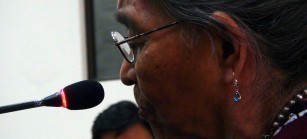
Antonia Chiquil Aguilar relates her testimony to the court.
Photo: Centro de Medios Independientes

Pushing the search for justice in national courts forward is the 2012 ruling by the Inter-American Court of Human Rights, which states that the Guatemalan government has the responsibility to conduct a full investigation into the forced disappearances listed in the Diary and prosecute those responsible.

NISGUA, through the Guatemalan Accompaniment Program and ACOGUATE, provides international human rights accompaniment to FAMDEGUA.


Wednesday, May 8, 2013

Genocide on Trial, Day 24/25: Defense incensed and exposed, Judge moves to concluding arguments

NISGUA continues live coverage of the trial in Guatemala of Efraín Ríos Montt and José Mauricio Rodríguez Sánchez for genocide and crimes against humanity.

Read our previous summaries: Day 1, 2, 3, 4/5, 6, 7, 8, 9, 10, 11-14, 12, 13/14, 15/16, 17/18, 19, 20-1, 20-2, 21, Constitutional Court decisions, trial suspension, Day 22 and our full archive of ongoing live Twitter coverage.

A complex entanglement of legal motions in lower and higher courts has plagued the genocide trial proceedings since they were halted on April 19. For great legal background we recommend RiosMontt-Trial.org, in particular the postings on legal battles during the temporary trial suspension, appeals court rulings earlier this week and Constitutional rulings yesterday. Expect analysis on additional rulings issued today on the RiosMontt-Trial blog tomorrow.

Yesterday, May 7, the genocide trial proceedings were the shortest yet, clocking in at just under 30 minutes due to the absence of Ríos Montt defense lawyer Francisco García Gudiel. García Gudiel called in sick to the courtroom, telling the court secretary he was "gravely ill".

Today started with the reappearance of two lawyers who participated in the April 19 walkout: Cesar Calderón for José Mauricio Rodríguez Sánchez and Francisco Palomo for Efraín Ríos Montt. Despite multiple requests to be removed from the case once Calderón was reinstated as Rodríguez Sánchez' lawyer, public defender Otto Ramírez was not removed from the defense. Judge Barrios indicated the need to ensure continuity in the event Calderón abandoned the defense once again.

Proceedings continued with a long and heated argument by Gudiel, touching on legal points ranging from the recusal of Judges Barrios and Xitumal to the annulment of yesterday's proceedings because he was not present due to illness.

Before the judges could move to deliberations, public prosecutor Orlando López interjected with a surprising announcement:

The audience then viewed date/time-stamped videos and stills showing Gudiel walking without difficulty. The prosecution argued against Gudiel's motion to annul yesterday's proceedings, as well as the point of recusal.

After deliberating, the judges ruled against Gudiel stating the trial proceedings would move forward. What followed was a tirade from Gudiel that stunned courtroom observers and later prompted a complaint to be filed before the Guatemalan Bar Association.


The judges, after calmly listening to Gudiel, address the court.

After deliberating Judge Barrios stated, "It’s important to state we don’t accept threats of any kind...We don't accept threats of any kind because we believe in judicial independence." They once again reject Gudiel's motion and order the trial to continue after the lunch recess.

Upon return from the lunch hour, Judge Barrios asked for the defense to present their final witnesses. Habitually unable to provide them when called upon, the defense once again offered reasons why they didn't have witnesses ready, asking for a continuance until the morning. The judges did not accept the requests attempting to delay the trial further, stating the defense has had ample opportunities to present their witnesses as well as an obligation to have their evidence ready starting at the beginning of the trial. It is important to note 94 Ixil survivors travelled great distances to give their testimony at the start of the trial, without delaying the proceedings.

Then, incredibly, Judge Barrios asked the public prosecutor's office to present their closing arguments. After almost three weeks of delays, dashed and then revitalized hopes, legal battles and suspended hearings, the genocide trial moved into the conclusions phase, a stage in the trial process many had both expected and doubted would ever happen.

Public prosecutor Orlando López' closing arguments began by outlining Ríos Montt's consolidation of state power, with an analysis particularly relevant to current events taking place in Guatemala.

A presentation displayed to the court provided analysis of the military's Counterinsurgency Manual, Plan Victoria 82 and Plan Sofía documents, the National Development Plan and defense witness Quilo Ayuso's testimony. This included an outline of the military's structure and chain of command, high military command's planning and operations strategies, as well as communications structures to show the defendants were aware of the implementation of their plans. The public prosecutor discussed the military's definition of the Ixil people as an internal enemy of state, the use of sexual violence and the forced transfer of Ixil children. In addition to document evidence, López provided a summary of the 94 eyewitness testimonies heard during the first weeks of the trial and the forensic anthropology evidence submitted.

We will be publishing in-depth coverage of the prosecution's concluding arguments soon; stay tuned.

The public prosecutor's arguments concluded with the request that Efraín Ríos Montt and José Mauricio Rodríguez Sánchez be found guilty of genocide and crimes against humanity and given the maximum sentence of 75 years.

Tomorrow civil plaintiffs from the survivor organization AJR (Association for Justice and Reconciliation) and CALDH (Center for Human Rights Legal Action) will each have two hours to provide their closing arguments, at which time the concluding statements from the defense will be heard. After conclusions, the plaintiffs and defendants will be given the opportunity to make requests of the court. It is anticipated that AJR President Benjamin Jerónimo will make a statement on behalf of the victims and survivors.


NISGUA has provided human rights accompaniment to the witness organization, the Association for Justice and Reconciliation, and their lawyers, the Center for Human Rights Legal Action since 2000. We will continue to bear witness to the truth and bravery of these survivors throughout this historic trial. To bear witness with us, stay tuned to our ongoing live Twitter coverage @NISGUA_Guate, like our Facebook page and sign up for email updates
 

Friday, May 3, 2013

Guatemalan gov't declares state of siege in municipalities surrounding Tahoe Escobal mine

During the early hours of Thursday, May 2, one day after the first anniversary of the state of siege in Santa Cruz de Barillas, Huehuetenango, the Guatemalan government declared another state of siege in four municipalities surrounding Tahoe Resources’ Escobal mine. The imposition of martial law comes less than one month after Minera San Rafael, Tahoe Resources wholly-owned Guatemala subsidiary, received its final permit for mineral exploitation. The permit was granted without the consent of the affected communities and in a context of escalating violence and criminalization against human rights defenders and their legal council.

Over the past three years, four municipalities, including two of those currently under a state of siege, carried out municipal level community referenda rejecting mining projects in their territory. During the past two months, eight villages in San Rafael Las Flores have carried out community referenda, given that attempts to organize a municipal level consultation were thwarted by legal appeals and injunctions filed by individuals who work for Minera San Rafael. In each of these referenda, the population voted overwhelmingly against the Escobal project.
"With the referedum we decide our future" Banner of the Committee in Defense of Life and Peace (Photo: NISGUA)
In a press conference yesterday, President Otto Pérez Molina and Minister of the Interior Mauricio López Bonilla explained that the suspension of basic civil liberties is in effect for the municipalities of Casillas and San Rafael Las Flores, in the department of Santa Rosa, as well as Jalapa and Mataquescuintla, in the department of Jalapa.

State of siege in Santa Rosa and Jalapa (Photo: MiMundo.org)
While Pérez Molina and López Bonilla claim the state of siege is not in response to mine opposition, their actions suggest otherwise. Prominent community activists, members of the Committee in Defense of Life and Peace, and leaders of the community referenda in San Rafael, had their homes raided by police early Thursday morning. The government has issued at least 18 arrest warrants for individuals allegedly involved in delinquent acts, including Roberto Gonzalez president of the Xinca Parliament and Rudy Pirvaral of the Committee in Defense of Life and Peace.

In statements to the press Bonilla attempted to explain that mining opposition has been used as a pretext for the establishment of organized crime in the region. "There is a difference between legitimate conflict and pseudo-conflict...by saying that they are opposing [the mine] through delinquent acts, they are hiding behind the excuse of mining opposition. It favors them to make people believe that there is conflict over mining in all of the municipalities."

State of siege in Santa Rosa and Jalapa (Photo: MiMundo.org)
The past week has seen an increase in conflict and violence in the departments surrounding the mine site.

On Saturday, April 27 mine security shot at and injured six community members, as they walked on a public road located in front of the mine installations. One of the men remain in the hospital in critical condition. Alberto Rotondo, head of security for Tahoe Resources' subsidiary, Minera San Rafael, is being held responsible for the attack. Medical personnel confirmed the attack was carried out with live ammunition, as well as rubber bullets, despite initial declarations from the company and López Bonilla which claimed only non-lethal measures were used. On the morning of April 30, Guatemalan authorities arrested Rotondo in the airport as he attempted to flee the country. Rotondo has been formally charged with attempted homicide.

On Monday the 29th, as Minera San Rafael management and the Guatemalan government signed an agreement outlining the royalties to be paid to the state, more than 2,000 residents of San Rafael Las Flores took to the streets in a peaceful march in opposition to the mine project. Later that afternoon, community members intercepted and detained 23 members of the national police in Jalapa, believing that they were mobilizing to repress the march in San Rafael. An operation carried out by the national police the following day resulted in the release of the officers.

Later that same day, a member of the National Police was killed in an armed attack carried out by a group of masked men in Sabana Redonda, a community located near the mine site. While this incident is still under investigation by Guatemalan authorities, the attack matches the pattern previously denounced by human rights organizations, which is characterized by illegal clandestine groups intent on creating instability in the region and delegitimizing peaceful opposition to the mine.

These recent events highlight the need for an in-depth investigation into the attacks and violence being carried out in communities surrounding the mine site, as was called for in the petition of over 4,000 signatures delivered by NISGUA to Guatemala’s Public Prosecutor’s office in early April.

Despite government claims on Thursday that they are in dialogue with mine affected communities, the deployment of 8,500 military and police to the four municipalities suggests otherwise. Far from acting as a mediator, the Guatemalan government has instead chosen to respond to conflict with the repression of communities opposing large-scale development projects and the stigmatization of community leaders and human rights defenders.


NISGUA has been accompanying the consultation processes in the communities surrounding the Tahoe Resources mine site since 2011.

Wednesday, April 17, 2013

Genocide on Trial, Days 17 & 18: AJR Responds to Efforts to Delegitimize the Trial

NISGUA continues live coverage of the trial in Guatemala of Efraín Rios Montt and Mauricio Rodríguez Sánchez for genocide and crimes against humanity.


Read our previous summaries: Day 1Day 2Day 3Day 4/5Day 6Day 7, Day 8, Day 9, Day 10, Day 12, Days 13/14, Days 15/16 and full archive of ongoing live Twitter coverage.

Days 17 and 18 of the genocide trial continued with expert testimonies, called by both the prosecution and defense. Expert Héctor Rosada Granados, a Guatemalan political analyst, opened day 17 and testified on the Guatemalan military's structure, ideology and chain of command. Rosada explained, "Guatemala's National Security Doctrine has its basis in the Cold War, in a climate of polarization between capitalism and communism."
University of Arizona Professor, Elizabeth Oglesby, testified on her experience studying displacement in the Ixil region while completing anthropological research with Myrna Mack. Eduardo Vasquez Arriaza followed Oglesby and complimented her testimony with maps of the displacement of the Ixiles during the conflict. Rodolfo Robles, a Peruvian former army general, dominated the afternoon's testimonies for the prosecution. Robles, who has previously testified in the Guatemalan case of the Dos Erres massacre and also against Peruvian ex-President Alberto Fujimori, provided a wealth of information around military terminology and command.
Judge Barrios ended day 17 reminding the defense team to come prepared to present their witnesses the next morning. The defense called two witnesses on Day 18 - Mauricio Illescas García, former lieutenant during Ríos Montt's regime, and Alfred Antonio Kaltschmitt Luhan, director of FUNDAPI (the Foundation to Aid the Ixil Indigenous People) and frequent right wing public commentator. The defense, however, was not prepared with more witnesses. Instead, the courtroom turned their attention to the prosecution's video evidence of 1982 interviews conducted by documentary filmmaker Pamela Yates. Viewing the three interviews with Efraín Ríos Montt, General Luis Gordillo Martínez and General Horacio Maldonado Schaad created a truly eery atmosphere in the courtroom on Tuesday afternoon. Ríos Montt was forced to watch his younger self, projected on the courtroom wall, proclaim, "If I can't control the army, then what am I doing?"

For additional coverage of the trial's expert testimonies from days 17 and 18, we recommend Kate Doyle's excellent summaries from Monday and Tuesday and journalist Xeni Jardin's account from inside the courtroom here.

Outside the courtroom, efforts continue to try to delegitimize the genocide case. A 10-page paid insert titled "The Farce of Genocide in Guatemala: a conspiracy perpetrated by Marxists with the Catholic Church" was published in Guatemala City-based newspaper El Periódico on Sunday, April 14. On Tuesday, two Guatemalan newspapers ran a false paid political advertisement in the name of the Association for Justice and Reconciliation (AJR). We have translated the AJR's statement in response to the ad below. You can view the original statement in Spanish here.


Statement by the Association for Justice and Reconciliation
The false paid political ad, published April 16th, is a new form of “dirty war”
Translation by NISGUA

On Tuesday, April 16, a false paid political advertisement was published in two Guatemalan newspapers, featuring the logo of the Association for Justice and Reconciliation (AJR) and the logo of an alleged "Movement for Guatemalan Progress," unknown to our organization until now. [This paid ad] opens a new chapter in the campaign of disinformation against social organizations that work for justice and against impunity.

The malicious and false publications previously mentioned show the photograph of a woman who is unaffiliated with the AJR, as well as an image of the AJR's logo extracted from a snapshot of the AJR's website where it is published. This implies multiple violations of the law as well as a clear intention to act through all available means with deceptive tricks characteristic of a “dirty war,” illustrating the mentality of its authors.

The AJR categorically rejects this apocryphal publication, which adds to the libel that came to light publicly on Sunday, April 14 of this year, which aims to confuse the Guatemalan population and revive the monsters of the psychological counterinsurgency warfare of the 1980s. Likewise, we announce that we have initiated the corresponding legal actions in order to find who, lacking all ethics, is responsible for publishing these types of documents and to identify what individual or legal entities orchestrated this campaign, which bears the mark—in form and content—of an intelligence operation, anachronistic and outdated, in accordance with the backwards mentality of groups that remain frozen in the past.

The AJR, as the plaintiff in the case accusing José Efraín Ríos Montt and José Mauricio Rodriguez Sánchez of genocide in the Ixil region between 1982 and 1983, deplores the attempt to use dishonest practices to hinder and discredit the current judicial process. We call on the population, organizations and institutions to reject reactionary methods so that we can advance toward a future of reconciliation, with justice and full respect for the individual and collective rights of all Guatemalans.


NISGUA has provided human rights accompaniment to the witness' organization, the Association for Justice and Reconciliation, and their lawyers, the Center for Human Rights Legal Action since 2000. We will continue to bear witness to the truth and bravery of these survivors throughout this historic trial. To bear witness with us, stay tuned to our ongoing live Twitter coverage @NISGUA_Guate, like our Facebook page and sign up for email updates.

You can take action to support these brave witnesses! Sign our pledge to commit to following the genocide trial and take a photo for justice with your friends.

Monday, April 15, 2013

Genocide on Trial, Days 15 & 16: Experts testify, "The Ixil social fabric was destroyed in the attack against their culture"

NISGUA continues live coverage of the trial in Guatemala of Efraín Rios Montt and Mauricio Rodríguez Sánchez for genocide and crimes against humanity.


Read our previous summaries: Day 1Day 2Day 3Day 4/5Day 6Day 7, Day 8, Day 9, Day 10, Day 12, Days 13/14 and full archive of ongoing live Twitter coverage.

The proceedings on April 11, day 15 of the genocide trial, started with a formal protest by the prosecution, with Edgar Pérez filing a formal protest that entrance to the courtroom and public bathroom access has been limited to the indigenous survivors coming to witness the historic trial against Efraín Ríos Montt and José Mauricio Rodríguez Sánchez.
The defense also started their day off with a motion, requesting the trial be suspended for two days so that José Mauricio Rodríguez Sánchez could visit a doctor only available weekdays. Opting not to suspend the trial, Judge Jazmin Barrios ruled he could be absent from the trial on April 12 until 2PM.

The day continued with extensive testimony by expert witnesses, most notably that of political analyst Marco Tulio Álvarez Bobadilla, former director of the Peace Archives, and Ramón Cadena, President of the International Commission of Jurists.

Álvarez submitted a report on the displacement of children in the Ixil region analyzing the military plans Victoria '82, Firmeza '83 and Operation Sofia. He highlighted the broader guidelines established by the military, which translated into operations and actions in the field.
The displacement of children was not an isolated act but a policy followed by the military institution...children were included as an internal enemy [of the state]. ... Children are identified in the army manual, which includes enemies that were not participants in the subversion but supporters. This broadened the definition of internal enemy.
In a particularly disturbing example of children as targets, Álvarez read a military report from the field included in Plan Sofia. A woman was hiding and upon discovery soldiers killed her, "eliminating her and two chocolates". Chocolates, said Álvarez, were the military's designation for children.

Álvarez also named the military strategy targeting children as an attack against the Maya Ixil culture, an element of genocide.
In many cases the transfer of children meant forced disappearance, with family members unable to locate them afterwards. ...These children were denied their identity…the social fabric was destroyed in the attack against the Ixil culture.
Lawyer Ramón Cadena followed Álvarez to testify on human rights violations of the Ixil civil population. Cadena, President of the International Commission of Jurists and an expert in international law, explained Guatemala's responsibility to comply with international law.
The Guatemalan state has certain obligations and commitments to fulfill under international human rights laws. The civil population is protected in armed conflicts by international law and customs of the international community. The Martens Clause, (ratified by the Hague in 1899), says that civil persons and combatants are protected by principles of human right, the principles of humanity and the demands of public conscience. Guatemala has ratified international human rights conventions - Geneva, Hague & Genocide conventions which all have relevance to the violations committed against Ixil people.
Using key passages from military plans, Cadena illustrated not only the military's intention to dismiss international standards of protecting the civil population but also their blatant violation of civilians' rights.
The military Plan Victoria 82 says, “The great masses of indigenous in the highlands of the nation have found an echo in the proclamations of subversives.” Plan Operation Sofia names 100% of the Ixil population as supporters of the subversives.The military doctrine allows justification of cruel attacks against the civil population and genocide against the Ixil population. Plan Firmeza 83 establish on pages 5-8, “The principal objective is to reach their physical and psychological control of the population.”

By 1981, an Inter-American Commission on Human Rights (CIDH) document concluded, "a situation has been created in Guatemala in which a lack of respect for human life and the laws that protect them predominate… The application of physical and psychological constraints of cruel and inhuman treatment has transgressed the limits of being a method of obtaining information or inflicting punishment, and has become a system of killing citizens." 
The military tried to achieve physical and psychological control of the population by using a number of tactics including massive attacks, torture, persecution, rape and forced displacement.
Some 40,000 refugees were displaced to Mexico and 200,000 were internally displaced. We have not yet measured the psychological impacts for the refugees. International human rights law prohibits forced displacement as a method of war and is also a method of genocide. In my opinion, forced displacement of the civil population should be considered an element of genocide.
Genocide is a crime defined by the intention to destroy a group either completely of partially.  In Guatemala, Cadena concludes, "The state designed a system to kill its citizens and it was focused on the Ixil region."

Day 16 included expert testimonies on a range of topics and featured experts: psychologist Nieves Gomez, historian Ángel Valdez Estrada, statistician Patrick Ball and specialist in woman's law Paloma Soria. Nieves Gomez, a psychologist with Guatemala's Community Studies and Psychosocial Support Team (ECAP), testified on the lasting effects of trauma suffered during conflict describing what is known about the psychological impacts of the victims which Cadena referred to.
Lasting effects include post-traumatic stress, living in state of anxiety, strong disorientation and disassociation and extreme continual stress, a lack of trust toward the state. In the case of rape, the lack of recognition of what happened, stigmatizes the victim and further polarizes society.
Fundamentally, "human beings have a desire to belong to a group - they need to feel pertinence and belonging. Humans need mutual support in order to grow.... Elements that identify a group can represent belonging for oneself- In the case of the Maya Ixil - dress, daily rituals, spirituality, daily use of home." One of the most devastating effects of the conflict is the difficulty to preserve culture rituals creating a rupture in the very group that victims had once belonged to, creating a gap from one generation to another. In the conflict, "no one trusted anyone. Often silence was the most sure way to save one's life." Moreover, "Massacres weren't punctual events, they took hours creating prolonged anxiety of death."

However, on a positive note, the example of tribunals in Rwanda has demonstrated that the damage from conflict doesn't have to be permanent or irreversible. "Survivors can overcome trauma." Gomez affirmed that there is much work to be done in the recuperation of the Maya Ixil social fabric but she emphasized, "it's important for the Maya Ixil community itself to decide how they want to achieve justice."  Finally, she concluded with this poignant quote from Mexican poet Javier Sicilia, 
A victim is someone who has returned from death, to a world he no longer entirely belongs to. Being in this world I can understand joy, but I am not entirely here. I am carrying a bit of death inside of me. This is difficult to share with others, but nor am I sure that others are prepared to hear the scale of what I am carrying.

Ángel Valdez Estrada
, historian and professor at the San Carlos University in Guatemala, testified on the systematic attack against the Maya Ixil people. He explained, the attack "required planning and intention…The military's tactic was to use short but repeated attacks because that's what helped them maintain constant fear and create distrust." Valdez qualified Ramón Cadena's observation of the military's intent to control the Ixil, as explained in military plans.

Why would the military target the Ixil?
The Ixil culture is in direct conflict with the nation's historical project of one singular culture. Cultural indicators like the dress, language & cosmovision, are relevant because they allowed the military to identify the Maya Ixil. If we all speak one language, then we have to share the same culture. Through the colors, the weaving, the Ixil's dress identifies them as an object of war… Culture is an element of resistance in conflicts. It represents courage to not break or be divided. Some indigenous people don't speak Spanish, they don't want to and it's a defense mechanism.

Was there intent to destroy the Ixil ethnicity?
Yes.

Patrick Ball
, a statistician and US citizen, gave quantitative support to earlier expert's conclusions. Ball, in his technical analysis, concludes the Guatemalan military killed indigenous people 8 times more than non-indigenous. During the period of April 1982 - July 1983, a narrowed range of the full dates implicated in the trial (March 23, 1982 to August 8, 1983), Ball found that of all the deaths committed by the military, they killed 5.5% of the indigenous population while they killed  only .7% of the non-indigenous population.

Ball's objective as a statistician is to identify bias in testimony. While there is a small margin of error, he claims "statistics knows no bias." Ball has spent more than twenty years conducting quantitative analysis for truth commissions, the UN, and international criminal tribunals. Read his full report, "State Violence in Guatemala 1960-1996" here.

Paloma Sorias, a specialist in international law and gender, rounded out day 16's riveting expert testimonies. Sorias currently works at Women's Link Worldwide in Madrid. Sorias's expert testimony focused on the specificity of women victims in the conflict. Warning: this section might be triggering due to descriptions of extreme sexual violence.
Maya women were systematically raped. Practice of discrimination toward women is part of destroying the social fabric. While men can also be subject to sexual violence, certain aspects like forced pregnancy and forced abortion exclusively affect women. Of all victims of sexual violence, 99% of cases included women victims of which 35% were girls under the age of 18 and 3% elderly.

I had access to Plan Victoria 82, in it there were plans for sexual violence. A passage from Annex F determines that soldiers on military bases were guaranteed have free days in which they could "eat, clean, wash clothes, and have access to the opposite sex". In other words it alluded to sexual slavery.
The definition of sexual violence however doesn't include just rape. Soria explains, "threats of rape or the threat of having to witness family member be raped can be considered an act of sexual violence. I also consider denying access to sexual and reproductive health also as act of sexual violence."

All in all, "sexual violence is way to impose power over another." Soria concluded, "I think that all the acts to disrupt the reproduction of a group through sexual violence, provide proof of the intention to destroy the Maya Ixil people. There was intention to commit genocide."


NISGUA has provided human rights accompaniment to the witness' organization, the Association for Justice and Reconciliation, and their lawyers, the Center for Human Rights Legal Action since 2000. We will continue to bear witness to the truth and bravery of these survivors throughout this historic trial. To bear witness with us, stay tuned to our ongoing live Twitter coverage @NISGUA_Guate, like our Facebook page and sign up for email updates.

You can take action to support these brave witnesses! Sign our pledge to commit to following the genocide trial and take a photo for justice with your friends.

Friday, April 12, 2013

Genocide on Trial, Days 13 & 14: Defense experts testify, "There was never intention to commit genocide"

NISGUA continues live coverage of the trial in Guatemala of Efraín Ríos Montt and Mauricio Rodríguez Sánchez for genocide and crimes against humanity.


Read our previous summaries: Day 1Day 2Day 3Day 4/5Day 6Day 7, Day 8, Day 9, Day 10, Day 12, Days 11-14, and full archive of ongoing live Twitter coverage.

On days 13 and 14, the court heard four controversial testimonies from experts called by the defense team. These experts were originally been denied approval to testify in the trial because the defense team submitted their names after the established deadline. However, the defense team appealed this ruling made by Judge Gálvez on February 4th and an appeals court approved the experts. On the second day of the trial, Judge Barrios recognized the appeals court's decision and swore in Manuel Eduardo Conde Orellana, José Luis Quilo Ayuso, Benjamin Rafael Francisco Godoy, and Carlos Leonel Mendez Tejada.

Carlos Leonel Mendez Tejada took the lead of the defense experts and testified on day 13, April 9th. A former Colonel of Engineers, Mendez Tejada was called to testiy on the military's chain of command. He explained that the chain of command of the president or head of state has changed historically in Guatemala. During times of peace, the president's role was limited; during wartime, the president maintained strong command. Despite testifying on behalf of the defense, expert Mendez Tejada confirmed:
Public prosecutor (MP): Can lower ranks go against strategies they receive?
Mendez Tejada: They can take initiative to change a situation if they're unhappy, always informing the Army Chief of Staff of changes.
MP: Does the army have discipline and hierarchy?
Mendez Tejada: Those are the army's identifying characteristics and they have always been maintained.

MP: Who is the country's highest authority?
Mendez Tejada: The president of Guatemala.
MP: Did you know that Guatemala was governed by a military junta from March 1982 to 1983?
Mendez Tejada: Of course.
MP: Who was the highest authority then?
Mendez Tejada: The president.
Starting in the early morning, the courtroom setting felt distinctly tense on day 14. Public attendance was higher than recent days and featured a number of high profile faces making for a dynamic crowd. Foreign diplomats were in attendance, including Alberto Brunori, representative of the UN's High Commissioner for Human Rights in Guatemala, and the first sighting of US Ambassador Arnold Chacon. In the afternoon, the US embassy released a statement confirming its support for justice and reconciliation in Guatemala, "as reflected in the Peace Accords."

Pro-military sign outside the courtroom. "The world is upside-down! ...We demand fair trials for military officials."

Well-known military supporters and family members, including Zury Ríos Montt and Ricardo Méndez Ruiz, president of Guatemala's Foundation Against Terrorism, also held a strong presence. However, human rights defenders and sympathizers continued to be the majority in the courtroom. From the early morning, National Coordination of Guatemalan Widows (CONAVIGUA) founder and director, Rosalinda Tuyuc, and Human Rights Defenders Protection Unit (UDEFEGUA) director, Claudia Samayoa, showed their support for the trial. In the afternoon, Nobel laureate Rigoberta Menchu Tum joined the already-crowded audience.

Moreover, Manuel Eduardo Conde Orellana was called to testify on day 14 only shortly after Fredy Peccerelli's highly technical testimony on forensic evidence that validates the massive and violent character of military operations in the Ixil region. Conde Orellana testified on his work with the reconciliation commission on Guatemala's peace negotiations leading up to the signing of Guatemala's Peace Accords in 1996. He cited the importance of reconciliation in the peace process and the challenges caused by high levels of mistrust at the negotiation table between the Guatemala National Revolutionary Unity (URNG) representatives and military representatives.

As one of his qualifications to work in peace negotiation, Conde Orellana took the opportunity to cite that his own father, Oscar Conde, was killed by rebel forces, which he called "an untried and unrecognized murder." When asked what methodology he used in his report, Conde Orellana replied, "I used the method of narration, transcription and my personal experiences." He repeated throughout his testimony the idea that the violence was global and not at all particular, "No one can say that the violence didn't affect him or her. No one can say they didn't know anyone who shed blood in internal armed conflict."

Defense expert José Luis Quilo Ayuso followed Conde Orellana to testify on military terminology and chain of command. Quilo Ayuso is well known as a former military official. In fact, he is the current president of Guatrmala's Association of Military Veterans (AVEMILGUA), which often hosts public actions in defense of military officials accused of crimes of the past.

The Public Prosecuter (MP) probed: Outside of the courtroom you've participated in public demonstrations of your support for the accused, correct?
Quilo Ayuso: Yes, as part of my association.
MP: As part of AVEMILGUA, are you in favor of the association's paid ad campaigns?
Quilo Ayuso: Yes, of course
MP: You've taken part in radio programs and said in public that there wasn't genocide?
Quilo Ayuso: Following my criteria, there was never intention to commit genocide.
Quilo Ayuso ended his testimony by confirmed that a national military intelligence network existed and continues to exist in Guatemala. He affirmed that General Rodríguez Sánchez was director of the network from 1982 to 1983.

The final defense expert Benjamin Rafael Francisco Godoy testified on the internal armed conflict and the insurgency in the Ixil region. Godoy's experience in the Guatemalan military spans the military hierarchy, including serving as Kaibil, specialists in counter-insurgency operations. Godoy was asked if he belongs to any military or ex-military associations and he confirmed that he also is a member of AVEMILGUA. He repeated a familiar military narrative in his testimony. He explained, "the entire national territory, 22 departments of Guatemala were affected by the 4 different guerrilla fronts." However, when asked who was the country's "internal enemy," he claimed he was unfamiliar with the term. Godoy's report, similar to earlier defense expert's contributions, lacked facts to prove his conclusions and presented a number of contradictions.
Public Prosecutor (MP): If your report is based in history, why didn't you include information on clandestine mass graves that have been discovered on military bases throughout the country?
Godoy: At the time I conducted my study, I didn't have that information.
MP: So your expert report is in fact based in history and not military narrative?
Godoy: Yes.
Judge Barrios ended day 14 noting that defense expert Godoy had not signed off on his report, thus not fulfilling proper legal procedure.


NISGUA has provided human rights accompaniment to the witness' organization, the Association for Justice and Reconciliation, and their lawyers, the Center for Human Rights Legal Action since 2000. We will continue to bear witness to the truth and bravery of these survivors throughout this historic trial. To bear witness with us, stay tuned to our ongoing live Twitter coverage @NISGUA_Guate, like our Facebook page and sign up for email updates.

You can take action to support these brave witnesses! Sign our pledge to commit to following the genocide trial and take a photo for justice with your friends.