Showing posts with label FAMDEGUA. Show all posts

Monday, July 28, 2014

Witnesses give pre-trial testimony for Military Diary case

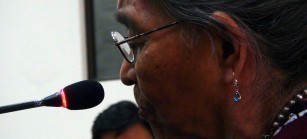
On July 3 and 4, four witnesses presented their testimony to the High Risk Court "B" in anticipation of the upcoming trial in the Military Diary case. Although a trial date has yet to be set, the court allowed the elderly witnesses to give their testimony, which will be admitted as evidence when procedural issues, currently impeding the start of the trial, are resolved.

Witnesses in the Military Diary case provide their testimony to a Guatemalan court.
Photo: elPeriódico

The Military Diary was anonymously withdrawn from the Guatemalan Military Archives and handed over to the U.S. based The National Security Archive, in 1999. The document lists the names of 183 people who were captured and forcibly disappeared during the term of dictator Oscar Humberto Mejía Victores, from 1983-1985. Alongside each name is a picture of the victim and details of their disappearance, including the date and location of their kidnapping by state security forces, as well as personal information about the victim. The majority of the entries are classified as "code 300", which was terminology used by the military to express that the victim had been executed.

The 54 page document has been authenticated by both the National Security Archive and the Guatemalan government, and provides an in-depth look into the systematic human rights abuses committed by the state against the civilian population. The document demonstrates the government's use of forced disappearance, torture and extra-judicial killings as integral strategies in its counter-insurgency effort.

A page from the Military Diary.
Photo: Centro de Medios Independientes
The details outlined in the Military Diary was corroborated by the women who provided their testimonies earlier this month. One of the witnesses, Aura Elena Farfán, president of the Association of the Family Members of the Detained and Disappeared of Guatemala (FAMDEGUA), recounted the forced disappearance of her brother, Rubén Amílcar Farfán, which occurred on May 15, 1984. At the time of his disappearance, Rubén was a student at the San Carlos University in Guatemala City.

Another witness, 77 year old Antonia Chiquil Aguilar, testified to the disappearance of her son, Manuel Ismael Salanic Chiguil. According to Aguilar, on the night of February 14, 1984, unidentifiable men dressed in blue and green violently entered her house in Guatemala City. Aguilar was forced to watch as the men repeatedly hit her son and subjected him to electric shocks before kidnapping him. Manuel was never to be seen again.

Antonia Chiquil Aguilar relates her testimony to the court.
Photo: Centro de Medios Independientes

Pushing the search for justice in national courts forward is the 2012 ruling by the Inter-American Court of Human Rights, which states that the Guatemalan government has the responsibility to conduct a full investigation into the forced disappearances listed in the Diary and prosecute those responsible.

NISGUA, through the Guatemalan Accompaniment Program and ACOGUATE, provides international human rights accompaniment to FAMDEGUA.


Thursday, September 19, 2013

Victim of Río Negro massacre exhumed from Cobán mass grave and buried in Rabinal

Boys carry Martina Rojas' photo through the streets of Rabinal. Photo: CPR Urbana


On September 7, Martina Rojas was buried in Rabinal, Baja Verapaz, 31 years after she was forcefully detained and disappeared from her home community of Río Negro, situated on the banks of the Chixoy River. On May 14, 1982, the Guatemalan military disappeared Rojas and dozens of other Maya Achí victims, as part of a series of massacres aimed at displacing the people of Río Negro in order to make way for the Chixoy dam. It was reported that Rojas was taken away by helicopter to an unknown location, until only recently confirmed to be a military base in Cobán, Alta Verapaz.

Rojas is honored on the eve of her burial. Photo: CPR Urbana

Earlier this year, Rojas' remains were uncovered in the mass grave located in the "Regional Training Command Center for Peacekeeping Operations", or CREOMPAZ, what used to be a functioning military base in Cobán, Alta Verapaz. The Guatemalan Forensic Anthropology Foundation (FAFG) and the Association of Families of the Detained and Disappeared (FAMDEGUA) began exhumations of the mass grave in February 2012. Despite the fact that anthropologists have uncovered the remains of at least 500 people, many with signs of torture, military officials continue to claim that, "The graves that have been discovered in Cobán are part of a cemetery".

So far, FAFG has positively identified seven individuals based on DNA collected and cataloged in their genetic database. Martina Rojas was identified before being buried on September 7 in Rabinal, near the community of Pacux, where her family members and other Río Negro survivors currently live.

The Chixoy river, once only a few inches deep and surrounded by the community of
Río Negro, is now flooded due to the hydro-electric dam. Photo: Elizabeth Bain

Guatemala's National Institute of Electrification (INDE) began speculation for the Chixoy dam project in 1976. Between February and September 1982, during the height of Guatemala's internal armed conflict, at least 444 men, women and children were killed in Río Negro. Financed by the Inter-American Development Bank and the World Bank, construction of the Chixoy dam began in January 1983.

In 2008, a Guatemalan court sentenced five ex-members of the civil patrol to 780 years in prison for the largest massacre in Río Negro, which killed 177 women and children on March 13, 1982. In June 2012, the Inter-American Court of Human Rights heard the Río Negro case and by September emitted a sentence in favor of the survivors. The court strongly recommended that the Guatemalan state search for those who were disappeared, investigate and charge the material authors of the massacres, and assume responsibility for the atrocities committed.

NISGUA provides ongoing human rights accompaniment to the Río Negro survivors and accompanied the 2008 legal process in the national court as well as the 2013 burial of Martina Rojas.