Showing posts with label disappeared. Show all posts

Monday, July 28, 2014

Witnesses give pre-trial testimony for Military Diary case

On July 3 and 4, four witnesses presented their testimony to the High Risk Court "B" in anticipation of the upcoming trial in the Military Diary case. Although a trial date has yet to be set, the court allowed the elderly witnesses to give their testimony, which will be admitted as evidence when procedural issues, currently impeding the start of the trial, are resolved.

Witnesses in the Military Diary case provide their testimony to a Guatemalan court.
Photo: elPeriódico

The Military Diary was anonymously withdrawn from the Guatemalan Military Archives and handed over to the U.S. based The National Security Archive, in 1999. The document lists the names of 183 people who were captured and forcibly disappeared during the term of dictator Oscar Humberto Mejía Victores, from 1983-1985. Alongside each name is a picture of the victim and details of their disappearance, including the date and location of their kidnapping by state security forces, as well as personal information about the victim. The majority of the entries are classified as "code 300", which was terminology used by the military to express that the victim had been executed.

The 54 page document has been authenticated by both the National Security Archive and the Guatemalan government, and provides an in-depth look into the systematic human rights abuses committed by the state against the civilian population. The document demonstrates the government's use of forced disappearance, torture and extra-judicial killings as integral strategies in its counter-insurgency effort.

A page from the Military Diary.
Photo: Centro de Medios Independientes
The details outlined in the Military Diary was corroborated by the women who provided their testimonies earlier this month. One of the witnesses, Aura Elena Farfán, president of the Association of the Family Members of the Detained and Disappeared of Guatemala (FAMDEGUA), recounted the forced disappearance of her brother, Rubén Amílcar Farfán, which occurred on May 15, 1984. At the time of his disappearance, Rubén was a student at the San Carlos University in Guatemala City.

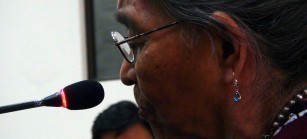
Another witness, 77 year old Antonia Chiquil Aguilar, testified to the disappearance of her son, Manuel Ismael Salanic Chiguil. According to Aguilar, on the night of February 14, 1984, unidentifiable men dressed in blue and green violently entered her house in Guatemala City. Aguilar was forced to watch as the men repeatedly hit her son and subjected him to electric shocks before kidnapping him. Manuel was never to be seen again.

Antonia Chiquil Aguilar relates her testimony to the court.
Photo: Centro de Medios Independientes

Pushing the search for justice in national courts forward is the 2012 ruling by the Inter-American Court of Human Rights, which states that the Guatemalan government has the responsibility to conduct a full investigation into the forced disappearances listed in the Diary and prosecute those responsible.

NISGUA, through the Guatemalan Accompaniment Program and ACOGUATE, provides international human rights accompaniment to FAMDEGUA.


Tuesday, July 15, 2014

Retired military officials arraigned for atrocities at Sepur Zarco military base

Ex-colonel Esteelmer Reyes Girón and ex-military commissioner Heriberto Valdéz Asij were arraigned and ordered to pre-trial detention on June 23 by Tribunal "B" of the High Risk Crimes Court. The two will remain in prison while they await trial on charges of assassination, forced disappearance, and crimes against humanity.

Estelmer Reyes Girón and Heriberto Valdéz Asij in court on June 23.
Photo: CPR-Urbana
The accusations stem from acts ostensibly committed between 1982 and 1983, when Reyes served as colonel of the military base Sepur Zarco, located in eastern Guatemalan department of Izabal, with Valdez as his subordinate. Reyes is accused of the assassination of Dominga Coc and her two daughters, whose remains were exhumed and identified by specialists with the Guatemalan Forensic Anthropology Foundation. Valdez is accused of forcibly disappearing a group of campesinos in 1982, who were at the time involved in a prolonged struggle to obtain legal titles for their lands.

The two are additionally accused of holding at least 15 Q'eqchí women as sexual slaves in the military base between 1982 and 1988. The women were enslaved after their husbands were forcibly disappeared, and held hostage in the military base for at least 6 months.

In September 2012, these 15 women presented their testimony to the court in anticipation of the upcoming trial. The women, concerned for their personal security, wore scarves over their heads to protect their identities as they recounted their stories.

In September 2012 15 women presented their testimony to a Guatemalan court.
Photo: Sandra Sebastián


According to the Commission for Historical Clarification, sexual violence was a "widespread and systematic practice by state agents as part of the counterinsurgency strategy" during Guatemala's 36-year long internal armed conflict. The women of the Sepur Zarco case set global precedent when the trial opened, as the first time the crime of sexual slavery as a crime against humanity was tried in a national court.

Judge Miguel Ángel Alvez reads his order sentencing Valdéz and Reyes to await trail in prison. (En español)

After the court presented its order, the ex-military officials were immediately brought to the Mariscal Zavala Prison. The two men will remain imprisoned until the commencement of their trial, which is tentatively scheduled for the beginning of October.

NISGUA, through the Guatemalan Accompaniment and ACOGUATE, has accompanied the Sepur Zarco case since 2012.

Thursday, February 27, 2014

Guatemala commemorates victims and 15 yr anniversary of truth commission

February 25 marks the annual Day of Dignity for Victims of the Internal Armed Conflict in Guatemala. In addition, 15 years ago to the day, the UN-sponsored Historical Clarification Commission presented its "Guatemala: Memory of Silence" report. Twelve volumes in total, the report provides findings from a detailed investigation of the acts of violence that occurred during Guatemala's 36-year internal armed conflict. 

On February 25, 1999, the head of the Commission shared before a packed audience at Guatemala's national theater: "The Commission concludes, with great consternation, that within the framework of counterinsurgency operations carried out between 1981 and 1983... agents of the State committed acts of genocide against groups of Maya people."

Further, the Commission revealed, according to their investigation, that the Guatemalan Army was responsible for 93% of deaths during the conflict, while the guerrillas were responsible for 3%. These and other findings would help form the foundation for the historic genocide trial against Ríos Montt that took place from March to May of last year.

This year, Guatemalan human rights defenders and social organizations partnered with musicians, poets and artists for a multi-generational, interactive day of activities to celebrate the 15-year anniversary of "Memory of Silence" and commemorate victims of the internal armed conflict. This year's events were particularly special, reflecting on the genocide trial and its historic sentence, that continues to validate genocide survivors' decades-long struggle seeking truth and justice for crimes of the past.


An emblematic photo of an Ixil woman swearing in
 to the genocide trial helped to set the stage.
"Justice for the disappeared"

The "Mother of the Disappeared" looks over just a few faces of
those disappeared during the internal armed conflict. 

Nearby schools brought students to participate in the day's activities and learn the importance of February 25. Youth were encouraged to get creative and write messages of inspiration on the public sidewalk and street, including: “Peace,” “No to racism,” “Free,” “Yes to life,” “The right to decide,” “I love Guatemala.”


The youth listened on to invited speakers, including Anselmo Roldán Aguilar, president of the Association for Justice and Reconciliation (AJR). He shared part of his story as a genocide survivor and explained, "Some say they don't want to remember what happened during the conflict, that's because they did not experience the violence first hand."

While justice in Guatemala has taken a serious hit recently with the fate of current Attorney General Claudia Paz y Paz's term limit uncertain and the issue of Ríos Montt's amnesty still unresolved, Roldán shared an inspiring message on behalf of the AJR. He declared: "We will continue fighting to break down the wall of impunity in Guatemala so we can all live in peace."

AJR board members, including President Anselmo Roldán (far right),
take the stage at the Feb. 25 events.