Wednesday, March 9, 2011

Violence Near Goldcorp Mine in Guatemala Underscores Need for Mine Suspension

In the following letter to Guatemalan authorities and Goldcorp Inc., the Coalition Against Unjust Mining in Guatemala (CAMIGUA) expresses its profound concern following reports of violence in the municipality of San Miguel Ixtahuacán. CAMIGUA believes that the recent incident underscores an urgent need for the Guatemalan government to fully implement precautionary measures issued by the Inter-American Commission on Human Rights (IACHR) last spring, including temporary closure of Goldcorp's Marlin mine. In lieu of immediate government action, the coalition requests that Goldcorp voluntarily take this step and fulfill its stated commitment to respect human rights.
______________________________________________

March 9, 2011

Ruth del Valle Cóbar, Msc., President
Presidential Commission for Coordinating Executive Policy in the Field of Human Rights (COPREDEH)
2 Ave. 10-50, Zona 9
Guatemala

Charles Jeannes, President and Chief Executive Officer
Goldcorp Inc.
Park Place, Ste. 3400-666 Burrard St.
Vancouver, B.C. V6C 2X8

Dear Ms. del Valle and Mr. Jeannes:

The Coalition Against Unjust Mining in Guatemala (CAMIGUA) and allies would like to express our profound concern following reports of violence in the municipality of San Miguel Ixtahuacán on February 28th 2011. The alleged incidents took place after a day of action organized by community members to urge Guatemalan authorities to implement precautionary measures, MC-260-07, issued by the Inter-American Commission on Human Rights (IACHR) on May 20th 2010. These measures, including the temporary suspension of the Marlin mine, are intended to provide immediate security and protection for the health and personal integrity of indigenous communities in the municipalities of Sipacapa and San Miguel Ixtahuacán. They are also intended to protect the communities’ rights while the IACHR examines alleged human rights violations stemming from the mine. Although President Álvaro Colóm publicly indicated his government would comply with the IACHR’s recommendation, [1] the mine continues to operate.

We believe that events such as those on February 28th underline the necessity for the Guatemalan government to fully implement the IACHR precautionary measures. Failure to address the underlying grievances about the Marlin mine generates conflict and fosters conditions within which violence can take place, as pointed out in Goldcorp’s own Human Rights Assessment. [2] We therefore urge the Government of Guatemala to comply with the precautionary measures and suspend operations at the Marlin mine. In lieu of immediate government action, we request that Goldcorp voluntarily take this step and fulfill its commitment to respecting human rights. We also ask Guatemalan authorities to ensure protection for the physical integrity of human rights defenders in San Miguel Ixtahuacán and to fully investigate all reported abuses against these defenders in accordance with its obligations under human rights law.

Goldcorp argues in its recently disclosed financial statements and accompanying analysis that “there is no basis under Guatemalan law to suspend operations at Marlin” and that to do so would have an “adverse effect... on its employees, suppliers, and the communities.” [3] Guatemala is party to the American Convention on Human Rights and, as a result, it is incumbent on the Guatemalan state to implement the recommendations of the Inter-American Commission on Human Rights. Furthermore, to the extent that a temporary suspension of the Marlin mine would have an adverse affect on employees, suppliers and communities, the company is fully capable of sustaining the costs of such a suspension and to ensure that others who might be affected do not suffer undue hardship as a result. According to Goldcorp's financial statements for 2010, [4] the Marlin mine was the company's second largest source of earnings in 2010. [5] Indeed, the company's total assets in 2010 [6] now exceed the GDP of Guatemala. [7]

We are deeply concerned by what took place on February 28th 2011, by persistent tensions in the communities of San Miguel Ixtahuacán, and by the ongoing situation of threats against human rights defenders opposed to the Marlin mine. Despite the efforts of the Government of Guatemala to convene a dialogue with selected participants, this recent conflict is an indication that neither the Guatemalan government nor Goldcorp have adequately addressed grievances of affected communities. We believe that a transparent process to address community grievances will not be able to take place until the precautionary measures issued by the IACHR are fully implemented, including the temporary suspension of the Marlin mine.

We believe the suspension of the Marlin mine, whether immediately enforced by the Guatemalan government or voluntarily by the company, would be a significant step to address existing tensions in San Miguel Ixtahuacán, and to ensure that economic interests do not once again come before the safety and wellbeing of indigenous communities in Guatemala. CAMIGUA and its allies also ask the Government of Guatemala to fully investigate the events of February 28th, to take action to protect human rights defenders, and to immediately implement the precautionary measures.

Sincerely,

Atlantic Regional Solidarity Network (Canada)
BC CASA/Café Justicia BC
Casa Maiz-Toronto
Center for International Environmental Law (US)
Collectif Guatemala (France)
FoodFirst Information and Action Network
Guatemala Community Network-Toronto
Guatemala Human Rights Commission/USA
Interamerican Association for Environmental Defense (AIDA)
LACASA, Latino American Canadian Solidarity Association. London Ontario, Canada
Latin America Working Group/USA
London Guatemalan Solidarity Committee. London Ontario, Canada
Maritimes-Guatemala Breaking the Silence Solidarity Network
MiningWatch Canada
NISGUA/Network in Solidarity with the People of Guatemala (US)
Plataforma Holandesa Contra la Impunidad en Guatemala
Public Service Alliance of Canada
Mining Injustice Solidarity Network, Toronto
Rights Action (Canada & USA)
The Social Justice Committee of Montreal
Solidarity of Austria with Guatemala

Background to events taking place February 28th 2011

According to eyewitness accounts, two hundred people protested peacefully during the day on February 28th 2011 to demand the full implementation of the precautionary measures issued by the Inter-American Commission on Human Rights on May 20, 2010. As the protest was disbanding, pro-mining community members from San Jose Ixcaniche, Siete Platos and Salitre assaulted the protesters, detaining some against their will until they agreed to sign confessions and pay those who were holding them.

On March 1, 2011, Goldcorp released its own statement regarding events occurring on February 28th. Further investigation of these events, including research by Amnesty International, indicates that this version of events is incomplete, inaccurate, and could possibly put in jeopardy the personal security of a recognized human rights defender, Aniseto López.

One of those injured was known human rights defender, Miguel Bámaca, who was beaten and left severely injured near his home. The Presidential Commission on Human Rights (COPREDEH) had already authorized precautionary measures for Miguel Bámaca as a result of previous attempts on his life. When Aniseto López tried to return to assist Miguel, he was detained and beaten. Reports from those present indicate that he was struck in the face and threatened.

Goldcorp’s statement repeatedly singles out Aniseto López as leader of the protest. This is not the first time Mr. López has been targeted. As he testified to the IACHR during a hearing on environmental defenders in October 2010, Aniseto was formally accused of assaulting a man in San Marcos during an Earth Day demonstration, despite being seven hours away in Guatemala City to attend a meeting. As the IACHR has repeatedly noted on this and similar situations in Guatemala, such accusations can put the security of human rights defenders in serious jeopardy.

Furthermore, reports by those present indicate that one bus, which was hired to transport approximately 45 protesters to their homes, was detained when it reached San Jose Ixcaniche. Community members there forced the protesters off the bus and assaulted them. [8] Some protesters tried to flee. In total, thirteen people have been reported injured, including a dozen protesters, one of whom was hospitalized, as well as a woman who was treated at the Marlin mine's medical clinic. Telephones, cameras, videos cameras, cassettes and tapes were also reportedly taken from the protesters.  

Although police in both San Marcos and San Miguel Ixtahuacán were informed of events, they indicated by phone that they would not send units to the area in part because they feared those who were holding the protesters. To secure their own release, the protesters were reportedly forced by their captors to sign documents confessing to certain events. We lament that Goldcorp is relying on these forced confessions instead of undertaking a careful investigation of the situation as required by standards of due diligence.

cc:

Santiago Canton, Executive Secretary
Inter-American Commission on Human Rights

Lic. Claudia Paz y paz Bailey
Attorney General and Chief of the Public Ministry

Dr. Sergio Fernando Morales Alvarado
Guatemalan Human Rights Ombudsman (PDH)

Claudia Samayoa, Director
Guatemalan Human Rights Defenders Protection Unit (UDEFEGUA)

David Diesley, Executive Vice President, Corporate Affairs and General Counsel
Goldcorp Inc.

Mrs. Evelyne Coulombe Chargé d'affaires
Canadian Embassy in Guatemala

Licenciado Georges de La Roche Embajador
Guatemalan Embassy in Canada

Board of Directors
Goldcorp Inc.

[1] Presidencia de la República, Comisión Presidencial Coordinadora de la Política del Ejecutivo en Materia de Derechos Humanos, Informe P-1018-2010/RDVC/HEMJ/ad, 23 June 2010.
[2] On Common Ground Consultants Inc., “Human Rights Assessment of Goldcorp's Marlin Mine: Executive Summary,” 34 (2010) (“The number one stakeholder concern relates to the environment of conflict, tension, and fragmentation in the project-affected communities… A vicious circle is created when conflict leads to human rights violations and infringements, which in turn lead to further conflict.”).
[3] Goldcorp's Management's Discussion & Analysis of Financial Condition and results of Operations for the year ended December 31st 2010. Accessed on sedar.comon February 27th 2011.
[4] Ibid.
[5] Goldcorp reports earnings of $268.6 million CDN from the Marlin mine in 2010, or roughly 18% of total earnings from operations during the last year. See Goldcorp's Management's Discussion & Analysis of Financial Condition and results of Operations for the year ended December 31st 2010. Accessed on sedar.com on February 27th 2011.
[6] Goldcorp's total assets in 2010 were $28.8 billion CDN. See Goldcorp's Management's Discussion & Analysis of Financial Condition and results of Operations for the year ended December 31st 2010. Accessed on sedar.com on February 27th 2011.
[7] The GDP of Guatemala was $23.7 billion USD in 2009 according to the US State Department. Accessed March 1st 2011.
[8] Amnesty International, Urgent Action 57/11, “Guatemala: Mine Activists Beaten and Threatened”

Tuesday, March 1, 2011

Communities reject initiative to regulate community referenda

A man waves a banner with the logo of the Comité de Unidad Campesina. Graham Hunt

In an interview with the Guatemalan newspaper Prensa Libre in San Pedro Sula, Honduras, Carlos Daniel de León of the Commerce and Investment Agency of Guatemala made known on February 19 that representatives of Guatemala's private sector had submitted to the executive branch of the government a proposal for a law that would regulate the carrying out of community referenda in Guatemala.  "The process is being evaluated," he explained, "so that not just anybody can have a community consultation, but that rather, in reality, it will be the institutions and in the adequate format."  He went on to clarify that "It has been a proposal of the private sector and is being evaluated by the Presidency--of the Republic--to to put systems in place to regulate the referendum process."

Graham Hunt
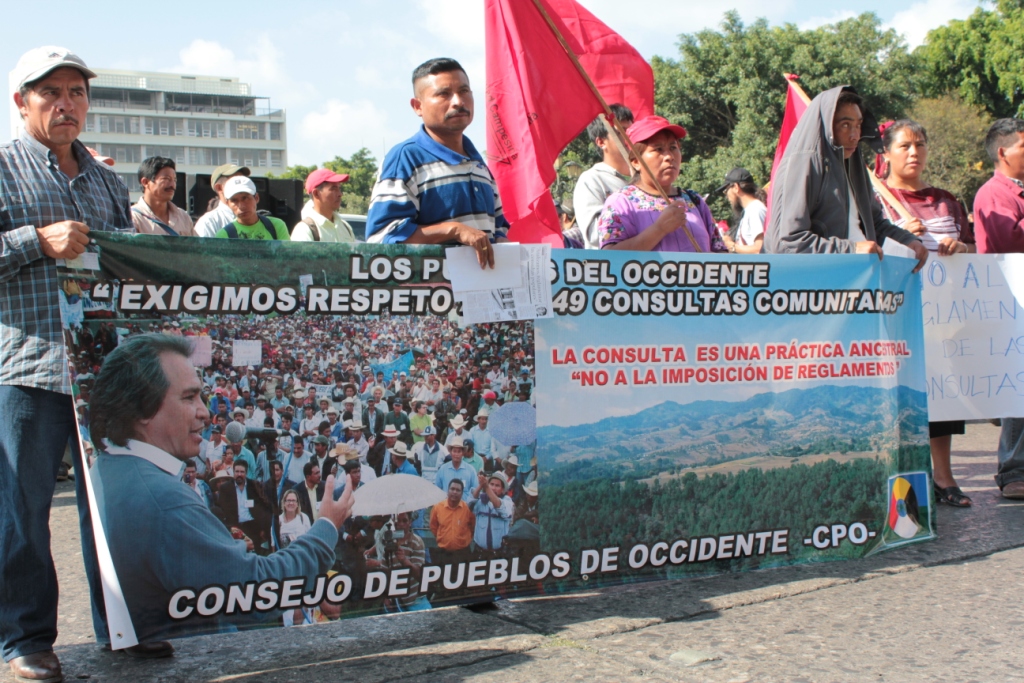
On February 23, president Álvaro Colom of the Unidad Nacional de Esperanza party convoked delegates of various sectors of civil society and private enterprise to the unveiling of the government's proposal for a law regulating community consultations.  As reported in a previous post regarding the good faith community referendum of San Juan Ostuncalco, on his visit to Guatemala in June 2010, U.N. Special Rapporteur on the Human Rights and Fundamental Liberties of Indigenous Peoples, James Anaya, denounced that since the ratification of ILO Convention 169 by the Guatemalan government in 1996, authorities have frequently taken the legal vacuum present with regards to its practical implementation as a lack of legal obligations to see to its application.  Indigenous organizations and communities, however, allege that the government's current proposal is a product of the initiative of private enterprise and, on February 23, denouncing that they are not being consulted as the government moves to regulate community referenda, the Consejo de Pueblos de Occidente (CPO), the Asamblea Departamental de Huehuetenango (ADH) the Consejo de Pueblos K'ichés (CPK), the Coordinación y Convergencia Nacional Maya Waqib' Kej,  the Comité de Unidad Campesina (CUC), the Coordinadora Nacional de Viudas de Guatemala (CONAVIGUA) and the collective MadreSelva, among other groups, staged a protest outside of the National Palace, site of the official meeting.

Members of the Consejo de Pueblos de Occidente (CPO) hold a banner featuring an image of U.N. Special Rapporteur on the Fundamental Rights of Indigenous Peoples, James Anaya, on his visit to Guatemala in June 2010.  Pancho Guindon.
In his preliminary observations regarding his june 13-18 visit to Guatemala, Anaya recognized that "the absence of a legislative and institutional framework has given rise to processes of consultation that are, to say the least, insufficient from the perspective of the international standards that recognize the rights of indigenous peoples."  He went on to say that "On the one hand, for some governmental sectors, the lack of internal regulation implies the absence of an effective obligation to consult.  From the perspective of international human rights law, nonetheless, this position is unsustainable.  The dispositions of Convention 169 are directly executable and of obligatory compliance by all public agents.  This conclusion has been confirmed by the jurisprudence of the Constitutional Court, which has expressly affirmed that consultation constitutes a fundamental right, part of the block of Constitutional rights--on a level with other rights recognized in the Constitution.  The argument as to the lack of an obligation to consult indigenous peoples has contributed greatly to the situation of grave legal insecurity of extractive activities and investment in the country."


"On the other hand," he continued, "there has come into being a debate as to the validity of the so-called good faith community referenda, referenda carried out by the very indigenous communities affected by mining or hydroelectic projects in application of the dispositions of the Municipal Code, and in the majority of which the communities have manifested themselves against such projects.  The Constitutional Court has interpreted that these referenda are not strictly binding given that municipalities do not have authority where mining is concerned.  In any case, I consider that the transcendence of community referenda does not exhaust itself with the question as to whether or not they are binding from the perspective of internal law.  These initiatives are valid and relevant to the degree that they constitute a reflection of the legitimate aspirations of indigenous communities to be listened to with relation to any project that may have an impact in their traditional territories."


He reiterated the need that a legal step be taken, affirming that "The regulation of referenda would grant these processes the greater legal certainty and security that are necessary for all action on the part of public powers.  Various international organisms, such as the Committee for the Elimination of Racial Discrimination (CERD), the Commission of Experts on the Application of International Conventions and Recommendations of the ILO and the Constitutional Court, itself, have declared themselves in this vein.  The majority of the interested actors, including various government ministries, organizations and indigenous peoples, along with the business sector, appear now to agree with the necessity of advancing urgently toward this objective."

Graham Hunt

As reported in the Prensa Libre and La Hora, the protest action in the capital was mirrored by a CPO/ADH press conference in the western department of Huehuetenango, where 30 of 32 municipalities have carried out community referenda in which the population has roundly rejected all types of mining operations.  As reported in the Prensa Libre, Francisco Morales of ADH expressed the groups rejection of the governmental initiative, saying that "Said regulation responds to the interests of the powerful classes, and therefore we won't allow it to enter into effect; the community consultations are not negotiable, because they come from the people and are true democratic processes that look to present the point of view of the population, principally regarding mining exploitation and the construction of hydroelectric dams and megaprojects."

The palace was guarded by a large delegation of officers of the National Civil Police force. Graham Hunt

In a press release, the Consejo de Pueblos de Occidente (CPO) manifested that "The intention to regulate the Right to Consultation contained in ILO Convention 169 is arbitrary, contradicts the very essence of this instrument and threatens, on the part of the State of Guatemala, principles of international law."  The CPO likewise expressed that "Should the regulation be passed, the spirit of the Convention shall be distorted, restricted and threatened in many of its intentions, thereby affecting fundamental rights of indigenous peoples contained in this international instrument, among them, the rights to consultation, forms of social organization and internal processes proper to indigenous peoples and the right to land."  CPO concluded that "We interpret this intention as a racist act of bad faith which, with an apparent desire that the State comply with its international obligations, disguises mechanisms that violate our rights and looks to consolidate individual national and foreign economic interests."  The CPO demanded that the executive branch of the government respect the referenda already carried out in indigenous territories, that indigenous communities' right to consultation be respected, and that the authorities desist in their attempt to regulate community consultations without the consent of the communities.

Graham Hunt

Similarly, in a press release, the Consejo de Pueblos K'ichés demanded that the government "Respect and not violate ancestral systems of consultation," that it "Respect the results of the good faith community referenda [already] realized throughout Ixim Uleu (the K'iché name for the territory which today comprises the nation of Guatemala)," and that it "Desist with its intent to 'regulate the process of consultations,' with the intentionality of the current proposal of the president of the republic."

Community mayors and heads of development boards holding varas, ceremonial staffs symbolic of community authority. Graham Hunt

For its part, the Coordinación y Convergencia Nacional Maya Waqib' Kej manifested by means of its own press release that "The exercise of consultation is an ancestral practice of indigenous peoples which has never been recognized by the State of Guatemala.  The present proposal to quicken the process of consultation of indigenous peoples corresponds to political and economic interests from the private sector and which oblige the government to limit indigenous rights to protect the transnational companies which currently are exploiting large extensions of land in Quiché, Huehuetenango, San Marcos, Sacatepéquez, Guatemala, Chimaltenango, Alta Verapaz, Jalapa, Jutiapa, Santa Rosa, Petén and Izabal, in short, the entire national territory.  Likewise, with this regulation the authorities are looking to guarantee for the future the continued exploitation of communal territories which historically belong to the indigenous Maya, Xinca and Garifuna peoples."

Graham Hunt

Organizations, among them the Consejo de Pueblos K'ichés, the Coordinadora Nacional de Viudas de Guatemala and the Coordinación y Convergencia Nacional Maya Waqib' Kej, were denied access to the national palace. Graham Hunt

Graham Hunt

Graham Hunt

President Colom of the Unidad Nacional de Esperanza party addresses the invitees to the official unveiling of the government's proposal to regulate community consultations in Guatemala. Pancho Guindon.

Members of the MadreSelva collective raised a banner demanding respect for the community referenda celebrated throughout Guatemala, strategically blocking the cameras of the television journalists filming the event. Pancho Guindon

Pancho Guindon

Having been denied entrance at the front of the Palace, the delegates requested permission to enter via the rear entrance.  Once again their request was denied, and lawyers accompanying the organizations filed a complaint before the Human Rights Ombudsman's office alleging they had been discriminated against as indigenous peoples. Graham Hunt

Graham Hunt

Graham Hunt

In an act of protest, community members burned a printed copy of the regulation proposed by the Colom administration. Graham Hunt